
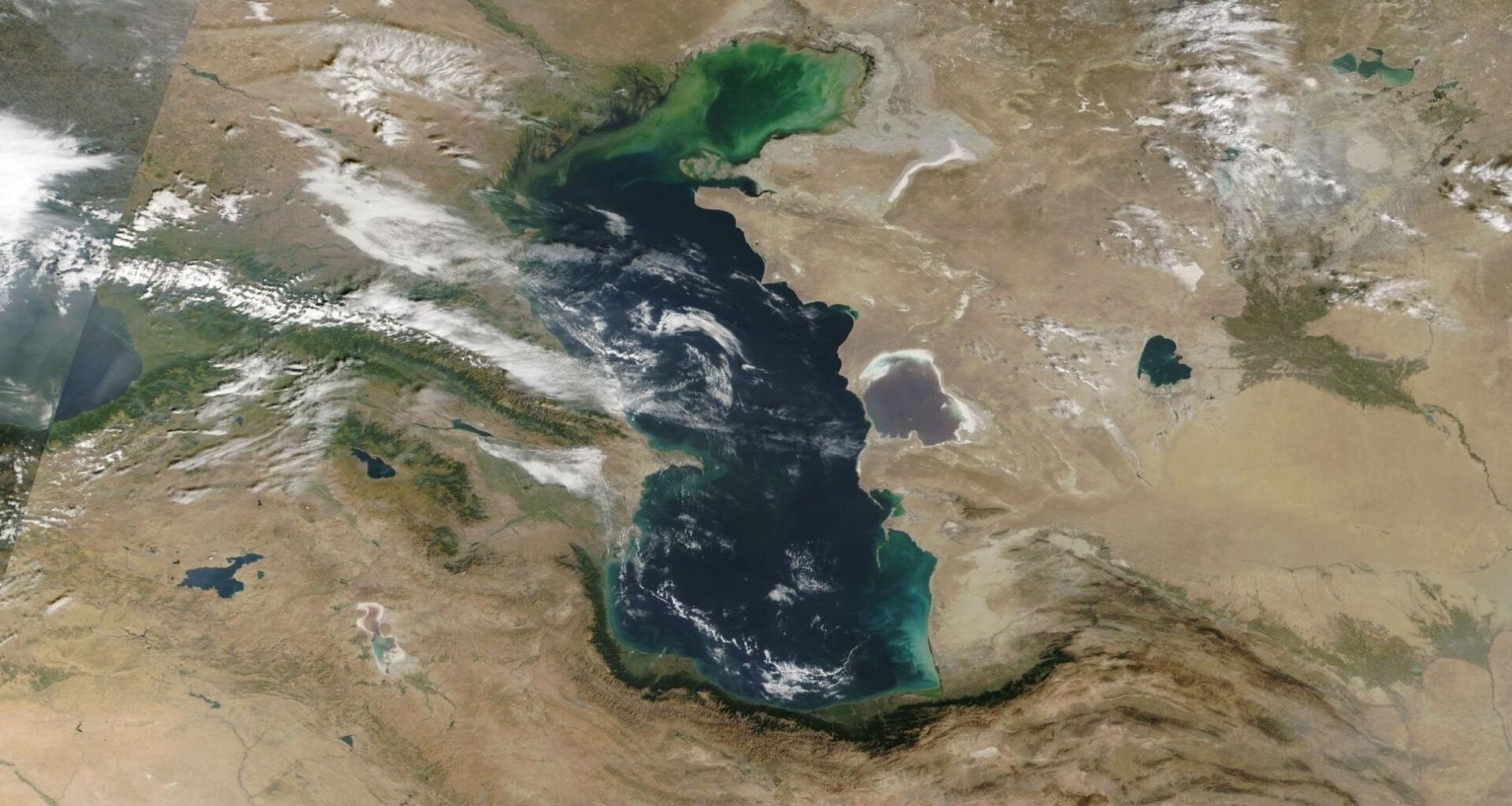
Speculation has recently mounted that Iran is managing to export its crude oil using routes over the Caspian Sea. Given the Iranian regime’s sanctions-breaking expertise, developed over nearly 50 years, one might expect the Iranians capable of putting such diversions in place. But as yet there is little public evidence that they have managed to do so in any appreciable quantity.
The fundamental problem for Iran lies in the logistics. There are no oil pipelines in place to carry Iranian oil from its main producing oilfields in the southwest to any points northwards. Iranian oil is produced primarily onshore in the southwestern province of Khuzestan (from the Ahvaz, Gachsaran, Marun and Aghajari oilfields) and offshore in the Gulf from the Abuzar, Doroud, Foroozan and Salman fields. Iran’s domestic oil is largely refined in Gulf coastal areas close to the producing fields, in part because any pipeline northwards would have to go through the Zagros Mountains.
This has meant that Tehran and Northern Iran rely on imported oil refined in Tehran and Tabriz. The crude is purchased from Russia, shipped south across the Caspian and piped further south by a small 100,00-bpd-capacity pipeline. This small line runs from Zaghmarz near Teka on the Caspian coast to Tehran and thence to Tabriz.
In lieu of a pipeline, using railcars or road transport to shift the oil is theoretically feasible, but such an exercise would be expensive and the necessary infrastructure is not at the moment in place. In addition, Iran has no dedicated export terminals on the Caspian Sea.

Caspian region pipeline networks (CIA World Factbook)

Iranian pipelines, including natural gas (red) (CIA World Factbook)
A number of other export solutions might be available to Iran if it enjoyed normal relations with its neighbors to the north. But Iranian threats have soured relationships, and diplomatic exchanges and visits by Iran to these northern neighbors are usually received coolly.
In theory, Iranian oil could be shipped through the BTC pipeline to Ceyhan from Baku, but there is no way of getting Iranian oil to Baku. Nor would Azerbaijan – which has a tense diplomatic relationship with Tehran – want to facilitate such an arrangement.
At the moment, Baku takes in Kazakh oil shipped across the Caspian Sea from Aktau. The oil is shuttled across the Caspian by five specially-designed, shallow-draft, Kazakh-flagged crude tankers, several of which are owned by foreign investors.
The tanker/container terminal and railhead at Aktau (Google Earth)
This fleet has been built up by Kazakhstan to reduce dependency on shifting its oil through the Caspian Pipeline Consortium (CPC) pipeline, which runs north of the Caspian through Russian territory. A study of the AIS tracks of these five tankers show them largely sticking to the Aktau-Baku route, and none ever going anywhere near Iranian waters.
Finally, Russia has a fleet of shallow-draft tankers which can navigate both the Caspian and Volga-Don Canal system. However, there are no Caspian Sea export terminals from which to pick up Iranian oil, and Russia is already facing difficulties exporting what it produces itself.

Stay on Top of the Daily Maritime News
The maritime news
that matters most
Get the latest maritime news delivered to your inbox daily.
For Iran, the ultimate goal would be to resume the 90% of exports of oil which went to China, now that shipborne exports by ship have been completely cut by the US naval blockade. The CPC in Kazakhstan already moves oil eastwards to China through Alashankou, but again there is no logistical means to get Iranian oil into the CPC, either at Aktau or elsewhere. The Kazakh government would not in any case be keen on the idea, as the risk of sanctions would also jeopardize the running of the CPC pipeline westwards.
Given Iranian ingenuity, the sanctions-breakers will be trying to invent new routes. But they face formidable infrastructure challenges, and their adversaries are watching for any signs that they are making a breakthrough. Ukraine has already demonstrated it has the capability to detect and engage any available Russian-associated targets in the Caspian Sea.
The opinions expressed herein are the author’s and not necessarily those of The Maritime Executive.