
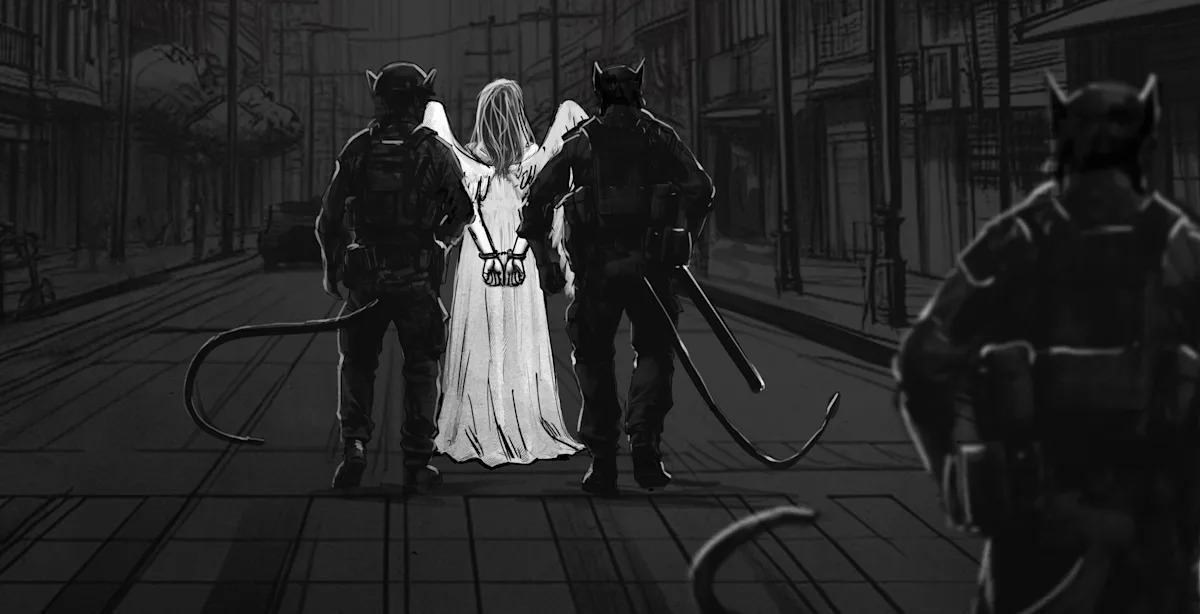
Iranian director Mohsen Amiryousefi (Fire Keeper, Lovely Trashes) discusses his past work and career with none other than the Angel of Death in his new film, The Banning Curse (Nefrin-e Toghif), a piece of “cinematic autofiction about the highs and lows of radical filmmaking,” as the BFI London Film Festival puts it.
The film, written and directed by the auteur, will world premiere in the program of the 70th edition of the festival on Wednesday. The director and his editor, Kamy Saffari, saw the U.K. reject their visa applications, according to a representative, so they won’t be able to travel to London to experience the audience reaction to the film. But Amiryousefi is used to facing all sorts of hurdles, which is just what his new film is about.
More from The Hollywood Reporter
“After the critical success of his first film at Cannes [where the black comedy Bitter Dream won a Golden Camera for best first feature film special mention], Amiryousefi returned to Iran to find it banned by state authorities,” teases a synopsis of his new film on the LFF website. “It’s a pattern that continued through his entire career, which the seasoned director looks back on in this imaginative, satirical portrait. A balance of biography and constructed fiction, the filmmaker’s own life and Iran’s turbulent political, social and cultural history are entwined via a rich trove of archive footage.”
Film history is also a recurring theme in the film. A trailer for The Banning Curse, which you can watch below, mentions a legendary Iranian actor, for example, while the film also mentions the works of such famous directors as Federico Fellini and Christopher Nolan.
By Zoom and via an interpreter, Amiryousefi talked to THR about The Banning Curse and its creation.
The film was shot indoors without shooting permits and without the need for a big budget. “It was not a very complicated thing for us, as it is something that I and many other filmmakers in Iran have done before,” the director shares with THR via his translator. “But the main point that was different was that I was in front of the camera this time. That was my first experience [acting], and I tried to be very honest and share all reflections on the subject in front of the camera.”
The Angel of Death is a character that Amiryousefi’s films have featured before. “From my very first film, there has been some kind of angel of death present, and this time, it is again,” the filmmaker explains. And audiences in his home country are familiar with the idea. “It is very regular for Iranian people to feel the Angel of Death beside them. I tried to make it change into something else in the middle of the film, where we can see that it is rather the double of the filmmaker. But the Angel of Death represents death as it is viewed and believed in Iranian society.”

The Banning Curse, courtesy of BFI London Film Festival
Does the Iranian filmmaker have any hopes for how The Banning Curse will be received by audiences at the LFF? “I don’t know how the audience will react, but I’m very happy that the film will be screened, I hope that this look at life, full of funny moments, full of anger, full of sorrow, can connect with the audience.”
Amiryousefi’s films have long been banned in his home country, but he also expects The Banning Curse to be seen there. “Luckily, nowadays there are so many ways to show films to the people,” he says. “There are a lot of spaces, and virtual screenings and streaming, so you can see people following Iranian films in those ways.”
Whether Iran’s restrictions will ever loosen is another matter, but Amiryousefi is hopeful. “Anything can happen, and I’m optimistic,” shares Amiryousefi. “I’d hope that there would be no problem for anyone, including me, to release films in Iran.”
The film’s references run from Italian classics to Hollywood blockbusters to Iranian cinema, and the director says they’re deliberate: “For me, Fellini is the greatest filmmaker in film history, and his films, especially La Strada and Amarcord, have a special place in my heart. But when it comes to Nolan, I was trying to connect to the filmmaking of today. And there are also some references to Iranian filmmakers, [such as] paying tribute to Abbas Kiarostami [and others].”

The Banning Curse, courtesy of BFI London Film Festival
For Iranian directors, prison is a real risk, and Mohammad Rasoulof is among those who have served time. Does Amiryousefi worry about the same fate? “When I was young, I was much more fearless,” quips Amiryousefi, who is 54. “Now that my hair is turning gray, I am somehow more conservative.”
The director wraps up our chat with another joke about his age: “When going through the archival footage, I saw someone who looked very familiar, and I told the editor to rewind. And I saw myself much younger with black, longer hair. It was me, but now, I feel I’m so different from that version.”
Best of The Hollywood Reporter
Sign up for THR’s Newsletter. For the latest news, follow us on Facebook, Twitter, and Instagram.