
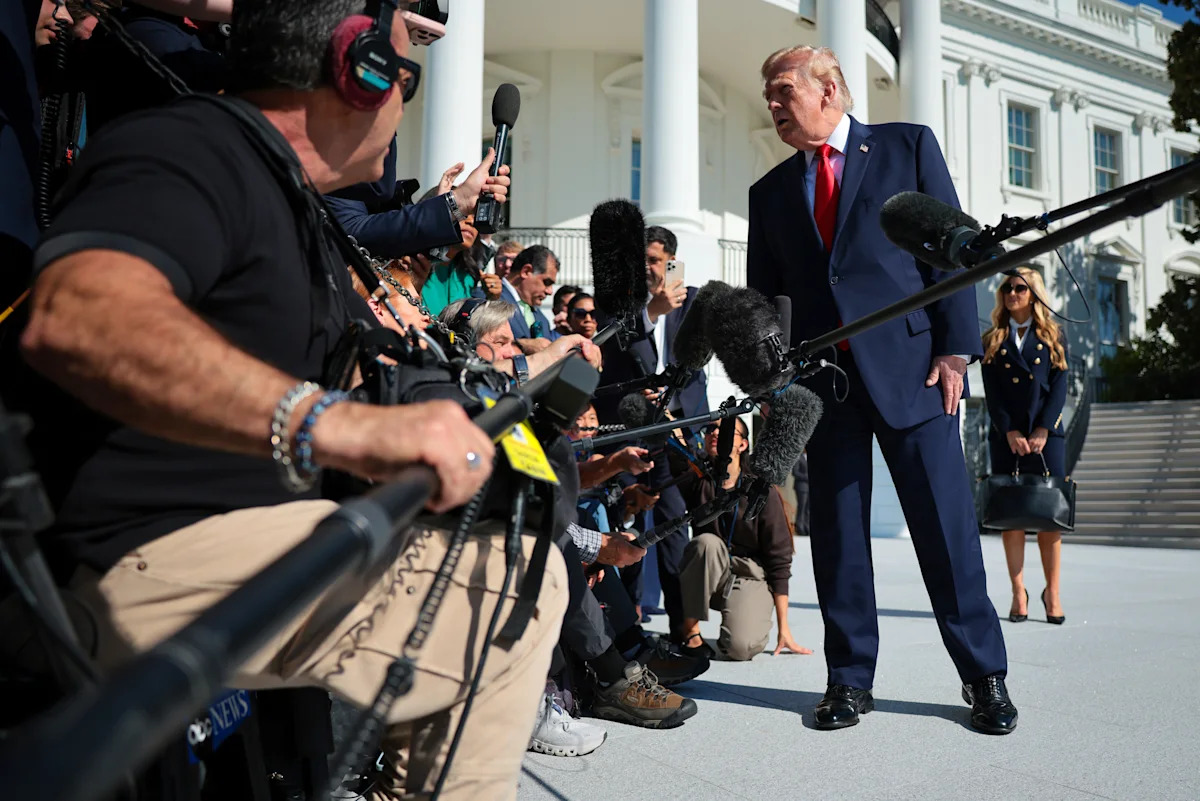
President Trump has begun to downplay his new deal with Russia after a plan to allow imports of Russian diesel into the US came under withering criticism, even from members of his own party.
“It’s a deal for the world … It’s not a deal with me,” Trump told reporters on Tuesday morning, repeating that it was “not a USA deal.”
“They’re releasing it to the entire world,” Trump added, after making similar comments on Monday that the deal would help US farmers, but said, “It’s not really a deal with me, it’s a deal for the rest of the world.”
 President Trump speaks to members of the media as he departs the White House on Oct. 13 to travel to Alaska for a rally. (Chip Somodevilla/Getty Images) · Chip Somodevilla via Getty Images
The contention is a marked shift since Trump announced the plans last week.
“I have just concluded a highly successful discussion with President Vladimir Putin, of Russia,” he wrote on Truth Social, adding that it will be a “great announcement…for Americans and, indeed, the World.”
The deal will include a quick release of 300,000 tons (about 2.2 million barrels) of diesel. That would then be followed by another 500,000 in November and 1 million tons “immediately thereafter” for a total of about 13.5 million barrels.
His administration quickly authorized US purchases of Russian diesel through next April.
Calls on the president to ‘immediately reverse course’
Blowback to the plan has been notable — even within Trump’s own party.
A bipartisan group of senators called on the president to “immediately reverse course,” in a letter signed by Republican Sens. Susan Collins of Maine, Lisa Murkowski of Alaska, Thom Tillis of North Carolina, and John Curtis of Utah, along with three Democrats.
The plan has also received a lukewarm reception on the midterm campaign trail, with figures like Republican Mike Rogers, who is locked in a tight Senate contest in Michigan, distancing himself from it.
Some energy experts suggest the deal might run afoul of US law, while others suggest it simply won’t work since Russia seems to lack enough excess diesel refining capacity to markedly increase exports and move US or global diesel prices.
Read more: How oil price shocks ripple through your wallet, from gas to groceries
In this pool photograph distributed by the Russian state agency Sputnik, Russia’s President Vladimir Putin is seen in Moscow on Oct. 11. (Vyacheslav Prokofyev/Pool/AFP via Getty Images) · VYACHESLAV PROKOFYEV via Getty Images
Indeed, the current average price of diesel, according to the American Automobile Association, was almost $6.28 per gallon on Tuesday, a tick up from almost $6.27 per gallon on Monday.
Wholesale diesel prices are “not blinking over Russia/US ‘deal'” Patrick De Haan, the head of petroleum analysis at GasBuddy, noted on Tuesday. “Truckers and farmers not going to see any relief anytime soon.”
But Trump continued to defend the deal and dodged a question about another major critique, which is that it could fund Russia’s war efforts against Ukraine.