
By Kourosh Ziabari
This article was originally published by Truthout
As Trump repeats annihilation threats against Iran, legal scholars implore other countries to step in.
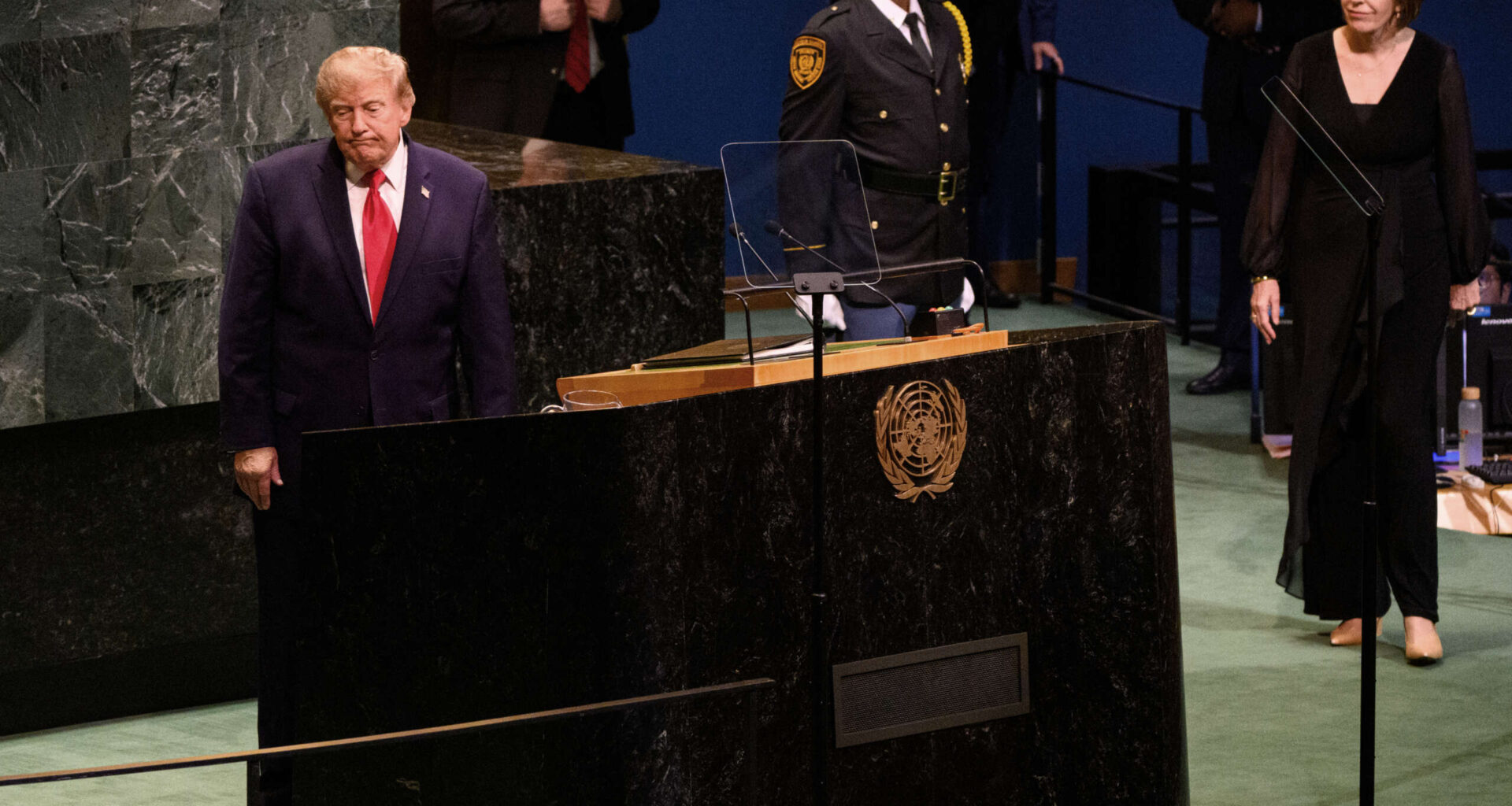
US President Donald Trump’s threats to destroy Iran have become so frequent that they often don’t make headlines. One recent exception, though, was during his 38-minute speech at the 81st session of the UN General Assembly on September 22, in which Trump mentioned Iran 17 times.
“Will a deal be made with Iran that lets them rebuild and create a far greater country than it ever was before? Maybe one of the greatest in the Middle East, or even the world,” he blustered. “Or do I annihilate the Islamic Republic and do it quickly, never giving them a chance to kill and destroy people and countries again?”
Using a mix of warnings and expletives to address Iranians, Trump falsely claimed that Tehran had refused to negotiate an agreement over its nuclear program. On both occasions when Iran was militarily attacked, in June 2025 and February 2026, it was in the middle of diplomatic talks with Trump’s envoys.
“Do I drive them into hell with no chance of survival and no hope of future greatness or generations?” he added during his speech at the international organization founded in 1945 to preserve global peace and security.
The U.S. military operations in Iran, an extension of the U.S.-Israeli aggression launched in February, have largely been on hold for the past few weeks as American voters gear up for the midterm elections in less than a month — with the unpopular war remaining a hot-button issue. But White House officials have sought to preserve momentum for the conflict through continued combative rhetoric, and Trump has led the charge with occasional social media outbursts and inflammatory monologues.
The UN address is far from the only time that Trump had resorted to annihilatory language to describe his intentions with Iran. “I have a big decision coming up,” Trump told Axios earlier in September. “Do I want to go in and annihilate them, or do I not?”
“My question is, if and when I want to destroy the entire country, when do I do it?” he told Fox News days after his speech at the UN. In October, TIME published an interview in which the publication asked him to clarify his annihilation comments. “Yeah, I would do that. It’s possible.… Because by annihilating Iran, we’ve created peace in the world. With Iran, I don’t think you could ever have peace.”
Most notably, in a widely criticized Truth Social post on April 7, he wrote, “a whole civilization will die tonight, never to be brought back again,” prompting calls from several members of the Congress for his impeachment under the 25th Amendment to the Constitution, including Rep. Steve Cohen (D-Tennessee), Rep. John Garamendi (D-California), and Rep. Jan Schakowsky (D-Illinois).
Different sections of the amendment have been invoked in the past when the sitting presidents were incapable of discharging their duties. For example, on November 19, 2021, former President Joe Biden invoked Section 3 of the 25th Amendment to undergo a medical surgery and his vice president Kamala Harris took charge as acting president for 85 minutes. Still, the fourth section of the amendment laying out the authority of the vice president and cabinet members to remove the president has never been invoked.
On April 30, a group of 30 psychiatrists and psychologists published a statement declaring that Trump was contending with a serious mental health impairment. The statement, which was entered into the Congressional Record by Senators Sheldon Whitehouse and Jack Reed of Rhode Island, argued that if the signatories were called to adjudicate the president’s fitness to fulfill the obligations of his office, they would confirm that “he lacks the capacity to do so.” Still, that option has not been raised by Vice President JD Vance or members of Trump’s cabinet.
“Trump’s statement was certainly genocidal in character, in the sense that it appears to demonstrate the intent to destroy the Iranian people as a protected national group, in whole or in part,” said Heidi Matthews, an assistant professor of law at York University in Toronto, referencing the U.S. president’s chilling Truth Social post.
“Direct and public incitement to genocide is considered an ‘other genocidal act,’ in that it is a crime independent of whether or not genocide is actually carried out,” she told Truthout.
Matthews, who is also the co-director of York University’s International and Transnational Law Intensive Program, believes the legal framework to interpret these remarks has already been established: “It is certainly reasonable to consider this statement both in terms of the crime of incitement to genocide, and also as constituting an unlawful breach of Article 2(4) of the UN Charter, which prohibits the threat or use of force against the territorial integrity or political independence of any state.”
Meanwhile, some Iranians listening to Trump’s remarks while grappling with the consequences of his aggression are concerned that the most powerful leader in the world may follow through on his rhetoric and take actions with irreversible consequences. The United States possesses nearly 5,000 nuclear warheads, and the decision to use them rests with the president.
Yalda Hasheminezhad, a 42-year-old cartoonist from Ardabil in northwestern Iran, said her reaction to Trump’s threats was a mixture of “sorrow and disbelief.”
“As a human being and as an artist, I cannot tolerate this much injustice, oppression, and violence,” Hasheminezhad told Truthout. “Behind each killing, there’s a human being, there’s a life, there’s a family, and it’s impossible to be indifferent to it.”
“I hope that one day, instead of making decisions on how to annihilate each other, people decide to live and try to make each other’s lives more peaceful. Yet, I feel that Trump isn’t a stable person and acts like a child who easily forgets what he said a few minutes ago,” she added.
In addition to his graphic comments, in recent months Trump has consistently expressed contempt for Iranians and used his Truth Social platform to publish AI-generated visuals depicting violence across Iran, including the critical Kharg Island in the Persian Gulf, which he has vowed on multiple occasions to destroy.
In one Truth Social post on September 6, he portrayed himself wielding a sledgehammer, shattering a sandstone-like map of Iran. Trump has also regularly threatened to attack civilian infrastructure; civilian sites were openly targeted during the height of U.S.-Israeli attacks.
Still, Trump’s public gestures toward Iran have been mercurial. After the Islamabad Memorandum of Understanding was signed by Tehran and Washington on June 17, Trump temporarily shifted his rhetoric and praised the Iranian leadership as “very rational people” who were “nice to deal with.” At a White House dinner on June 25, he promised American farmers that they’d be able to sell their products to “the lovely country of Iran.” Once the ceasefire agreement collapsed, he went back to his more violent language.
Many international leaders have shrugged off Trump’s rhetoric. In September, Canadian Prime Minister Mark Carney downplayed Trump’s threat to “annihilate” Iran as speaking the “language of war.” But legal scholars specializing in the study of mass atrocities disagree, arguing that incitement to violence, even if not carried out, has been deemed criminal under international law.
“I do not think that dismissing these remarks as simply the language of war is either accurate or helpful,” said Craig Martin, co-director of the International and Comparative Law Center at Washburn University School of Law.
“These statements were clearly threats designed to coerce Iran into conceding, and they threatened actions that would have been unlawful under international law … the threats themselves may have been unlawful and even risen to the level of constituting a war crime,” he told Truthout.
Since the beginning of the war, Trump has made four international trips and met several foreign dignitaries, including at the 36th NATO Summit in Ankara in July. Throughout this time, his counterparts have rarely criticized his frightening statements. Scholars of international law believe world leaders should call out the harm of Trump’s rhetoric and align their foreign policy with their international legal obligations.
“Third states are legally obligated to ensure respect for the rules of international humanitarian law and to prevent genocide, making it imperative that leaders recognize Trump’s threats for what they are: unlawful and potentially criminal,” York University’s Matthews said, pointing to discursive double standards in safeguarding international law, which are making illegal wars more frequent.
Since September, when a United Nations fact-finding mission found reasonable grounds to believe the United States has committed war crimes in Iran by targeting civilian sites, specifically an elementary school in Minab killing more than 120 children and a sports hall in Lamerd, the question of accountability has been debated more widely.
This comes at a time when the U.S. State Department has sanctioned the International Criminal Court and clarified its determination to “dismantle” the UN-affiliated judicial system in a bid to avert future legal proceedings implicating members of the current administration and Israeli officials.
“Neither the U.S. nor Iran have ratified the Rome Statute for the International Criminal Court, but Trump could theoretically be prosecuted by another state under the well-established doctrine of universal jurisdiction,” said Marjorie Cohn, professor emerita at Thomas Jefferson School of Law and former president of the National Lawyers Guild.
“Another state could also file a case with the International Court of Justice, asking for an advisory opinion about Trump’s war crimes and genocidal threats against Iran,” she told Truthout.
But the structures of international law continue to determine the context of relations between countries, even if they have been increasingly weakened. The United Nations General Assembly remains the largest global forum for consensus-building on key issues, the Security Council makes decisions directly affecting global peace and security, and the UN’s humanitarian agencies are facilitating critical aid to war- and poverty-stricken regions.
Gabor Rona, a professor of practice at the Cardozo Law School in New York, says the bodies of international law known as jus ad bellum and jus in bello, which dictate why and how wars should be fought, are being overlooked. Still, these laws have been enshrined in the UN Charter and remain binding.
“It is forbidden to target civilians, civilian infrastructure, cultural property, hospitals, and to cause long-term and widespread environmental damage,” Rona told Truthout. “Trump’s threats violate jus ad bellum and constitute a threat to violate jus in bello. These are the types of international crimes for which Nazi leaders were prosecuted at Nuremberg.”
“Despite ongoing serious problems and conflicts, the past 80 years have seen unprecedented advances in peace, diplomacy, human development, health, welfare, education, life expectancy, etc. These advances are in no small part a product of the post-World War II international order that is now at grave risk,” he added.
Trump has suggested that he will likely resume his bombing operations in Iran after the midterms. He also rejected a new diplomatic proposal by the Iranian delegation visiting New York for the UN General Assembly and doesn’t appear to have a clear vision of why he is continuing the war. Many Iranians are adjusting to the new reality of uncertainty and violence, and some of them are ignoring his bombast.
“When I first heard him [Trump] saying a few months ago that he would do something annihilatory, I was truly scared, because we were in the middle of the war, and I was seeing he was striking different places and people were rushing to the north,” said Shabnam Assad, a 40-year-old civil engineer in Rasht.
“But over time, I saw that he’s a capricious person and changes his mind a lot, and generally, both I and many people I know have really stopped following the news. We don’t believe in anything anymore, and are simply coping with the economy,” she told Truthout. “I have concluded that I should not waste my life and time on things like this.”
This article was originally published by Truthout and is licensed under Creative Commons (CC BY-NC-ND 4.0). Please maintain all links and credits in accordance with our republishing guidelines.