
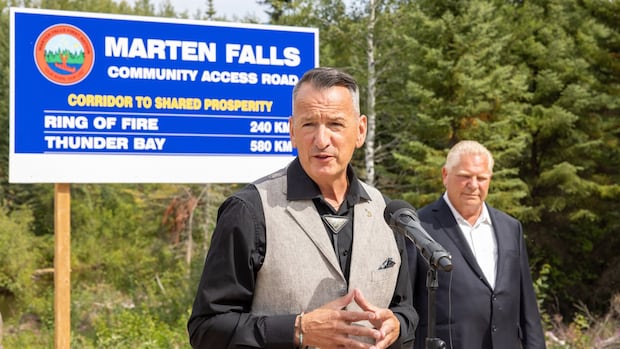
Changing clocks twice a year will be a thing of the past for parts of northwestern Ontario.
The province announced Tuesday that parts of this area of Ontario will be moving to permanent daylight saving time as of Nov. 1.
The move allows the communities to align with Manitoba, which announced last month it will move to permanent daylight saving time on Nov. 1.
Kenora-Rainy River MPP, Minister of Northern Development, and Minister of Indigenous Affairs Greg Rickford said the decision comes after consultations with municipalities and First Nations in the area, which runs from the English River to the Manitoba Border.
“On a practical side, an overwhelming majority of the people of northwestern Ontario sitting in the central standard time zone just thought it made more sense to go with Manitoba, because our transactions are more typically with them,” Rickford told CBC News on Tuesday morning.
“We heard from particularly health entities, who said ‘look, whatever decision’s made, it should involve the least amount of time zones possible, because there are electronic medical records, and their appointment planning either in Manitoba or Thunder Bay would be impacted by that,” he said. “And secondly, could we do that as quickly as possible so that they could begin those preparations?”
Rickford said the changes only affect areas in the region on central time; it won’t have any impact on communities in the eastern time zone, such as Thunder Bay.
“Providing certainty and predictability is essential to supporting strong communities and a competitive economy,” Ontario Attorney General Doug Downey said in a media release. “By keeping this part of the province aligned with Manitoba, our government is taking a practical, common-sense approach to avoid unnecessary disruptions and ensure economic stability in communities that reside in Ontario’s central time zone.”
Kenora Mayor Andrew Poirier said Tuesday he’s pleased with Ontario’s decision.
“(Manitoba) really is where, not only just economically and that, but socially, that’s where our connection is,” he said. “It’s reciprocated by Manitobans, because we do have an awful lot of Manitobans that own property and around the Kenora area.”
Kenora council recently passed a resolution urging the government to end daylight saving time for parts of the region. Poirier noted that the city conducted a survey of residents, and nearly 5,300 people responded; of those, just over 93 per cent were in favour of the change.
Poirier said Kenora representatives are now discussing what sort of steps the city needs to take to make sure the change is implemented smoothly.
“There still might be internal things that have to take place … even with the time not changing because a lot of these systems are set up to change,” he said. “You have to make sure that that’s not going to happen. So we’re going to do that and come out with a communication strategy just to begin to remind people.”
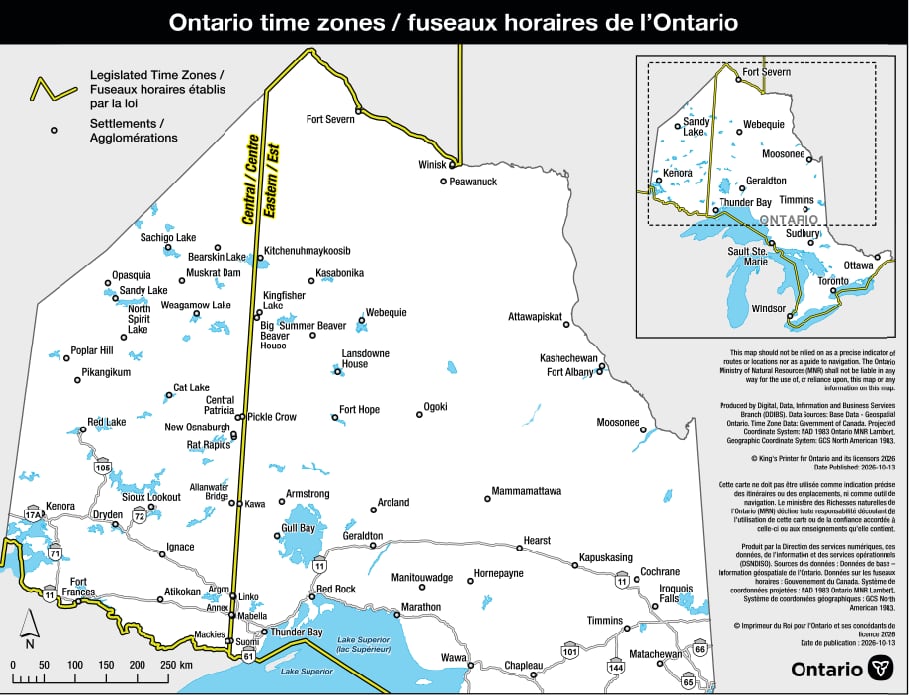
A map of time zones in Ontario. The area that’s in the central time zone will be switching to permanent daylight saving time on Nov. 1. (Government of Ontario/Provided)
Rick Dumas, president of the Northwestern Ontario Municipal Association, was also supportive of the change.
“This is welcome news for northwestern Ontario and a practical solution to a very real concern raised by our member municipalities,” he said in a media release. “Our communities have strong economic, social and healthcare ties with Manitoba, and maintaining consistent time zones helps avoid unnecessary confusion and disruption.”
In an interview with CBC, Dumas said the change will be important for it’s members in the central time zone.
They’re dealing a lot times with Manitoba,” he said. “So they want to being consistent with Manitoba, specifically for healthcare and things like that, flight times.”
“When there’s an hour difference all the time, they’re switching back and forth,” Dumas said. “At least having that split being constant with that zone is going to be beneficial to those members.”
Fort Frances Mayor Andrew Hallikas said he, too, was pleased with the change.
“We all put out surveys to our residents to see how they felt about it,” he said. “The surveys came back overwhelmingly in favor of joining Manitoba as having permanent daylight saving time.”
“I’ve done a lot of surveys as during my career in municipal politics, and usually a strong majority is 60 per cent,” Hallikas said. “On our survey, 92 per cent of the people surveyed thought that we should go with Manitoba in terms of having permanent daylight saving time.”
“We met all of the municipalities, First Nations, Metis leaders of Kenora District and Rainy River District,” Hallikas said. “There was unanimous consensus across both of those districts that we should go with Manitoba.”
“In my career in municipal politics, I’ve rarely seen such unanimity and then such a strong endorsement of an idea. It was refreshing, quite frankly.”
Kiiwetinoong MPP Sol Mamakwa also weighed in today, and said the change is a relief.
“We did not want to be the island of central time and between Ontario and Manitoba,” he said. “Over the past few weeks, since the announcement from Manitoba, I’ve been speaking … with other First Nations and other municipalities just on this issue.”
“We know this is a nonpartisan issue. We knew it was an opportunity to work collaboratively across parties to find a solution that meets the needs of the people of northwest Ontario.”