
Gaza’s shrinking territory
A year after the US-brokered Gaza ceasefire, Israel has expanded its military-controlled territory beyond the original Yellow Line established under US President Donald Trump’s 20-point plan to end the war.
The agreement initially required Israeli forces to withdraw to the demarcation within 24 hours, with further withdrawals expected in subsequent phases.
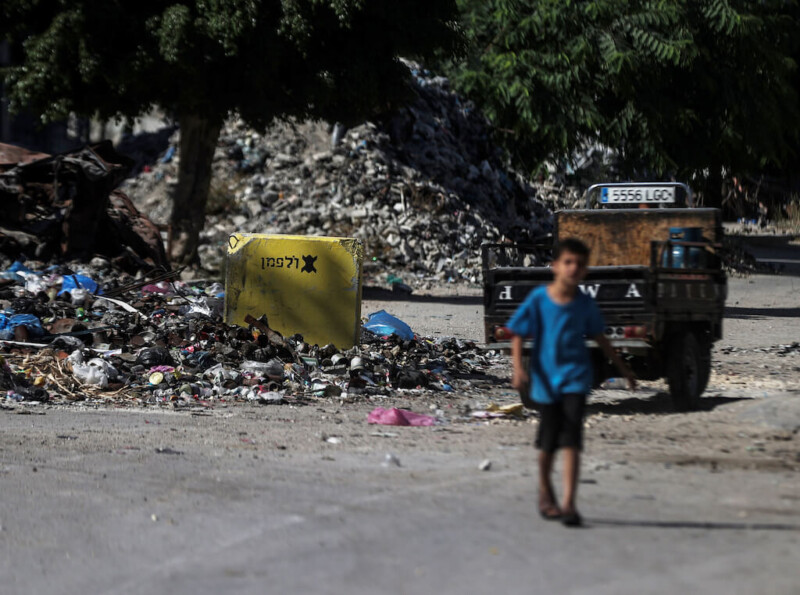
Instead, Israeli troops have repeatedly moved the yellow concrete blocks marking the boundary farther west, bringing additional Palestinian neighbourhoods and agricultural areas under military control.
On Sunday, Israeli forces reportedly relocated the blocks dozens of metres west in Shujayea, southeastern Gaza City, forcing more Palestinian families to flee.
“It’s not simply about where the ‘Yellow Line’ is today but where it can move next,” Al Jazeera correspondent Ibrahim al-Khalili reported from Gaza City.
The original ceasefire arrangement left Israel controlling approximately 53 percent of Gaza, restricting Palestinians to 172 square kilometres of the 365-square-kilometre territory.
Research organisation Forensic Architecture estimated that Israeli control had expanded to 58 percent by December. In March, the Israeli military introduced an additional restricted area, described as the “orange line”, requiring humanitarian organisations to coordinate movements with the army.
According to the UN Office for the Coordination of Humanitarian Affairs (OCHA), military control and access restrictions now cover 65 percent of Gaza.
The remaining population is concentrated within approximately 128 square kilometres, increasing population density to nearly 16,000 people per square kilometre, almost three times its prewar level.
Each resident has an average of just 61 square metres of land, compared with approximately 160 square metres before the war.
The humanitarian consequences are compounded by extensive destruction. The UN Satellite Centre estimates that 82 percent of Gaza’s structures have been damaged or destroyed, while the Food and Agriculture Organization says only 3 percent of its cropland remains both undamaged and accessible.
More than 950,000 Palestinians are living in displacement sites vulnerable to flooding, predominantly in tents and makeshift shelters.
Approaching the Yellow Line also poses significant dangers. Nearly 1,500 Palestinians have been killed across Gaza since the ceasefire was announced, according to figures cited by Al Jazeera.