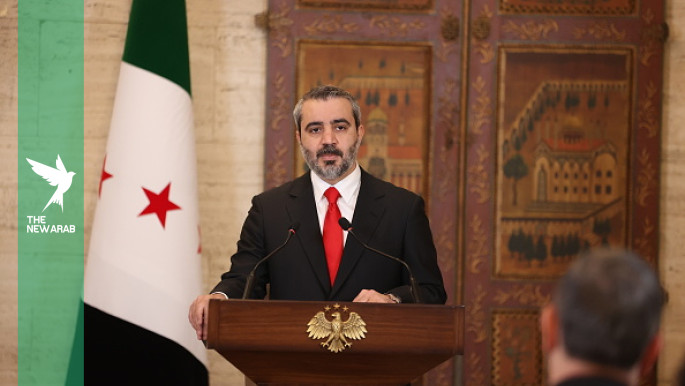
Shaibani claims Israel is providing weapons and support to separatist groups in the Suweida province [Getty]
Syrian Foreign Minister Asaad al-Shaibani has accused Israel of supplying weapons and financial support to armed militias in the southern province of Suweida, alleging that Israel is seeking to destabilise Syria and undermine its sovereignty.
Speaking at a press conference in Damascus on Tuesday, al-Shaibani said Israel was supporting armed groups operating outside the authority of the Syrian state, amid continuing tensions over the future of the predominantly Druze province.
“Israel supports armed militias operating outside the law in the city of Sweida, providing them with weapons and funding to pursue an agenda of chaos in the region,” he said, according to Syria’s official SANA news agency.
The accusations come amid mounting concerns over Israel’s involvement in southern Syria, where Israeli forces have expanded their military presence since the overthrow of Bashar al-Assad in December 2024.
Al-Shaibani accused Israel of pursuing a wider campaign to destabilise the country through attacks on infrastructure, the occupation of additional Syrian territory and the displacement and detention of Syrian civilians.
He said the fate of dozens of Syrians detained by Israeli forces remained unknown, calling on the international community to intervene and prevent further escalation.
Suweida has remained largely outside central government control following deadly clashes in July 2025 involving Druze armed factions, Bedouin groups and Syrian government forces.
The violence, which included abuses against Druze civilians by government-linked fighters, deepened mistrust between Damascus and sections of the Druze community.
Israel subsequently launched airstrikes against Syrian government positions, including targets in Damascus, claiming that its intervention was necessary to protect Syria’s Druze minority.
However, Israeli involvement has also raised concerns about efforts to encourage the fragmentation of Syria by supporting armed groups opposed to the central government.
Much of Suweida is now controlled by factions associated with Druze religious leader Sheikh Hikmat al-Hijri, who has openly advocated separating the province from Damascus and establishing an independent Druze entity under Israeli protection.
In January, al-Hijri told Israeli newspaper Yedioth Ahronoth that his movement considered itself closely aligned with Israel and viewed the country as a guarantor of its political future.
“We see ourselves as an inseparable part of the existence of the State of Israel. This relationship is international and of critical importance,” he said.
He also called for Syria’s partition, arguing that independent or autonomous territories represented a possible future for the country.
In August, al-Hijri went further, declaring during a gathering in Suwayda that his supporters were an “integral part of the State of Israel” and shared its ideology.
His position has nevertheless faced opposition from other Druze religious figures, activists and armed factions who reject Israeli intervention and support maintaining Suwayda within a unified Syrian state.
The New Arab has previously reported on allegations that Israel has provided financial and military assistance to Druze militias operating in Suweida, including the Military Council, an armed faction associated with al-Hijri.
According to a Washington Post investigation published in December 2025, Israeli officials acknowledged providing support to Druze armed groups through the Kurdish-led Syrian Democratic Forces (SDF).
The report detailed financial transfers, weapons supplies and military assistance, including an alleged payment of $24,000 to help establish the Military Council.
It also described cooperation involving military training and the provision of weapons, including anti-tank missiles, to strengthen Druze factions opposed to Damascus.
The allegations have added to concerns that Israel is seeking to cultivate armed allies in southern Syria as part of a broader effort to prevent the re-establishment of strong central government authority.
Israel has repeatedly demanded the demilitarisation of southern Syria and opposed the deployment of Syrian government forces near its borders, while continuing military operations inside Syrian territory.
Following Assad’s overthrow, Israeli forces seized the UN-monitored buffer zone established under the 1974 disengagement agreement and expanded their presence beyond positions occupied before December 2024.
Israel has occupied most of Syria’s Golan Heights since 1967, an occupation not recognised by the international community.
Despite the tensions, Damascus and Israel have engaged in several rounds of US-mediated negotiations aimed at establishing new security arrangements along their shared frontier.
In August, Syrian and Israeli delegations met in Jordan under American mediation to discuss Israeli military operations, the detention of Syrian civilians and the possibility of withdrawing Israeli forces to positions held before Assad’s overthrow.
Al-Shaibani called for Israel to return to the 1974 disengagement agreement and allow the United Nations Disengagement Observer Force to carry out its responsibilities.
He also urged Israel to engage seriously in the US-sponsored negotiations, reiterating Damascus’s commitment to reaching an agreement that respects Syrian sovereignty and territorial integrity.
The Syrian foreign minister’s latest accusations come as the government of President Ahmed al-Sharaa continues efforts to consolidate its authority across the country, with Suwayda remaining one of the principal areas outside Damascus’s control.