
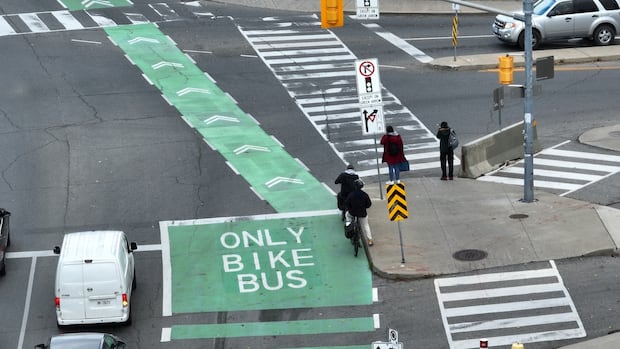
Premier Doug Ford’s government is appealing an Ontario Superior Court of Justice decision from last month that struck down its plan to remove bike lanes on three major Toronto streets.
Justice Paul Schabas ruled on July 30 that the removal of certain bike lanes will “put people at increased risk of harm and death, which engages the right to life and security of the person.”
Immediately after Schabas’s decision was released, a spokesperson for Ontario’s transportation minister said the government would appeal.
The Ford government officially served a notice of appeal to Toronto cycling advocacy group Cycle Toronto and the other cycling advocates who launched the court challenge Thursday.
In December, lawyers for Cycle Toronto alongside other advocates launched a court challenge in an effort to strike down parts of a law that would allow the province to remove the 19 kilometres of protected bike lanes on Yonge Street, Bloor Street and University Avenue, and replace them with vehicle lanes.
The province has been pushing for the removals as a solution to Toronto’s traffic congestion, but cyclists and advocates say bike lanes are crucial for public safety and that removing them won’t solve traffic concerns.
Schabas concluded last month removing the bike lanes will not reduce congestion and highlighted expert evidence “which establishes that bicycle lanes, and in particular separated or protected bicycle lanes, reduce motor vehicle traffic congestion by providing an alternative method of transportation that is safer for all users of the roads.”
Province says court erred in finding right to bike lanes
In its appeal, the province argues the court erred in finding a constitutional right to bike lanes, also stating that the court disregarded Ontario’s evidence, which demonstrated that travel times increased after the installation of the target bike lanes.
“This conclusion disregards entirely that the carrying capacity of the roadways for motor vehicles transporting people and goods will be increased by the restoration of a lane for motor vehicle traffic,” reads the appeal.
In a statement to CBC Toronto on Friday, a spokesperson for the minister of transportation said the government will continue with the design work necessary to begin removals of bike lanes.
“We were elected by the people of Ontario with a clear mandate to restore lanes of traffic and move bike lanes off of major roads to secondary roads to get drivers moving. We are delivering on that mandate and have served our appeal to the court,” said spokesperson Dakota Brasier.
WATCH | Reaction pours in after Ontario judge blocks Ford’s bike lane removal plan: 
Reaction pours in after Ontario judge blocks Ford’s bike lane removal plan
An Ontario court ruled against the Ford government’s plan to remove bike lanes along three major Toronto streets. CBC’s Tyler Cheese has reaction from those on both sides of the debate.
Ford made removing the bike lanes a campaign issue during the snap election he called and won in February.
He and Toronto Mayor Olivia Chow had been negotiating a compromise for months, with the mayor saying she believed there was a solution that would keep the bike lanes and add an extra lane of traffic in each direction on the three roads.
Toronto city council voted in November to oppose the province’s plans to override the city’s authority and remove the lanes.
A city report from the same month estimated the cost of removing the targeted bike lanes in Toronto at $48 million.
6 cyclists killed in Toronto last year
Schabas wrote in his decision last month that removing the target bike lanes and replacing them with lanes for cars will make these roads less safe for cyclists and for other road users, resulting in an increased likelihood of collisions, injuries, and death.
Six cyclists were killed in Toronto last year, all on roads without protected bike lanes.
There have been no fatalities involving cyclists this year, according to Toronto police data.
Data from the 2021 Statistics Canada census suggests the number of people commuting on bicycles in areas of Toronto where bike lanes are located is far above one per cent, with the exception of the federal riding of Etobicoke-Lakeshore, where the debate over the Bloor bike lane has been arguably most intense.