

 Shutterstock
On Oct. 27, Israelis will go to the polls to decide, among other things, whether their courts can still tell the government no. For nearly four years, Prime Minister Benjamin Netanyahu—on trial for corruption since 2020—has presided over an effort to bring Israel’s Supreme Court to heel. In March 2025, his coalition pushed through a law giving whichever coalition holds power more control over the committee that appoints judges—a law set to take effect only once the next Knesset, Israel’s parliament, is seated. If Netanyahu’s bloc wins a majority, it will inherit the very power it has spent years trying to seize.
Israelis are choosing whether their country remains a democracy in which the majority governs within limits set by law—or becomes one in which a majority can do as it pleases.
The overhaul that Yariv Levin unveiled in January 2023, days after becoming justice minister, was pitched by him and Netanyahu as a corrective to an activist judiciary. Its real aim was to build the same kind of “illiberal democracy” that Viktor Orbán built in Hungary and Jarosław Kaczyński tried to build in Poland.
Israeli democracy rests on far thinner institutional foundations than America’s. Its parliamentary system all but guarantees the government a majority in the legislature, and its electoral system gives individual lawmakers little reason to break with their party leaders. There is no second chamber to amend or debate bills, and no written constitution—only quasi-constitutional Basic Laws that a simple Knesset majority can amend or repeal. The only real checks on executive power are the Supreme Court’s authority to strike down laws that violate fundamental rights and the government’s legal advisers, headed by the attorney general, who can block ministerial decisions that break the law.
The overhaul targeted precisely these few limits. Former Supreme Court Justice Elyakim Rubinstein warned that it risked creating a “democratic dictatorship.” That it has not yet come to pass is owed largely to the extraordinary response from Israeli civil society.
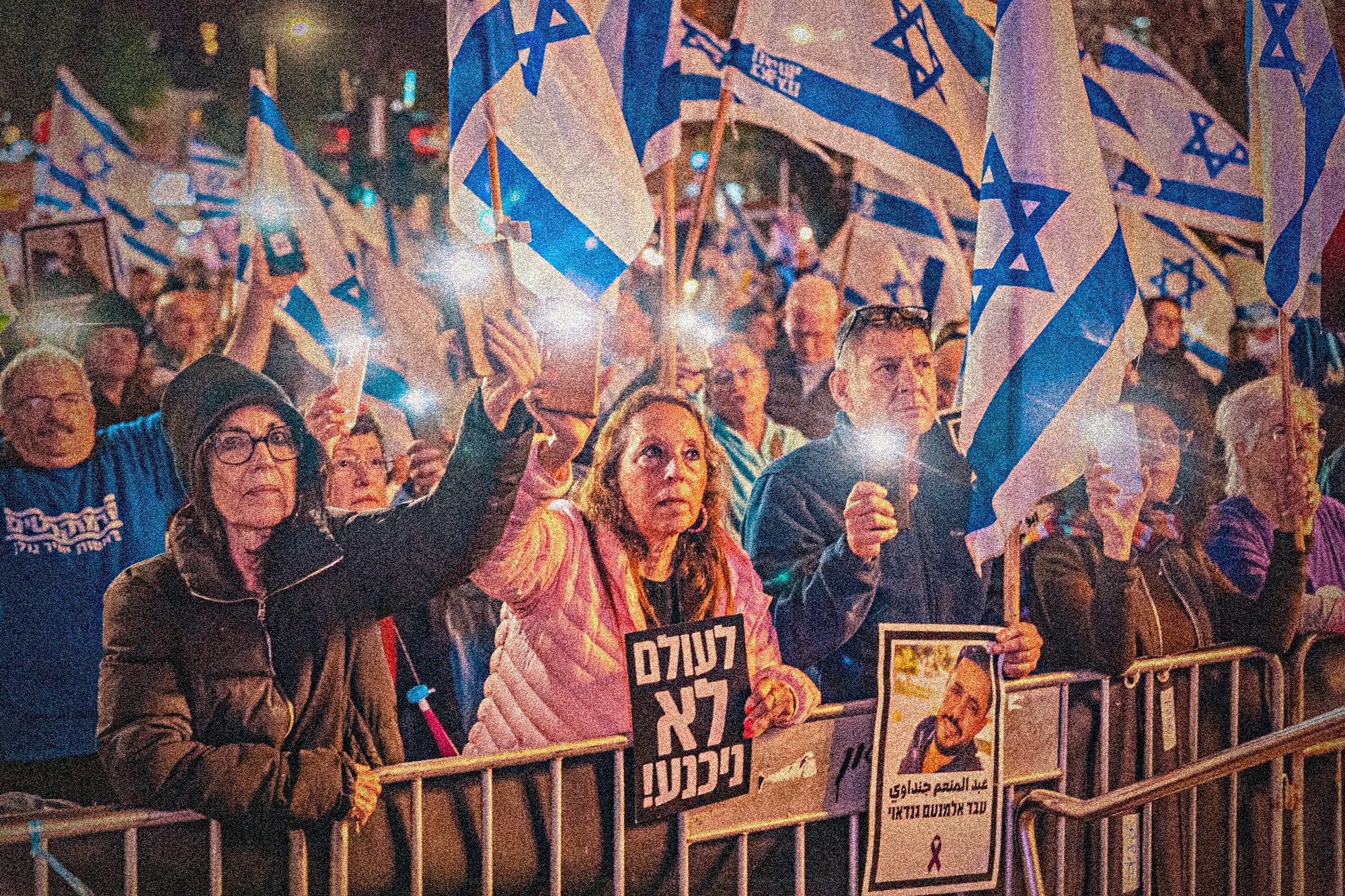
Within days of Levin’s announcement, protesters were in the streets, soon by the tens of thousands. Every Saturday night, towns and cities across Israel hosted mass demonstrations, until the horrors of Oct. 7 brought them to a halt. At their peak, close to half a million people turned out. As a proportion of the population, that’s the equivalent of some 15 million Americans.
In 2023 I interviewed two legal scholars from Hungary and Poland who had recently visited Israel and attended the protests. Gábor Halmai told me that Israeli protesters served as “a model for Hungary. Nothing similar to this happened in my country.” Tomasz Koncewicz said that “[t]he Israelis made this intuitive assertion that following now the path blazed by Poland or Hungary of dismantling the justice system would deprive them of their rights, and undermine the very essence of their democracy. … You may not have a constitution, but people feel loyal, committed, to the constitutional idea.”
To witness the protests was to look out on a sea of Israeli flags. The movement was profoundly patriotic, drawing less on universal or revolutionary values than on the founding values of the state. Protesters objected to more than an affront to their liberal consciences: they saw a government abandoning the standards set by its own Declaration of Independence.
As I lay out in detail in my recent book, though people calling themselves Zionists have taken many different political paths and have acted in different ways—certainly some morally objectionable—essential Zionism is a profoundly liberal idea. From the get-go, the Zionist movement was liberal and democratic, in a way that was really quite extraordinary for the time.
 Liberal Ideals Can Strengthen, Not Weaken, Judaism
Delegates at the pre-state Zionist congresses were democratically elected, including, of course, from countries that were not themselves democracies, like Tsarist Russia. From the Second Zionist Congress in 1898, women had full equality as voters and representatives, at a time when almost no democracy let women vote and more than two decades before the 19th Amendment did so for American women.
We also know that the founding father of political Zionism, Theodor Herzl, envisaged something very much like a liberal democracy when he imagined the Jewish state that he hoped would emerge from his tireless diplomacy. He says so explicitly in his 1902 novel, Altneuland, which depicts a Jewish state with equal rights for all its citizens, Jewish and Arab. What’s more, the villain of the story is a racist Jewish candidate who runs for election on a platform of denying non-Jews the vote.
The Zionist leaders who shaped the movement on its road to statehood were a diverse bunch, but the two most consequential were the socialist David Ben-Gurion and the classical liberal Vladimir “Ze’ev” Jabotinsky—essentially the fathers of what would become the two dominant political factions in the new Jewish state.
Ben-Gurion oversaw the final drafting of Israel’s Declaration of Independence, which combined the Zionist raison d’être of a nation-state for the Jewish people in their historic homeland with a commitment to “complete equality of social and political rights to all its inhabitants irrespective of religion, race or sex.” Of course, like America’s founders, Ben-Gurion did not always live up to his words. It was he who placed Arab towns and villages in the new state under military rule, treating their residents—now Israeli citizens—as a potential fifth column. Military rule was not lifted until 1966.
Jabotinsky was an ardent admirer of America’s founding fathers and the system of checks and balances they established. He wrote of democracy that it “means freedom”: “Even a government of majority rule can negate freedom. … These contradictions will have to be prevented. The Jewish State will have to be such, ensuring that the minority will not be rendered defenseless.”
His most consequential disciple, future Israeli Prime Minister Menachem Begin, took this even further. As early as 1951, he advocated not just for the “rule of law” but for the “Supremacy of the Law” to prevent “an elected parliamentary majority” becoming “an instrument in the hands of a group of rulers … a camouflage for their tyranny.”
One of the ironies of our moment is that the sharpest early warning against unlimited majority power came from Begin, the first prime minister from the Israeli right and a founder of the Likud now pursuing it.
Netanyahu was once an avowed defender of the judiciary. Over a decade ago, he used the appointment of a new Supreme Court president to reassure the court that “every time something arrives on my desk that threatens the independence of Israeli courts, I will block it.” But as the investigations into him became indictments, and then a trial, he allowed his party to be hijacked by Orbán-like postliberals, led by Levin.
 Moses Can Lead Israelis and Palestinians Out of Their Bloody Conflict
The coalition he formed after the 2022 election brought in partners with their own reasons to want the courts weakened. One was the far-right religious nationalists, led by Bezalel Smotrich and Itamar Ben-Gvir—the latter convicted in 2007 of incitement to racism and support for a terrorist organization—who show an explicit disregard for the rule of law and are bent on expanding Jewish settlement in the West Bank. The other was the ultra-Orthodox parties, with a narrow sectarian agenda: securing public funding for their religious schools and keeping their community exempt from military service. That last goal put them on a collision course with the court. In 2024, the justices unanimously ordered the state to begin drafting yeshiva students, and the fight over exemptions led the ultra-Orthodox parties to walk out of the government in July 2025, though they remain part of Netanyahu’s bloc heading into the election.
All the parties’ varied ambitions required that Israel’s powerful Supreme Court be neutered, and so all were united in their desire to remake the judiciary in such a way that it would be effectively powerless to check or balance the executive.
This is the coalition that will be reconstituted if Netanyahu’s bloc wins a majority on Oct. 27, and it has kept working since the war began. Besides the judicial-selection law, the government voted to fire Attorney General Gali Baharav-Miara, a consistent opponent of its attempts to subvert the rule of law. When the court unanimously voided the firing last December, with its conservative justices joining the majority, Levin urged the government to “totally reject this unlawful intervention.”
Netanyahu has also refused to set up a state commission of inquiry into Oct. 7, the independent body Israel normally convenes after a national disaster. He wants politicians to pick the panel instead. It’s not hard to see why he’d object to an inquiry he couldn’t control. In the months before Oct. 7, he was repeatedly warned, including by military intelligence, that Israel’s enemies saw the domestic turmoil over the overhaul as an opening. All the main opposition parties have promised an independent commission.
In September, Israel’s Central Elections Committee, a panel of party appointees, voted to bar the two main Arab-led party lists from the ballot, acting on petitions from Likud and Ben-Gvir’s Otzma Yehudit. Those lists draw most of their support from Israel’s Arab citizens, who make up about a fifth of the population. On Oct. 2, the Supreme Court unanimously overturned the bans. Had the coalition’s original overhaul passed in 2023, it would by now control appointments to the court that issued that ruling.
With no party capable of winning an outright majority under Israel’s proportional system, everything comes down to coalition arithmetic. Right now, polling puts Netanyahu’s bloc in the low 50s—short of the 61 seats required to govern. If no one can assemble 61, Netanyahu stays on as head of a caretaker government until someone can.
The choice facing Israeli voters is not left vs. right. The Israeli left is associated with a push for territorial withdrawal and a Palestinian state. This had long been a matter of deep ambivalence for most Israelis after what they regard as Palestinian rejections of multiple credible peace offers, typically followed by waves of terror; it was then rendered unconscionable for many after Oct. 7. Just one of the four main opposition parties, the Democrats, is left-wing in any meaningful sense. The opposition’s front-runner is Gadi Eisenkot, a centrist former army chief whose Yashar party has led most recent polls. Two of its other leaders, former Prime Minister Naftali Bennett, now running on a joint ticket with centrist Yair Lapid, and Avigdor Liberman, have right-wing credentials and records at least as serious as Netanyahu’s—if not more so. Both formerly worked with Netanyahu before going on to lead ultra-hawkish right-wing parties of their own. Both are on record criticizing Netanyahu from the right over his too-cautious approach to Hamas in the years before the Oct. 7 attacks.
 Can Each Side’s Faith Break the Cycle of Mutually Assured Destruction for Israelis and Palestinians?
The real divide is about competing notions of just what Israel should be: a Jewish nation-state, run according to liberal democratic principles; or a quasi-authoritarian Jewish state where democracy means unchecked majority rule. That does not make the opposition a band of liberal purists. Liberman’s party voted to bar the Arab lists from the ballot, while Bennett has ruled out governing with any Arab party. These can be seen as troubling developments from the standpoint of Israel’s founding commitment to equality, but also reflect the reality of post-Oct. 7 Israel. Most Jewish citizens will not accept a governing coalition with Arab parties unwilling to condemn Hamas without caveats. Ra’am, one of the two lists the committee tried to bar, was part of Bennett’s 2021-22 coalition, and I am one of many who would like to see its impressive leader, Mansour Abbas, back in government. But even though he did unequivocally condemn Oct. 7, his party contains other figures with more ambiguous records in this regard. Unfortunately, that is enough to make the party politically toxic for some.
Nevertheless, on the question at the heart of this election—whether the government will remain subject to checks from the courts and legal advisers—the opposition stands on one side and Netanyahu’s bloc on the other.
Israel’s founding fathers differed profoundly on many things, but none imagined a Jewish state in which an electoral majority could do as it pleased, unrestrained by law or indifferent to the rights of minorities. The hundreds of thousands of Israelis who took to the streets in 2023 understood this instinctively. They were not protesting against their country, but in defense of what it was founded to be. The question facing Israeli voters is whether that founding vision will survive—or whether the country’s leaders will succeed in dismantling it.

© The UnPopulist, 2026
Follow us on Bluesky, Threads, YouTube, TikTok, Facebook, Instagram, and X.
We welcome your reactions and replies. Please adhere to our comments policy.