
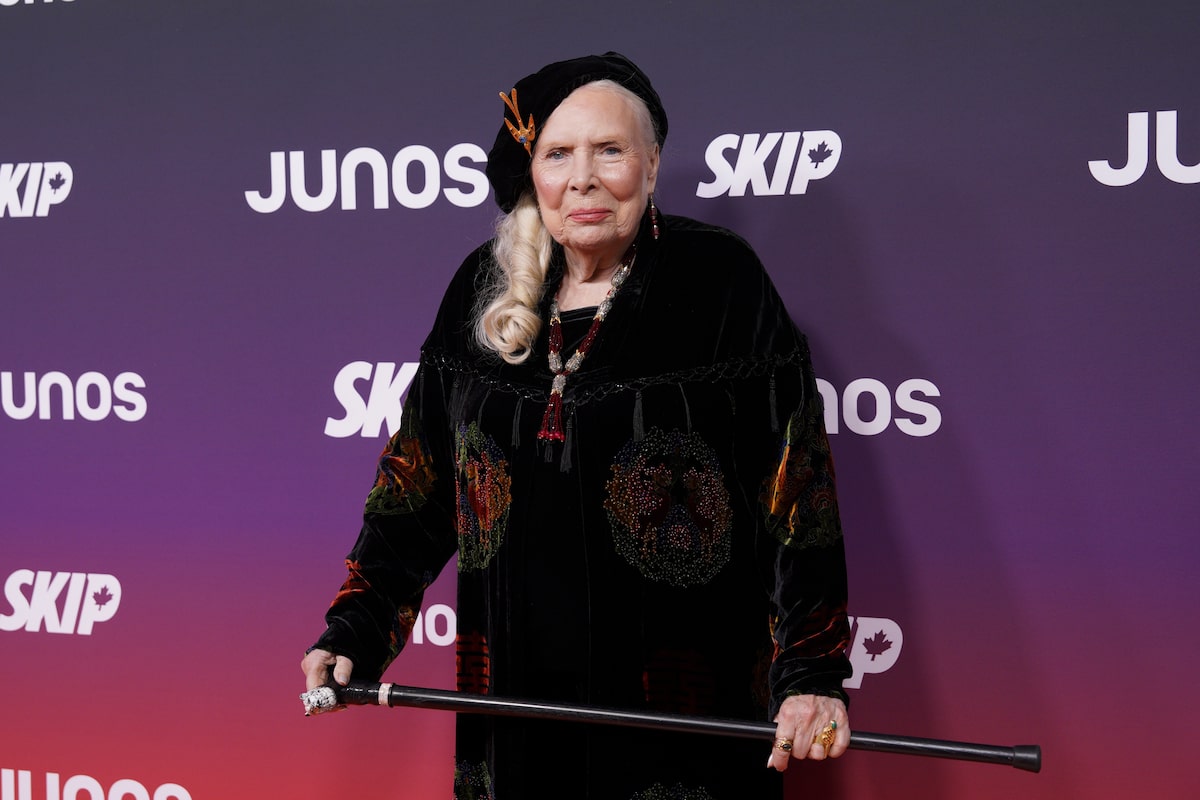
At the Juno Awards this spring in Hamilton, Mitchell received a lifetime achievement award from Prime Minister Mark Carney.Peter Power/The Canadian Press
According to her 1971 song A Case of You, Joni Mitchell drew a map of Canada on the back of a cartoon coaster in the blue light of a television screen. “Oh, Canada,” the Alberta-born daughter of a Royal Canadian Air Force lieutenant sang.
I always wondered what a cartoon coaster was exactly. Now one might wonder where Mitchell puts herself on the map of Canada.
On Tuesday, the legendary singer-songwriter became a U.S. citizen after decades of living and paying taxes in the country. “A journey that began 62 years ago,” she wrote on an Instagram post that showed her smiling while holding a miniature U.S. flag at the naturalization ceremony.
For some, the stars-and-stripes imagery stung. One of Mitchell’s more than one million Instagram followers said her heart was broken. On X, seven-time Juno-winning blues guitarist David Gogo called Mitchell a “traitor.”
She is not that. The California singer and long-time resident of that state still holds her Canadian citizenship. Before a brain aneurysm rupture in 2015 impacted her speech and limited her mobility, she regularly visited her 80-acre property on British Columbia’s Sunshine Coast. “L.A. is my workplace, B.C. is my heartbeat,” she told the Ottawa Citizen in 2006.
Mitchell is an 82-year-old Companion of the Order of Canada. When prime minister Pierre Trudeau inducted her into the Canadian Music Hall of Fame in 1981, she said the honour made her “feel like Boom Boom Geoffrion.” A deep-cut Habs reference!
Mitchell’s Canadian bona fides should not be questioned. Reasonable Canadians, even ones who hold her and her work close to their hearts, would agree her diplomatic status is her own business.
Still, it’s a curious move by the icon at a time when the United States and Canada are embroiled in a grim trade war that has plunged bilateral relations to the lowest point since 1812. It’s left some Canadians a little confused.
“When I first saw the photo of Joni in front of the American flag, I did feel a sharp pain in my heart,” said former CBC Radio host Carol Off, author of the new book True Patriot Love. “She is key to my life. Her poetry and her songs have informed me since I was a teenager. I can’t judge her, though. She’s 82 and making decisions on her life. That said, it certainly feels like the wrong time to be doing this.”
Or is it?
At the Juno Awards this spring in Hamilton, Mitchell received a lifetime achievement award from Prime Minister Mark Carney. In her acceptance speech, she said she was “happy to be in Canada” because she was living in the U.S., “and you know what’s happening there.”
Joni Mitchell’s lifetime achievement Juno yet another jewel in the Canadian icon’s crown
The U.S. midterm elections are less than three weeks away. Two years ago, on the eve of the presidential election, Mitchell performed at the Hollywood Bowl in Los Angeles. She brought out the political song Dog Eat Dog for the occasion: “It’s dog eat dog, ain’t it Flim Flam man?”
After, she addressed the audience: “Everybody get out and vote. This is an important one. I wish I could vote – I’m Canadian. I’m one of those lousy immigrants.”
Now she’s a naturalized citizen with voting-booth privileges.
“Joni has always been frustrated that she couldn’t vote down there,” said Bernie Fiedler, friends with Mitchell since the 1960s, when he booked her to play his Riverboat Coffee House in Toronto. “She loathes Trump. I think the elections are a big part of the reason for getting U.S. citizenship.”
Or perhaps she was miffed after being left off The New York Times’ recent list of the 30 greatest living American songwriters. It must have been a blow to the ego of the person David Crosby once said was as “humble as Mussolini.” (Crosby, who dated Mitchell and produced her first album, also said she was the greatest songwriter of the era.)
Though Mitchell and Neil Young had worked and lived in the U.S. for most of their careers, they were ruled ineligible because they were born in Canada. Thank you for respecting Canada’s rock ‘n’ sovereignty, New York Times.
It’s a messy business, this pop culture patriotism. When Canadian poet Anne Carson won the Nobel Prize for Literature last week, Iceland claimed her has one of their own. Carson splits time between Reykjavík and Ann Arbor, Mich., and holds Icelandic and Canadian passports.
Canada doesn’t own Carson outright, and now they no longer have exclusive rights to Mitchell. We should be okay with that. Consider Mitchell’s eloquent Both Sides Now, written in her 20s just as her career began to skyrocket.
But now old friends are acting strange
They shake their heads, they say I’ve changed
Well something’s lost, but something’s gained
In living every day