
“I’m racist, it’s a genocide, I’m into it,” Seinfeld replied sarcastically, breaking into a dance as security removed the heckler. His reaction seemed to reflect a mood that is becoming increasingly visible in one of the world’s great Jewish cities.
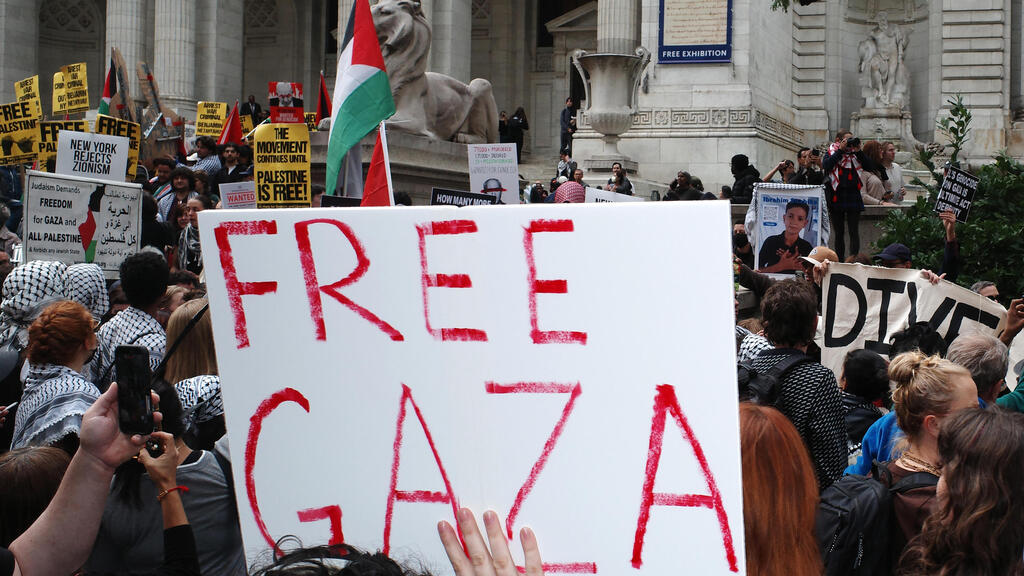
Anti-Israel protestors in New York
(Photo: Michael M. Santiago / Getty Images)
I have been in New York since the beginning of the spring semester as a visiting lecturer at Columbia University. The past week, marked by tensions surrounding the anniversary of the October 7 massacre, offered a revealing glimpse into the city’s changing atmosphere.
The first thing that struck me was how deeply divided the anniversary has become. While Jews and supporters of Israel gathered to commemorate the victims of the Hamas massacre, anti-Israel activists used the same date to renew their demonstrations.
Yet despite the concerns surrounding the anniversary, both protests I attended, one near the entrance to Columbia’s campus and another near City Hall, drew significantly smaller crowds than in previous years.
The protesters were accompanied by a conspicuous presence of Neturei Karta, the fringe anti-Zionist ultra-Orthodox Jewish group. When one of its members realized I was Israeli, he shouted at me, “You’re the reason Jews are hated around the world.”
For the most part, however, the demonstrations seemed increasingly marginal.
Historian Rebecca Kobrin, who has closely followed developments at Columbia and across New York in recent years, offered a similar assessment.
“This year is calmer, with fewer protesters outside the university and more meaningful commemorative events on campus,” she said.
Paradoxically, the declining turnout appeared to coincide with more extreme rhetoric.
Kobrin noted that one of the protesters’ new targets was New York Mayor Zohran Mamdani himself. Some activists denounced him because, in their view, his support for Netanyahu’s arrest did not go far enough. They wanted him to reject Zionism altogether.
As the protesters became more radical, many ordinary New Yorkers passing by appeared to regard them with a mixture of bewilderment and disdain.
To gain another perspective on the mood, I went to see NAZA, the controversial documentary about Israel’s military campaign in Gaza.
The film has been filling the relatively small theaters where it is screened, but the audience at the screening I attended seemed far from convinced.
At the end, the credits rolled against a backdrop of mournful music that continued for several minutes, apparently designed to invite applause or expressions of support.
One viewer, herself a legal scholar, described it as “a film that encourages people not to think.”
New Yorkers, after all, are sophisticated audiences.
For me, the film also contained a striking contradiction. Its central argument is that Israel committed genocide in Gaza, yet its own account describes the IDF’s insistence on calculating expected collateral damage before military operations.
If genocide were the objective, why would Israel devote so much effort to assessing how many noncombatants might be harmed?
That question, in my view, deserves more serious consideration than the film provides.
Another striking feature of life among Israelis in New York is how difficult it is to find someone living here temporarily for work who does not intend to travel to Israel to vote in the upcoming election.
Despite criticism of Israelis who live abroad, I see their determination to participate as an admirable expression of mutual responsibility.
Most of the Israelis working here for a few years plan to return home when their assignments end. They remain deeply invested in Israel’s future and want to have a say in shaping it.
Flying to Israel is no small undertaking. Airfares are particularly expensive at this time of year, and taking time away from work is not always simple.
Yet the people I have spoken with are prepared to make the journey because they feel a responsibility toward their country.
Judging by the impression I have gathered, almost all intend to vote for parties belonging to Israel’s political change bloc.
Will their votes affect the election results? That is impossible to know.
But the connection between Israel and the United States today extends far beyond the thousands of Israelis living in America who intend to return home to cast their ballots.
Two elections, one shared future
About a week after Israel’s October 27 election, Americans will vote in their own midterm elections on November 3.
We would do well to consider these two elections together rather than as separate political events.
The political atmosphere in New York may be changing. Anti-Israel demonstrations appear to be drawing fewer participants, and the hostility that once seemed overwhelming is becoming less dominant in some public spaces.
But the deeper questions about Israel’s standing, Jewish identity and the relationship between the two countries remain unresolved.
The outcomes of the elections in Israel and the United States will, to a considerable extent, shape the future of Jews both in Israel and around the world.