
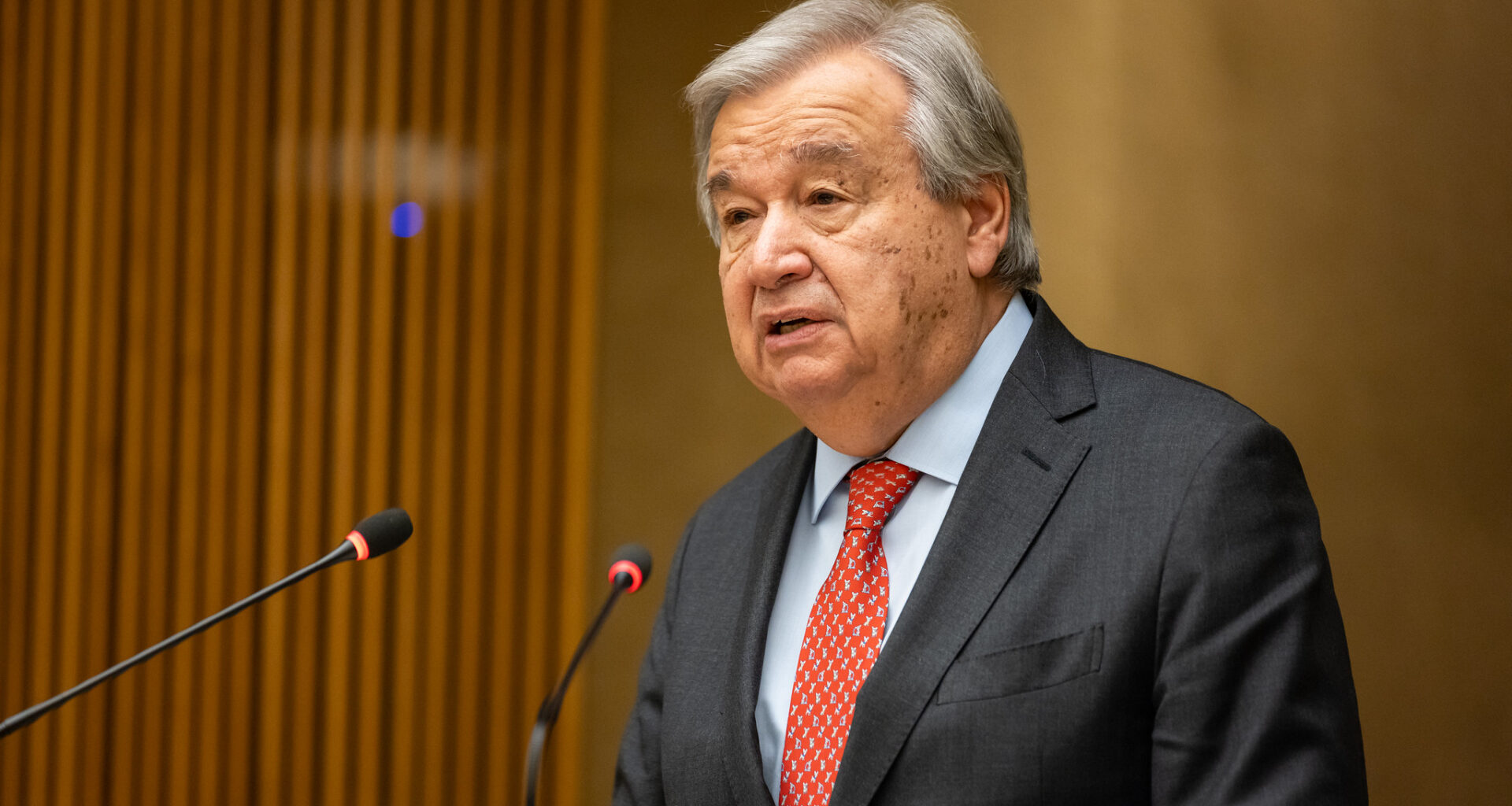
Three years after the October 7, 2023, Hamas massacre, the blood libel of “ethnic cleansing” continues to be leveled against Israel from the highest platforms of the international system. At the recent 81st United Nations General Assembly, Secretary-General António Guterres declared that “violence, displacement, and settlement expansion by Israel in the occupied West Bank are bulldozing the path to peace and raising the specter of ethnic cleansing,” warning that the two-state solution risks disappearing “before our eyes.” He described Israel’s campaign in Gaza following the October 7 massacre as an “onslaught on Palestinians” whose scale of killing and destruction was “unlike anything I’ve witnessed” as secretary-general. In his anniversary message marking three years since the atrocities, Guterres again acknowledged the horror of that day while pivoting rapidly to Palestinian suffering and the incomplete ceasefire.
French President Emmanuel Macron issued his own indictment from the UNGA podium, citing daily “violations” in the West Bank and asserting, against the evidence of continuous Hamas terror activity there, that “Hamas has never operated in the West Bank.” Only weeks earlier, British Foreign Secretary Ed Miliband imposed a boycott on goods from Israeli communities in Judea and Samaria, restricted financial and real-estate services tied to them, and accused Israel of “ethnic cleansing” from the floor of Parliament.
These are the most recent salvos on Israel’s “Eighth Front,” the political, legal, and media war waged against the Jewish state from within the free world’s own institutions. What began as one government’s hostile policy has become a coordinated assault across Western capitals and the UN itself.
At the General Assembly, Prime Minister Benjamin Netanyahu rejected the genocide and war-crimes accusations, defended Israel’s campaign against Hamas and the Iranian axis as legitimate self-defense, and confronted the critics who have normalized the Israel genocide libels as “legitimate political criticism.” This inversion of morality and reality suggests an even more dangerous implication. A prospective military victory over Iran’s terror axis will not hold without an equally serious offensive on the battlefield of international legitimacy. Israel must shift from defense to offense, from explaining to exposing, and it must do so with institutional permanence, regardless of who forms Israel’s next government after the elections of 27 October.
The Inversion at the Heart of the Libel
“Ethnic cleansing” in international law describes a purposeful policy of forcibly removing a civilian population through violence or terror. No such policy exists in Gaza, Judea, or Samaria. What does exist is an expanding pattern of illegal Palestinian construction in Area C, the territory under complete Israeli civilian and military administration as per the Oslo Accords, a binding international agreement signed by both the PLO and Israel. Israel’s administration of Area C is most visible in the Jerusalem-adjacent neighborhood of Isawiya and the E1 corridor which connects Jerusalem to the Dead Sea, where a registered Arab population of roughly 8,000 may now number closer to 80,000. If anyone is engineering a demographic takeover of territory in defiance of signed agreements, it is the Palestinian Authority.
Macron’s mistaken declaration fares no better. Hamas terrorists attack Jews in Judea and Samaria almost daily; only days before his speech, a Hamas-linked attacker murdered Netanel Shukrun, a French citizen and father of six. Even Richard Goldstone, whose UN report on the 2009 Gaza war became a rallying point for this campaign, later reversed himself: “In Israel, there is no apartheid… It is an unfair and inaccurate slander against Israel.”
These libels are not new. Their roots stretch back more than a century, to the eliminationist Islamic rhetoric of the British-appointed first Grand Mufti of Jerusalem, Haj Amin al-Husseini. The Muslim Brotherhood, Soviet propaganda, and later the Islamic Republic of Iran continued the libels, casting Israel as the embodiment of Western imperialism. This narrative was enshrined in the 1975 UN resolution equating Zionism with racism. Though the resolution was revoked, the narrative survived, re-emerging today as the charges of apartheid, settler colonialism, and genocide.
The Red-Green Assault and October 7 as Information War
Today’s campaign reflects the convergence of revolutionary Islamism, led by Iran, Hamas, Hizbullah, and the Muslim Brotherhood; a radical progressive left that frames Israel through the language of colonialism and intersectionality; and an extremist right whose antisemitism increasingly overlaps with anti-Zionism. They agree on almost nothing else, yet they are united against Jewish sovereignty and, more broadly, the Western democratic order.
October 7 demonstrated that terrorism now operates simultaneously on the physical and cognitive battlefields. As Hamas carried out the worst mass murder of Jews since the Holocaust, the global narrative shifted within days from documenting Hamas’s atrocities in southern Israel to indicting Israel even before Israel entered the Gaza Strip. Three years later, that cognitive warfare campaign against the Jewish state continues unabated. The objective remains to isolate Israel diplomatically, weaken its alliance with the United States, divide it from Jewish communities abroad, and erode Western support for its legitimacy.
Israel’s New Policy Direction
Israel has played defense for too long, rebutting each libel only after it has saturated headlines, parliaments, and campuses. The state invests enormously in military preparedness and intelligence, but nothing comparable in defending its legitimacy.
Regardless of the results of the upcoming national election, Israel must establish a permanent national strategic influence and information security directorate reporting directly to the Prime Minister’s Office. It would coordinate messaging across the IDF, the intelligence community, the Foreign Ministry, and diplomatic missions; use artificial and open-source intelligence to detect hostile influence campaigns; rapidly expose disinformation; and coordinate with democratic allies. During the Cold War, the United States built institutions to expose Soviet disinformation. Israel requires comparable institutional innovation.
This posture must extend to nongovernmental organizations that amplify the enemy narrative. Israel’s ambassador in Washington, Dr. Yechiel Leiter, made the point this year about J Street, which calls itself “pro-Israel, pro-peace” while calling for phasing out U.S. security assistance to Israel during a multi-front war to annihilate it. “The tent,” Leiter said, “should be wide and as inclusive as possible, but it cannot be inclusive to those who are contributing to the efforts of those seeking to collapse the tent.”
The Political Warfare Engine: Tehran, Doha, Beijing
Above all, Israel’s offensive must expose the political-warfare infrastructure Iran has built over nearly five decades. The regime has perfected deception as statecraft, concealing its nuclear weapons work and sponsorship of terror, projecting victimhood abroad even as it calls for Israel’s destruction in Persian-language speeches at home. This duplicity is regime doctrine.
Qatar must similarly be exposed. Documents captured by the IDF in Gaza reveal a secure “Al Jazeera phone” linking Hamas’s military operations room to the network’s management in Doha. It includes editorial instructions on which terms to use and which images to suppress, and Hamas operatives moonlighting as Al Jazeera correspondents. Treating Qatar as a mediator rather than as Hamas’s funder and propagandist is precisely the conceptual error that Israel must correct.
For its part, Beijing has kept the Iranian regime solvent by purchasing the overwhelming majority of its sanctioned oil exports, well over a million barrels a day, through a shadow fleet of tankers and front companies. That revenue funds the missiles, proxies, and disinformation apparatus Israel now fights. In addition, China’s TikTok platform has suppressed anti-Islam content while amplifying antisemitic and anti-Israel narratives. China’s digital hostility must be exposed and countered.
The Path Forward
Israel may not out-litigate its enemies at the International Court of Justice or out-vote their blocs at the UN. It can swiftly and aggressively expose the funders of terror and their narratives. It must hold hostile governments and international organizations to their own legal obligations, insist that self-proclaimed allies earn that title through their conduct, and treat Iran, Qatar, China, and their Western enablers as the coordinated threat that they represent.
The war against the Islamic Republic and its proxies has demonstrated Israel’s operational superiority, but lasting strategic gains depend on success beyond the military battlefield. Multi-dimensional warfare – political, diplomatic, economic, academic, media, and social networks – has become a central component of modern conflict. Israel must become as effective at exposing the lies and defending the truth as it has been at defending its borders.
Three years after October 7, 2023, and with national elections days away, the question is no longer whether Israel will continue to play defense against inverted truths. The question is whether the next government – whatever its composition – will finally build the permanent capacity to champion the offense on the Eighth Front.