
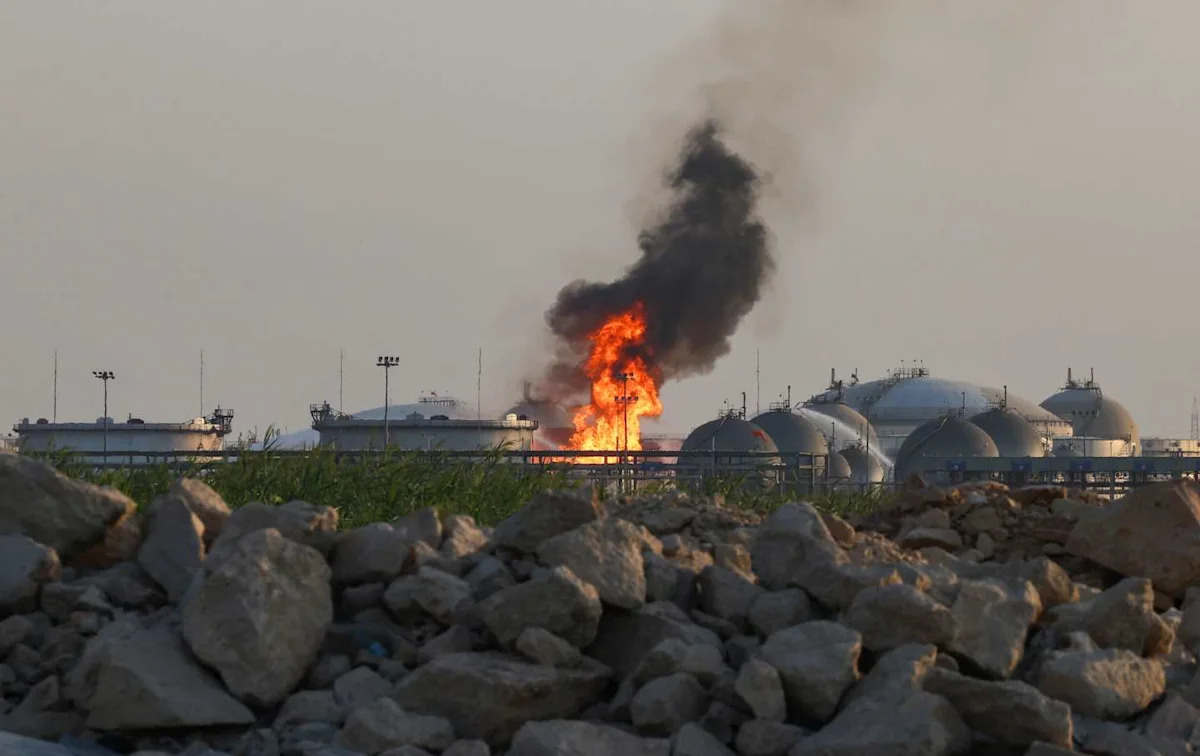
The Houthis, an Iranian ally vying for control of war-torn Yemen, hit the headquarters of the Saudi state oil company Aramco in Dharan on Tuesday night. That attack came just days after they fired ballistic missiles into the King Khalid International Airport in Riyadh, killing 12 and further puncturing the regime’s carefully cultivated image of competence amid a sea of instability. These market-rattling attacks unfolded just weeks after an Iraq-based militia struck and damaged a critical east-west Saudi oil pipeline.
This sudden demonstration of Saudi Arabia’s vulnerability is the latest bout of regional fallout from President Donald Trump’s impulsive and failed war against Iran. The conflict hasn’t accomplished any of Trump’s war aims—to the extent that he’s able to articulate them—but it is clearly destabilizing the entire Persian Gulf region with consequences that will extend far beyond the time horizon of the upcoming midterm elections or even this disastrous presidency. And if Trump can’t bring himself to somehow come to terms with an emboldened Tehran, it’s far from clear that the chaos now enveloping the Gulf can be stopped at its frontiers.
Riyadh is under siege from all directions in what amounts to a dizzying reversal of fortune. Just a year ago, Saudi Arabia was riding high, having greased enough palms inside the Trump family syndicate to ensure that the Kingdom wouldn’t be the target of confiscatory tariffs or some other sudden spasm of incoherent, late-night rage from the president himself.
Meanwhile, the Kingdom’s longtime rivals in Tehran were on their heels, having allowed the joint Israeli-American 12-Day War in the summer of 2025 to degrade Iran’s nuclear program and military readiness without any meaningful retaliation. Riyadh also had significant leverage to deploy, given that Trump was desperate for the Saudis to abandon the Palestinian cause, join the Abraham Accords, and come to a diplomatic accord with Israel.
Today the Saudis’ decades-long security and development strategy is in deep crisis, thanks to an American war that Riyadh very much egged on. There’s never been any reason to support America’s alliance with the corrupt, despotic Saudi regime. But the sudden unraveling of the Saudi economy would have knock-on effects that would be unpleasant for everyone. And it’s now clear that the shortage of critical munitions plaguing the US military extends to regional allies who seem to be close to defenseless against missile and drone strikes.
The fact that the Houthis, who control barely a third of one of the poorest countries on Earth, can almost effortlessly bring a wealthy, advanced society like Saudi Arabia to its knees with the flick of a switch is genuinely unnerving. It suggests, among other things, that no structure in the Gulf region that doesn’t have its own battery of Patriot missiles is safe from attacks from Iran and its allies. This is but the most recent indication that Trump’s repeated claims to have obliterated Iran’s military-industrial base are utterly unfounded.
Iran is not a puppeteer of the Houthis, but Houthi forces are more than willing to play the part of chaos agent in Tehran’s quest to cleave the Gulf Arab monarchies from their security alliance with the United States. That maneuver is calculated to tighten the economic vise on Trump, which would further the Houthis’ ambitions to secure the permanent eviction of Saudi forces from Yemeni territory as part of the settlement.
The Iranians are, in effect, trying to supplant America’s dominant position in the regional balance of power by making the US military response look shambolic and inadequate. So far, they’re succeeding. Iran is acting as an entity that, in Charles Tilly’s famous description of European state transformation, “produces both the danger and, at a price, the shield against it”—-in other words, a protection racket.
This leaves the Saudis and other Gulf monarchies in a bind. Rather than banking on a distant, unreliable ally in Washington that’s tailing off into imperial madness, they are being asked to accept Iranian hegemony in the Gulf at gunpoint in exchange for peace. If they ever want their reputations as slick oases of oligarchic capitalism back, they may have to do exactly that.
A turn toward the Iranians would of course mean relinquishing decades of close collaboration with the still-powerful United States—and it might be too fraught and costly for the Kingdom to consider seriously. But at minimum, Iran has punctured the myth of American supremacy in the region and made it very uncomfortable for the Gulf monarchies to simply return to their prior security strategies if and when the war ends.