
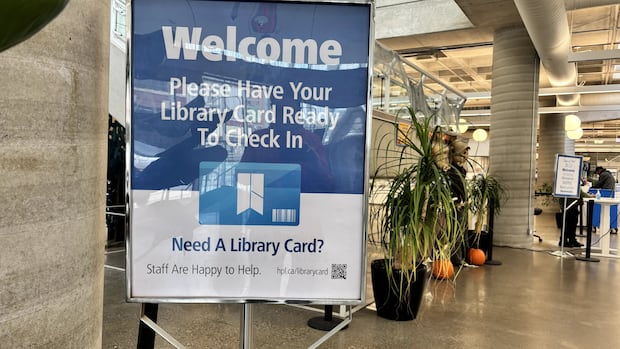
Visitors to the Hamilton Public Library’s Central branch once again need to show a valid library card or enter as a library member’s guest or they will be turned away.
Signs are now up in the library’s entryway instructing visitors over the age of 18 that they must have a valid library card to enter designated areas of the branch. The signs also say people can enter the library as a members guest.
In a statement to CBC News, HPL spokesperson Shelley McKay said they are “seeing an increase in incidents at the Central Library and visible, daily drug use on York Boulevard.”
She said, as incidents historically increase during fall and winter, HPL is reinstating the protocol to “help prevent further escalation, keep Central Library open and maintain access to library services.”
Earlier this year, the library ran a pilot program that implemented the same policy in an attempt to reduce drug use and disruption in the busy downtown space. The eight-week pilot, which ran from March 16 to May 17, required adults to scan a library card to access the main areas of the Central Library where washrooms are located. Those under 18 were exempt.
Regular public access resumed on May 19.
CBC News confirmed signs requiring visitors to check in with their library cards were in place at the downtown branch on Wednesday after it was initially reported by the Public Record on Tuesday.
CBC also confirmed the library has partitioned off access to the stairs and elevator and areas beyond the entrance and computer lab, requiring visitors to show their library card and enter those areas through the welcome desk. On Wednesday morning, at least two people were turned away by staff.
McKay confirmed a library card is not required to enter the building through York Boulevard or Jackson Square, but adults are required to show a card or check in with a guest to access spaces beyond the first-floor corridor and public computers.
McKay said the decision to reinstate the card checking policy was an operational one made by library leadership that considered current conditions, historical patterns of incidents at the library, the evaluation of how the spring pilot program went as well as feedback from members, staff and community partners.
The Library board was informed of the decision, she said.
McKay said the policy will only apply to the Central Library branch downtown and is expected to be in place until April 5, 2027.
Policy tweaked based on feedback from pilot program
McKay said the current policy has been adapted based on feedback from the spring pilot program.
Now, library members can bring up to two guests into the branch who do not need their own card or ID. Staff at the information desk can also help people get a library card if they don’t have one, which doesn’t require government ID.
Programs on the first floor, like social worker and community partner supports, public computers, printing, photocopying and holds pick up will still be accessible without showing a library card.
Visitors without a card can ask library staff for access to the washroom, which will be provided with a security staff member accompanying them.
Pilot program received mixed reviews
In March, chief librarian Paul Takala said it had been a “very difficult winter” at the branch, with workers witnessing near-daily overdoses and drug dealing inside. He said something needed to change and, at one point, floated the idea of temporarily closing the branch, before taking that idea off the table.
Instead, Takala pitched the check-in system, which the HPL board approved 8-2. The idea, he told CBC Hamilton at the time, was that people would be less likely to break the law or library rules if staff knew who they were.
Following the March library board decision, the union representing about 250 HPL staff was “very upset” with the pilot, Lisa Hunt, president of Canadian Union of Public Employees Local (CUPE) 932 told CBC Hamilton at the time.
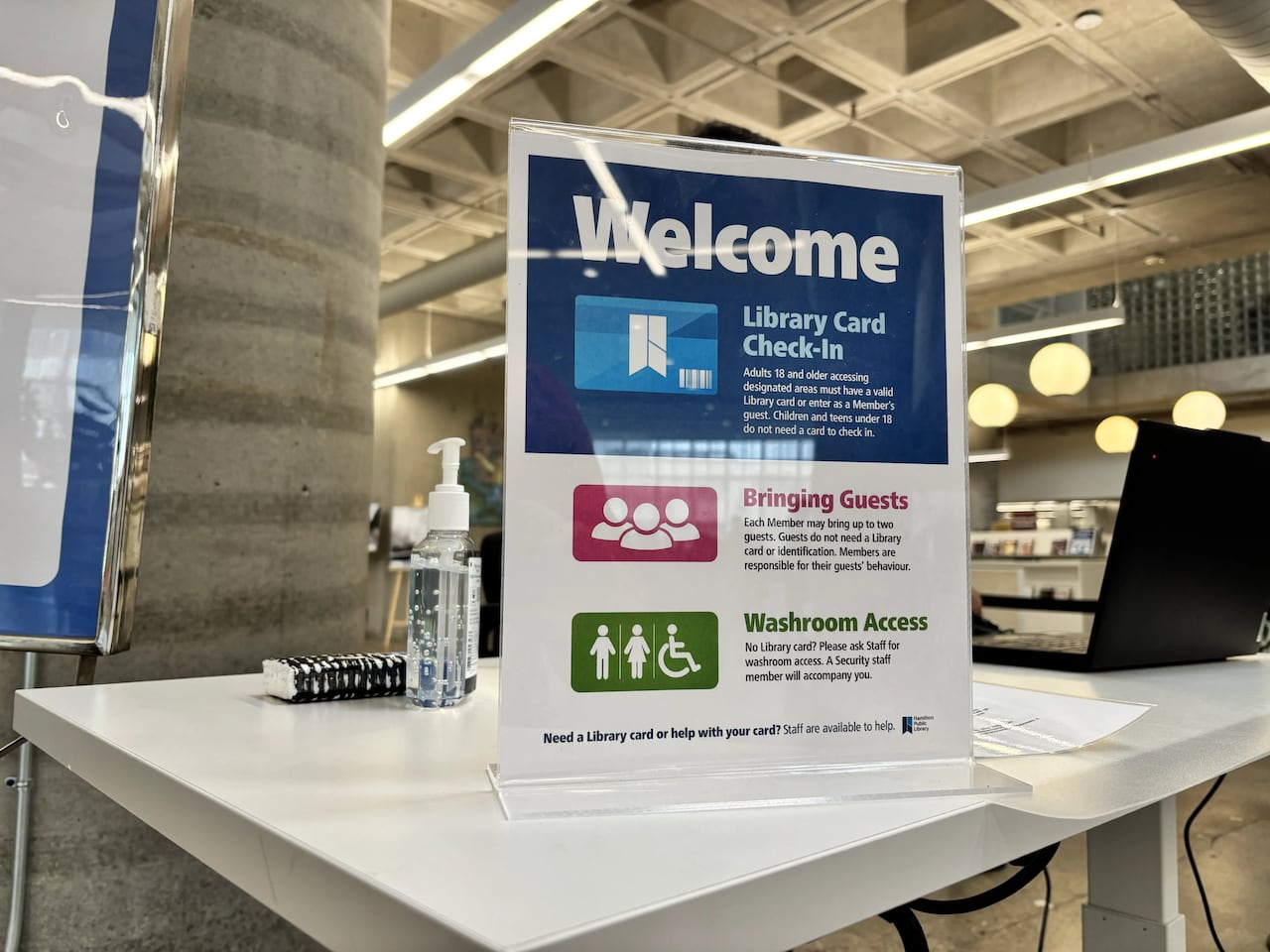
Signs at the welcome desk at Hamilton Public Library’s central branch say visitors over the age of 18 must show a valid library card to enter ‘designated areas’ of the branch, or enter as a member’s guest. (Eva Salinas/CBC)
In a presentation to the HPL board, CUPE 932 said card checks are discriminatory and put workers at risk of verbal abuse and tense interactions with angry library members. It also said it worried about the pilot becoming standard practice.
In June, a review of the card check-in system was presented to the HPL board, which found that the pilot dramatically reduced overdoses, drug use and emergency calls.
The report said that suspected drug-use incidents dropped from 202 before the pilot to 52 during the pilot period, while naloxone administrations fell from 42 to just two. Calls to 911 also declined sharply, from 109 to 23.
Earlier this year, Hunt also expressed concerns about how the policy would impact the city’s most vulnerable people who rely on library services. HPL’s Central branch, which sees 20,000 visitors a week, is connected to Jackson Square and its street entrance is across from an emergency shelter. During the winter, it and other branches serve as warming spaces for people who are vulnerable and unhoused.
The policy change also comes at a time when a nearby downtown drop-in centre, Cathedral Café, that served hundreds of people each day has been temporarily closed after part of the ceiling inside the building collapsed. Last week, St. Matthew’s House, which supports the cafe said while repairs are underway there is no timeline for when the cafe might reopen.
McKay said the library will continue to work with community partners and “advocate for meaningful changes that address the underlying issues, while keeping Library spaces safe and welcoming.”