
Iran continues to clash with rebels in its Balochistan region, according to numerous reports. This follows several weeks of growing unrest in the region – the Sistan and Balochistan province of Iran. Little is known about the situation because media is not allowed in the area, and Iran keeps a tight lid on information. Nevertheless, videos that have appeared over the last two weeks, along with reports, appear to indicate a growing insurgency.
Recently, an Iranian commander and a police officer were reportedly killed in clashes. Haalvsh, a human rights group, said that “both casualties were from Zabol district.” It identified them as “Afsaneh Aqila, a female commander of the all-women’s Basij unit in Mehrestan County and Mohammad Ali Shahriari, a male police officer.”
On October 1, videos shared on social media showed smoke billowing from fighting in the area of Zahedan city.
Now, the Kurdish media outlet Rudaw has reported that “Iranian forces deployed around 40 additional vehicles to Taftan county in southeastern Sistan and Balochistan province on Tuesday, a Baluch rights monitor reported, as clashes between Iranian security forces and militants continue.”
A human rights group that covers the Baloch region said it has documented the arrival of more regime forces to the region, as well as fighting between the Islamic Revolutionary Guard Corps (IRGC) and local rebels. “As the clashes intensified, approximately 40 additional military vehicles carrying reinforcements were reportedly dispatched to the area on Tuesday,” Rudaw said.
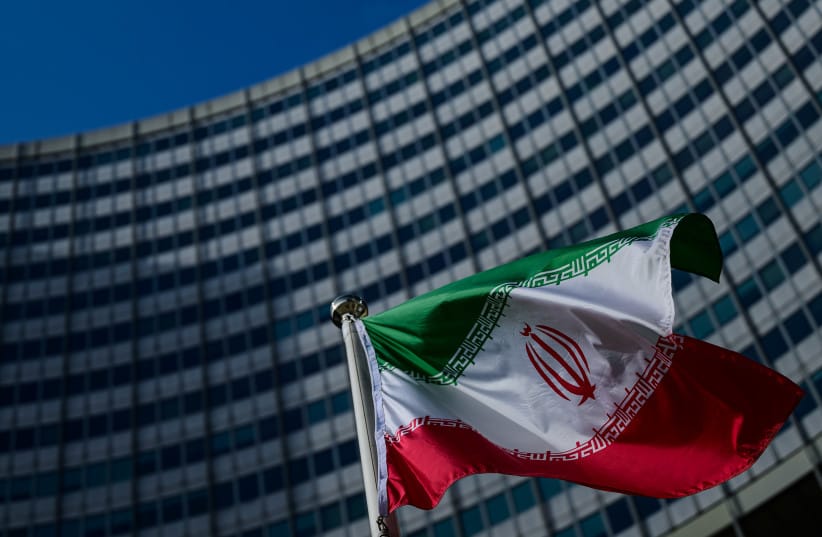 The flag of Iran is seen outside the International Atomic Energy Agency (IAEA) headquarters during a meeting of the IAEA Board of Governors on March 02, 2026 in Vienna, Austria;illustrative (credit: Christian Bruna/Getty Images)Iranian security forces suffer casualties amid clashes with Baloch rebels
The reports indicated that not much is known about the results of the clashes, notably the number of casualties on both sides. “The reported deployment of reinforcements and other details have not been independently verified,” it said.
However, Rudaw added, “More than a dozen Iranian military and police personnel were killed or wounded in four attacks over a 24-hour period last week, according to Haalvsh.”
Iranian state media also reported on the clashes. The regime views the Baloch rebels as “terrorists.” Fars News in Iran, which is linked to the IRGC, described clashes on Tuesday, saying “initial reports indicated that several militants had been killed during the operation. The reported casualties could not be independently verified, and it was unclear whether the incident was connected to the clashes in Taftan.”
TodayPress.TV, a media organization based in Azerbaijan, noted that “a bloody crackdown by Iran’s Islamic Revolutionary Guard Corps is reportedly unfolding in the Sistan and Balochistan region, where assassinations are being carried out almost daily.”
It added: “Several militant groups have joined forces in the region and claim to be fighting for control of all of Iran. However, at least one of these groups has historically been associated with Baloch separatism and follows a distinctly conservative Sunni ideology.”
Reports point to escalating IRGC crackdown in Balochistan
TodayPress.TV noted the scale of the fighting: “IRGC members, Basij forces, clerics affiliated with the regime, and foreign militants have been targeted. Police stations, military bases, and checkpoints have come under attack, while patrols have also been targeted. Clashes have reportedly extended as far as Kerman Province.”
Meanwhile, The Arab Weekly asked whether fighting might become Iran’s “Achilles heel.” This indicates that many people in the region are watching closely what happens in southeastern Iran, some 10 months after the Islamic Republic’s brutal crackdown on protests in January 2026, with tens of thousands of people murdered.
The Arab Weekly explained: “Sistan and Balochistan Province lies in Iran’s far southeast and is the country’s second-largest province by area, after Kerman. It consists of two main regions: Sistan, whose population is predominantly Shia, and Balochistan, which is considerably larger than Sistan, accounts for most of the province’s territory, and has a predominantly Sunni population.”
It added that “if we classify the regions inhabited by Iran’s non-Persian national and ethnic communities according to their national identities and geographical characteristics, rather than the country’s official administrative divisions, we can speak of Balochistan as a distinct region within Iran.
“This region extends beyond the Baloch-inhabited areas of Sistan and Balochistan Province to include parts of Kerman Province where Baloch communities also live,” The Arab Weekly said.
Iran launches new operations as Baloch insurgency continues
Iran’s IRGC continues to portray itself as able to “dismantle” what it calls “terrorist cells” in the Balochistan region.
A recent report at Al-Monitor said, “Iran’s IRGC announced a new operation against armed militants in the southeastern province of Sistan and Baluchistan, which is witnessing almost daily attacks and clashes.” The Baloch groups in southeastern Iran include the Sunni militant group Jaish al-Adl.
Meanwhile, across the border in Pakistan, Baloch armed groups are fighting the Pakistani government. This week, the Baloch Liberation Army in Pakistan said it had carried out numerous attacks.
On Monday, that army was reported to have “carried out 16 organized and intense attacks against the occupying Pakistani military in various regions of Balochistan over the past six days, inflicting severe personnel and material losses on the enemy.”