
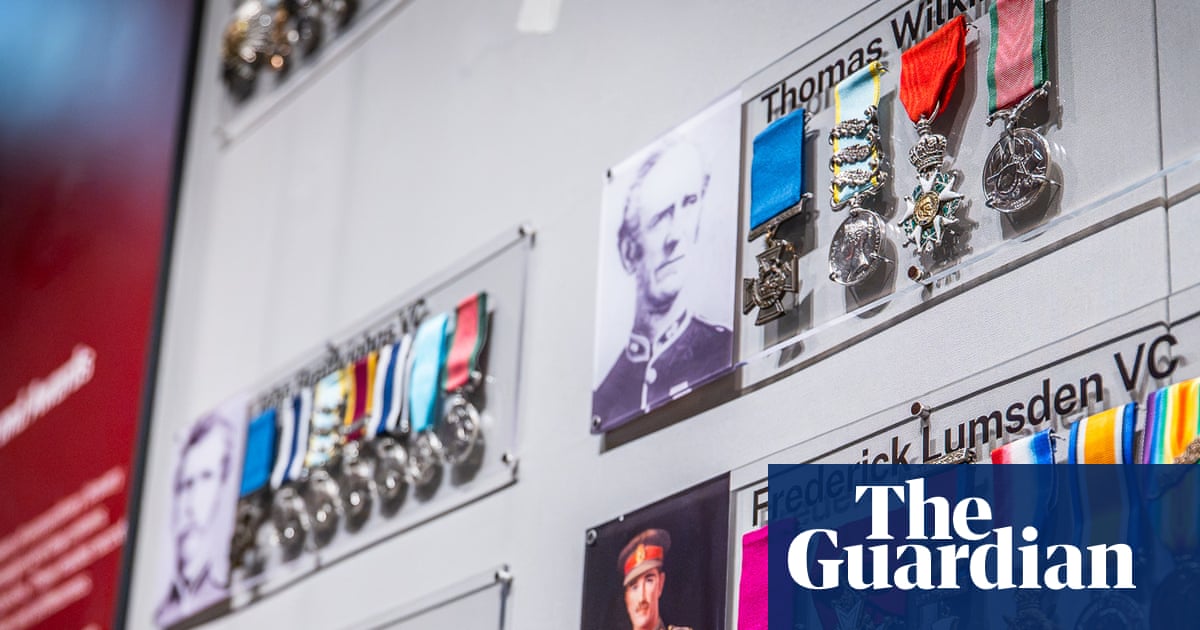
They tell tales of bravery under fire, may lead to conversations about the UK’s place in the world and could prompt visitors to reflect on what they might have done if faced with the same perilous circumstances.
All 10 Victoria Crosses (VCs) awarded to members of the Royal Marines are going on display together for the first time along with tales of courage during conflicts such as the Crimean and both world wars.
“It’s fantastically special,” said Matthew Sheldon, the chief executive officer of Royal Navy Museums. “The Royal Marines have only ever been awarded 10 Victoria Crosses. We have all 10 of them. The originals have never been seen together before. They’ve been in secure storage, not visible to the public, which seemed like a crying shame.”
The medals will go on permanent display at a new £15m “Royal Marines Experience” at Portsmouth Historic Dockyard telling 360 years of marines’ history.
Sheldon said the marines awarded VCs tended to be “youngish” and not from very senior ranks. Like modern marines, who usually work in small, agile teams, they tended to find themselves in very close quarters to the enemy.
He said the stories could lead to debate about the role the UK played in global conflicts.
Mark Berry, the assistant curator of artefacts at Royal Navy Museums, installing the Victoria Crosses. Photograph: Royal Navy Museums
“When we look at the world now and we look at our military, it’s not about large set pieces – it’s often quite small incidents below the level of full-out declared wars. I think the medals ask questions about the world we live in now.”
Earlier this month, the Royal Marines returned to the Faroe Islands for the first time since the second world war as part of security efforts in the strategically vital Greenland-Iceland-UK Gap. This autumn, commando engineers have been practising digging underground hospitals that offer protection against drone attacks.
Sheldon said he thought the medals could prompt visitors to ask questions of themselves. “They are about a moment in time and somebody’s choice in that moment. They are powerful because they make you think: ‘What would I have done in the same incident.’”
Staff at the museum say it is hard to pick out a favourite story but when pressed, Sheldon said he was very keen on that of Sgt Norman Augustus Finch, born in 1890.
Finch was awarded the Victoria Cross during the Zeebrugge Raid on 23 April 1918. While serving onboard HMS Vindictive, Finch was stationed on a high lookout platform.
During the battle, his position was hit by shells, killing or wounding everyone around him. Although he was severely injured, Finch remained at his post and continued to fire on enemy positions until another shell finally put him out of action.
L/Cpl Walter Richard Parker who served as a stretcher bearer during the Gallipoli campaign in May 1915. Photograph: Royal Navy Museums
Because of the bravery shown by the entire battalion, the marines were allowed to vote for who should receive the VC. Finch was chosen by his peers.
Mark Berry, the assistant curator of artefacts, said he liked the story of L/Cpl Walter Richard Parker. During the Gallipoli campaign, Parker served as a stretcher bearer.
On the morning of 1 May 1915, Parker was a member of a party tasked with taking aid to men in an isolated frontline trench. To reach the trench, Parker crossed 365 metres (400 yards) of open ground under intense enemy fire.
He was the only person to successfully reach the trench. Having aided the wounded, he helped them evacuate the next morning, and himself was severely injured in the thigh and chest.
Berry said: “It’s a really good example of the multilayered role of the marines. It’s not just fighting. It’s also trying to save lives, trying to help people.”