

Cindy Mitchell left the federal public service this past spring through workforce adjustment, the process used when federal positions are being cut or eliminated. She was entitled to a transition payment, including $42,151 that was supposed to be transferred into her registered retirement savings plan.
The money was issued as a paper cheque. It never reached her bank.
Her compensation adviser, the federal pay specialist handling her file, later told Mitchell in correspondence reviewed by The Hill Times that the cheque appeared to have been “intercepted behind the scenes” and that the same thing had happened on “numerous files.”
Mitchell is one of three current and former public servants who told The Hill Times they have encountered delayed, missing, or unresolved payments while moving through workforce adjustment. Their stories come as thousands of employees move through the government’s workforce-reduction process, raising questions about whether the federal pay system can keep pace with a surge of complex departure transactions Ottawa knew was coming.
Those transactions can include transition payments, severance, final pay, and unused leave payouts, while unresolved older Phoenix pay issues also have to be settled. The decade-old pay system has cost over $5-billion and has left tens of thousands of people overpaid, underpaid, or waiting years for compensation.
According to Treasury Board Secretariat data as of Sept. 14, 4,613 public servants had selected a workforce adjustment option under the government’s spending review. Of those, 4,119 chose options that include a Transition Support Measure, like Mitchell.
In a March update on the government’s effort to address these longstanding issues, Public Services and Procurement Canada’s (PSPC) point person told reporters those facing layoffs and severance would a receive “white glove” service, with trained staff in place.
“I feel pretty comfortable we’ll be able to manage the volume at this point,” said Alex Benay, PSCP’s then-associate deputy minister, who has since left the role.
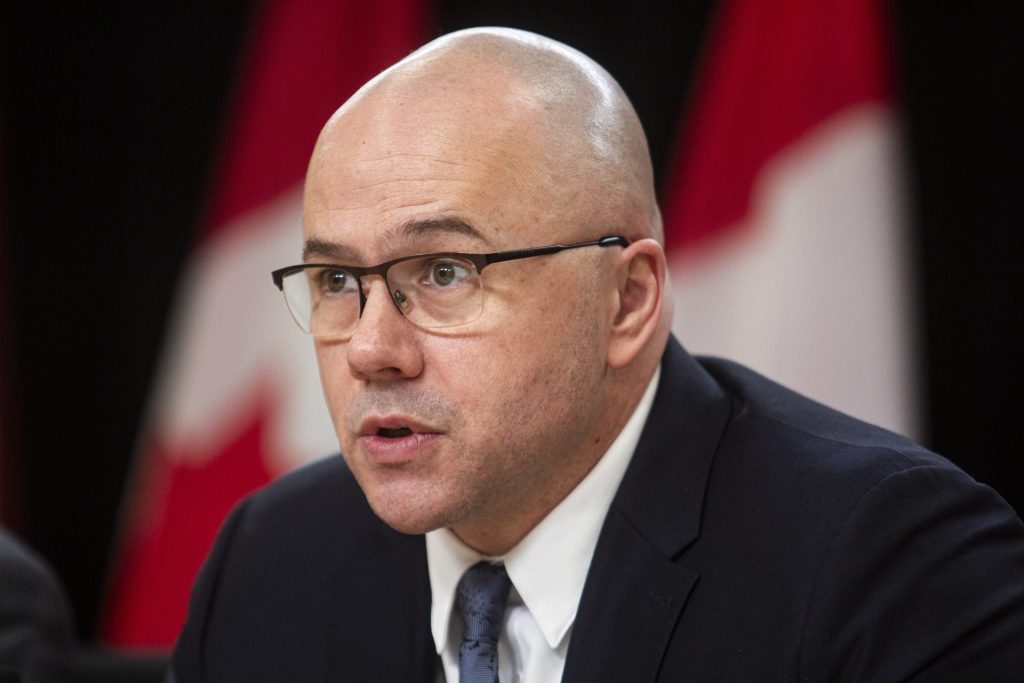 Public Services and Procurement Canada associate deputy minister Alex Benay said in March that public servants facing layoffs and severance could expect ‘white glove’ treatment, with trained staff in place. The Hill Times photograph by Andrew Meade
Ottawa has also allocated additional funding to increase Pay Centre capacity.
But Mitchell’s troubles started before the cheque went missing.
Her Natural Resources Canada position was not being eliminated. After about 25 years in the public service, she left through alternation, allowing another employee whose position was at risk to move into her job. Treasury Board data shows 888 staff have chosen to leave via this option.
Mitchell’s Transition Support Measure totalled about $131,000. She took $20,000 in cash in 2026, directed $42,151 into her RRSP, and deferred roughly $68,800 until 2027 to spread the tax impact across two calendar years.
Before the payments could be finalized, old unresolved pay issues on Mitchell’s file had to be fixed, adding another delay.
She eventually received the first cash portion and her severance. But her adviser told her the RRSP payment had to be issued as a paper cheque, routed through Environment and Climate Change Canada, where Mitchell had been transferred on paper through the alternation, and then forwarded to her bank.
Correspondence reviewed by The Hill Times shows Mitchell was told the cheque should reach her bank within about two weeks of Aug. 26. By Sept. 17, she had told her adviser the bank still had not received it.
Mitchell said she was never told where the potentially intercepted cheque went. A replacement was scheduled to be printed Oct. 7, and to be sent through the same process.
“I am not confident,” Mitchell said when asked whether she believes the second cheque would actually arrive. “That’s why I’m going to watch it closely.”
Mitchell said she could absorb the delay, but worried about workers leaving government without the same financial cushion.
“What if I was a single mom or dad or whatever, or even a single person who had bills to pay and was struggling with this process?” she said.
Different delays, similar uncertainty
For another federal worker, the strain came from waiting months for her Transition Support Measure.
The worker, who asked not to be named because she is still moving through workforce adjustment, submitted her departure option back in April.
Correspondence reviewed by The Hill Times shows Health Canada told her the Pay Centre would generally send the forms needed to arrange the payment about three to four weeks after departure.
Once the Pay Centre had the completed form and required documents, the standard processing window was about 25 business days, according to the correspondence.
 Public Service Alliance of Canada members demonstrate outside the Prime Minister’s Office in Ottawa on Feb. 28, 2020, marking four years of problems with the Phoenix pay system. The Agriculture Union says older Phoenix issues are now holding up some transition payments for workers leaving government. The Hill Times photograph by Andrew Meade
She said she did not receive the form until June, several weeks later than expected. After returning it, she repeatedly sought updates and eventually asked how to escalate her case, citing financial hardship. Her payment arrived July 29.
“I burned through all of my savings waiting for this to come in,” she said.
She still had a mortgage, car payments, and a dependent attending college, she added.
The Hill Times asked Health Canada whether employees going through workforce adjustment were experiencing pay or departure-processing delays beyond the timelines communicated to staff, and whether the department had raised any concerns with Public Services and Procurement Canada about Pay Centre capacity or timeliness.
Health Canada said it is not aware of employees whose workforce-adjustment pay or departure processing has exceeded those expected timelines, and said it has not raised concerns with PSPC about Pay Centre capacity or timeliness related to the current workforce-reduction exercise.
Spokesperson Marie-Pier Burelle said a dedicated Pay Centre team recently reported that it was meeting the required service standards for workforce-adjustment cases. The department did not provide those figures.
Past Phoenix failures have had severe consequences for workers. In 2017, Nunatsiaq News reported that then-Nunavut senator Dennis Patterson had received accounts of federal employees who had depleted their savings and faced eviction, including a young Inuk worker who sold his snowmobile to pay bills and support his family. The following year, Parliament heard the case of a Service Canada worker whose daughter left a Camosun College program after unpredictable pay left the family struggling to keep up with its mortgage and utilities.
For a third worker whom The Hill Times spoke with, the wait began before anyone had even picked up her file.
The former public servant—who asked not to be named because she is pursuing the issue through her union and is considering seeking legal advice—left through alternation in the spring. She said it took almost four months for the Pay Centre to assign her file to a compensation adviser.
More than five months after leaving, she said she is still waiting for a complete accounting of her final pay, including unused vacation, earlier pay still owed, and any overpayments the government may seek to recover.
Federal guidance says money an employee owes the government, including past overpayments, can be deducted from severance or other final payments.
She has received the paperwork to direct her severance, but is holding off on signing it until she knows what the government believes she is owed and what it may deduct.
“It creates a limbo, but the administrative delay created it,” she said.
Her Transition Support Measure is not late; she chose to defer it to later years.
What the unions are seeing
Union figures show pay problems related to workforce adjustment are reaching bargaining agents, although the early counts do not establish how widespread they are.
 Agriculture Union national president Milton Dyck says the union knows of roughly half a dozen cases of pay problems tied to workforce adjustment, and has had to intervene or escalate some of them. Handout photograph
The Agriculture Union, which represents more than 7,700 federal workers, is aware of roughly half a dozen cases, national president Milton Dyck told The Hill Times.
Dyck said recurring problems include transition payments held up by unresolved earlier transactions, including older Phoenix issues. He said the union has had to intervene or escalate some cases.
The Professional Institute of the Public Service of Canada (PIPSC) reported a lighter caseload.
PIPSC communications officer Johanne Fillion said its team helping members with Phoenix problems had encountered only two pay cases related to workforce adjustment, and both had been resolved.
“Maybe it is still too early to tell about Phoenix pay repercussions,” Fillion said.
A surge Ottawa knew was coming
Ottawa had already begun preparing the Pay Centre for an increase in work tied to the government’s workforce reductions.
In its spring economic update, the feds earmarked $36-million specifically for added Pay Centre capacity to carry out the spending review.
Warnings about the complexity of that work also came early.
At a Feb. 23 news conference, PIPSC president Sean O’Reilly warned that workforce adjustment would bring a surge of complex pay transactions, including early retirements, alternations, and layoffs, risking new errors and a larger backlog.
 PIPSC president Sean O’Reilly warned back in February that workforce adjustment, early retirements, transfers, and layoffs were among the complex transactions Phoenix has struggled to process accurately. Handout photograph
Less than two weeks later, at Benay’s update, he told reporters the department’s was managing the pay backlog and prepared to support those facing layoffs.
Whether that added capacity is keeping pace is harder to determine.
The Hill Times asked PSPC how long workforce adjustment files are taking to process, how many remain outstanding, whether delays or a backlog have emerged, and whether it still has enough capacity to handle the volume.
Nicole Allen, with PSPC media relations, said the department is still looking into the questions and was unlikely to provide a full response before publication, but expects to provide more information later this week.
PSPC instead pointed The Hill Times to its general Pay Centre dashboard, which does not separately identify workforce adjustment files.
Get Today’s Headlines Newsletter
Your quick scan of the news you need each weekday to be the smartest person in the room.
By entering your email address you consent to receive email from The Hill Times containing news, analysis, updates and offers. You may unsubscribe at any time. See our privacy policy
The dashboard nevertheless shows a Pay Centre carrying substantial outstanding work as workforce adjustment departures pick up speed.
As of Sept. 23, it shows 198,000 transactions ready to be processed. Of those, 33,000 were outside their applicable service standards but less than a year old, while another 66,000 had been waiting for more than a year.
Those figures cover the Pay Centre’s entire workload, so they do not show how quickly transition payments, severance, or other departure files are moving.
Federal workforce adjustment guidance says Pay Centre requests to process departure-related pay actions are usually subject to a 25-working-day service standard.
The Hill Times
Editor’s note: This story was updated on Oct 15. to include a response from Health Canada.

Mzwandile Poncana is an award-winning journalist and The Hill Times’ public service reporter. Born in Botswana, he is a Concordia University journalism graduate and was the 2023 Canadian Journalism Foundation Black Investigative Journalism Fellow. He’s previously worked at Metroland Media, and his reporting has appeared in the Toronto Star, Xtra Magazine, The Hamilton Spectator, the Waterloo Region Record, Ricochet, and other publications. Contact him at mponcana@hilltimes.com. See all stories BY MZWANDILE PONCANA