
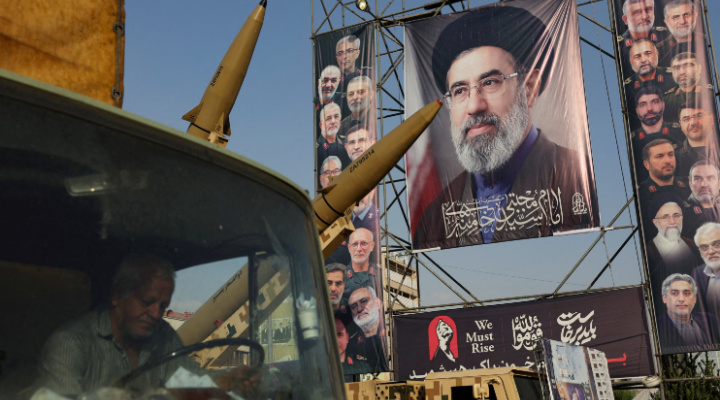
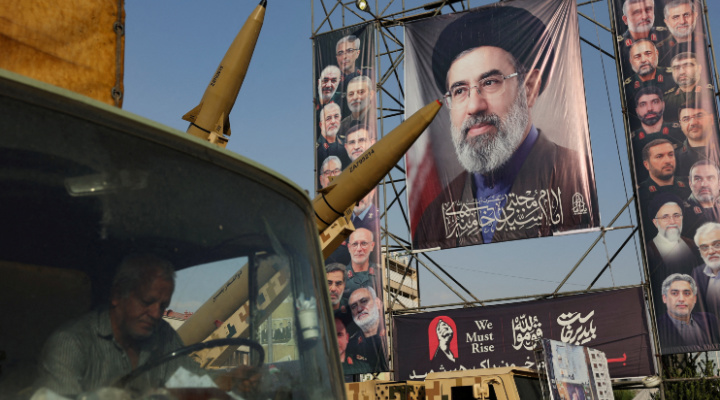
Iranian missiles are displayed next to a banner with a picture of Iran’s Supreme Leader, Mojtaba Khamenei, on a street in Tehran, Iran, Sept. 27, 2026. Photo: Majid Asgaripour/WANA (West Asia News Agency) via REUTERS
Iran’s apparent efforts to resume underground ballistic missile production and reports of Tehran mobilizing its regional terrorist proxies are putting Israel on high alert over the threat of a renewed multi-front confrontation in the Middle East.
New satellite imagery showing renewed tunneling and underground construction at three major Iranian sites — Parchin, Khojir, and Shahroud — has raised concerns about the Iranian regime’s efforts to rebuild its missile production capabilities despite Israeli and American strikes that severely damaged key facilities, according to a report released Wednesday by the Foreign Policy Research Institute (FPRI).
Experts note that the findings align with an earlier Wall Street Journal report indicating that Iran had resumed assembling ballistic missiles in underground facilities using components stockpiled before the war.
Even though all three sites remain heavily damaged, with rubble largely uncleared and restoration work limited, the report’s findings suggest Iran may be shifting some production and assembly operations underground to shield them from future attacks as tensions with Washington and Jerusalem remain high.
At Parchin, one of the three sites identified in the report and located southeast of Tehran, facilities used to produce solid rocket fuel remain damaged, with repairs underway following last year’s 12-day war.
Experts point out that restoring production will require clearing rubble, repairing damaged structures, and installing specialized equipment, suggesting that the facilities are still far from being fully operational.
However, the report identifies more substantial activity at the nearby Shahid Borujerdi tunnel complex, where satellite imagery shows the rapid restoration of a structure believed to provide electricity and other essential services to the underground facilities.
Experts also note tanks ranging from five to 13 meters long outside the tunnels, similar to those found at other Iranian missile production sites, suggesting the complex may be used to produce or assemble ballistic, cruise, or surface-to-air missiles, though this remains unconfirmed.
The second location, Hojir, a major defense complex southeast of Tehran, suffered extensive damage during the recent war, with both solid-fuel missile production sites still buried in rubble and facilities used to produce liquid-fueled missiles also heavily damaged.
FPRI’s findings challenge the Wall Street Journal‘s report that Iran has resumed underground missile assembly at Hojir, with researchers suggesting that if production has restarted, it may be taking place at a different, unidentified facility rather than the Shahid Muwahid complex.
The third location, Shahrud, a major solid-fuel missile production site in northeastern Iran, shows more progress in debris removal than Parchin and Khojir, with some damaged structures undergoing initial repairs, though extensive rebuilding and the installation of specialized equipment are still needed before production can resume.
Experts have also identified extensive excavation for a new tunnel complex in a mountain north of the production line, which they believe may be linked to Iran’s missile industry.
Even though the exact timeline remains uncertain, the report estimates that Iran could resume production within roughly a year if it concentrates restoration efforts at a single site and secures the necessary industrial equipment.
However, analysts warn that rebuilding the main factories may not be enough, as damage to other facilities that manufacture missile components could create bottlenecks and further delay the restoration of Iran’s missile production capabilities.
The reported findings cast partial doubt on earlier assessments that Tehran’s military infrastructure had been largely devastated during the war, suggesting that Iran’s defense industry was seriously damaged but not eliminated or unable to resume in some capacity.
According to another report published last week by the Institute for Science and International Security, satellite imagery has also revealed renewed activity at Minzadehei, a suspected nuclear weapons development site northeast of Tehran, with regular vehicle movements resuming after extensive cleanup efforts to clear debris and repair damage to the surrounding hillside.
Israeli officials have previously warned that Iran had restarted limited production of ballistic missiles, launch platforms, and anti-aircraft systems, relying on surviving components and production lines that escaped destruction or had already been restored.
Previous Israeli intelligence assessments also indicated that the regime had recovered missiles and launchers from underground tunnel systems damaged or rendered inaccessible during the conflict.
There is still no consensus on how long Iran’s reconstruction will take. Current estimates range from several months to several years, depending on the weapons system and the scale of foreign assistance Tehran is able to secure.
However, Israeli officials have warned that Iran’s reconstruction efforts are advancing faster than initial intelligence estimates had projected, as Tehran takes advantage of the ceasefire and ongoing diplomatic talks with the US to rebuild critical military capabilities.
These reconstruction efforts come as the threat of a broader regional confrontation looms, with Tehran reportedly instructing Lebanon-based Hezbollah, its chief terrorist proxy, to increase its military readiness for a conflict it considers “imminent,” raising fears of a wider escalation beyond Iran’s borders.
According to the Emirati news website Iram News, Iran is mobilizing its regional terrorist proxies and preparing them for a possible escalation of hostilities with Israel and the United States.
Unlike in the previous conflict, Hezbollah is reportedly preparing to adopt a decentralized combat system that would allow its forces on the ground to operate independently, even if Israeli strikes its senior leadership or cuts communication with central command.
Preparing for a possible escalation, the Iranian regime is not just funding its proxies and supplying weapons but also overseeing their military reconstruction and coordinating their readiness to ensure they can continue operating even if Iran’s senior leadership and military infrastructure come under attack, preventing a crippling blow to Tehran’s regional network.
Even with these efforts, experts note that Hezbollah has not necessarily regained its former military capabilities or its ability to shift the balance of power in the region. Rather, the move toward decentralized command is an attempt to address weaknesses exposed by Israeli operations.
In Israel, officials have warned of a “high probability” of attacks on civilians and renewed fighting, with security alerts expected to increase as election day approaches later this month for Israel (Oct. 27) and the US (Nov. 3) amid fears of escalation on multiple fronts.
Israeli Defense Minister Israel Katz has requested an extension of the special state of emergency until Nov. 3, keeping emergency measures in place beyond election day amid ongoing security concerns.
On Wednesday, the Israeli defense chief issued a stark warning to Hezbollah, cautioning that any involvement in an Iranian attack on Israel would trigger a severe military response.
“If Hezbollah joins Iran in an attack on Israel, it will suffer a severe blow and lose more territory in southern Lebanon … which will become part of Israel’s permanent security zone. The Israel Defense Forces are prepared to carry out the maneuver,” he said.