
Reuters counted at least 135 drone and missile strikes on at least 84 infrastructure sites in Saudi Arabia, the UAE, Iraq, Qatar, Kuwait, Oman and Bahrain since the war began on February 28. Again and again, the munitions struck the one piece of equipment a facility could least afford to lose, some of it hidden under rooftops or only a few meters across.
Iran’s parliament speaker, Mohammad-Bagher Ghalibaf, has said as much. “It’s simple: the oil and gas production chain here is sprawling, accessible, and exposed,” he wrote on X in early September.
 Iran escalates Hormuz tanker attacks in gamble ahead of US midterms
“American oil and gas companies across these waters and facilities share that exposure.” Three days later, three pumping stations on Saudi Arabia’s East-West Pipeline were hit.
Reuters based its findings on 36 interviews, imagery and satellite data.
‘Falling debris’
In at least 34 statements, the region’s governments blamed damage on debris from successful interceptions. Fourteen experts who reviewed Reuters’ imagery, 11 from the affected industries, said that was highly improbable, citing signs of explosive detonation and the importance of what was hit.
 Iran warns of wider risks as regional attacks intensify
Five of the states make it illegal to photograph or share certain images of strike damage.
‘Running out of water in days’
Kuwait, a desert country, draws 90 percent of its drinking water from desalination plants, most of them attached to coastal power stations because removing salt from seawater takes enormous amounts of heat and electricity.
Iran hit at least four of Kuwait’s eight combined power and desalination plants between March 2 and July 20, Reuters found, some more than once. In one four-day period in July, it struck what the government called “several” desalination plants, one of them at least twice.
“If you were to attack enough of their capacity, we’re talking about running out of water in days or weeks,” said Michael Christopher Low, director of the Middle East Center at the University of Utah. Donald Trump had threatened Iran’s water supply in March, Low said, but it was Iran that turned the threat into reality for its neighbors.
Kuwait’s government asked citizens to save water and electricity in “the spirit of shared responsibility.”
 Tehran signals escalation in conflict IRGC likens to a ‘world war’
The strikes also hit Kuwait’s main refineries. In April it exported no crude at all, the first time since 1991, according to TankerTrackers.
A nuclear power plant
On May 17, a drone hit an electrical substation at the UAE’s Barakah nuclear plant, about 130 meters from a reactor, forcing one of its four reactors onto emergency diesel generators, according to the International Atomic Energy Agency.
“This means whoever was or is behind this knew exactly what they were doing,” IAEA chief Rafael Grossi said.
Three officials told Reuters Iran had the plant’s floor plan. The UAE said the drone came from “armed factions in Iraq.” There was no radioactive release.
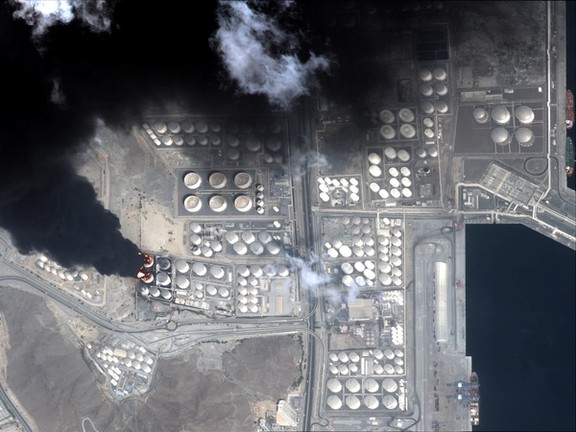 A satellite image taken March 5, 2026, at the United Arab Emirates port of Fujairah after an attack on March 3, 2026, shows tanks burning.
Fujairah
The UAE’s main oil port outside the Strait of Hormuz, Fujairah was the region’s lifeline once Iran blockaded the strait. It was struck at least 19 times, and for the first three months of the war was either under attack or under repair.
 Khamenei adviser warns UAE as tensions with Tehran escalate
 Iran’s rhetoric against UAE hardens after Netanyahu visit
The first strike, on March 3, left tanks burning that were still visible from space two days later. On March 9, a strike destroyed the first of the port’s two matrix manifolds, a junction of 62 pipelines that carries crude and refined products from the terminals to the ships. Emirati officials blamed debris.
“This is a wound to the brain and heart,” said Ramanan Krishnamoorti, a petroleum engineering professor at the University of Houston, who said it stretched credibility that debris had simply fallen onto the manifold.
Strikes on March 14, 16 and 17, beginning hours after a US attack on Iran’s Kharg Island oil terminal, damaged the second manifold, Reuters found, a hit not previously reported. Loadings fell to 440,000 barrels a day in the week of March 16, less than half the 2025 average, according to Kpler.
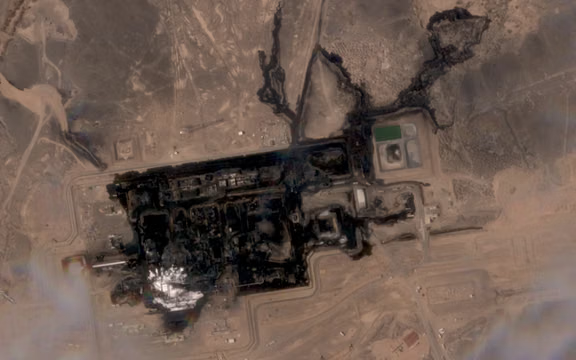 A satellite image taken September 11, 2025, shows the aftermath of a September 10, 2026, attack on a pumping station on Saudi Arabia’s East-West Pipeline.
“We were watching it come in and watching the helicopters blast the drones out of the sky,” said a foreign businessman who watched one wave from a nearby road. “They were sending swarms of drones and one or two got through.” American-made Patriot batteries sat about 3 kilometers away.
The port recovered to a weekly record of 3.2 million barrels a day by the end of March. Iran struck again on April 6 and May 4, the second time hitting the pipes feeding the first manifold. Refined exports essentially stopped: a single ship left between May 4 and June 1, and they did not recover until September. In at least six statements, Emirati authorities blamed debris; none admitted major damage.
The UAE’s reprieve
Strikes on UAE infrastructure stopped after May 17.
In June, four sources told Reuters, the UAE agreed to unlock at least $10 billion in frozen Iranian funds, $3 billion of which was released, and two said Iran agreed in return to stop attacking. The UAE denied any agreement. A senior Iranian official confirmed the transfer but said it reflected “the correction of the UAE’s behavior.”
In September, as Iran attacked ADNOC tankers at sea, Fujairah set a monthly export record of 2.62 million barrels a day.
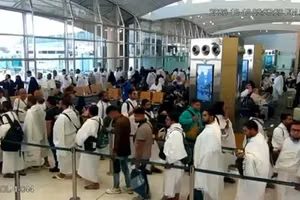 Houthi airport strikes carry echoes of Iran’s aviation threats, experts say
 Trump says Iran decision coming, suggests Tehran behind Houthi attacks
The other routes
At Qatar’s Ras Laffan, which handles nearly a fifth of the world’s liquefied natural gas, two strikes destroyed the cold boxes that chill gas into liquid. QatarEnergy says repairs will take three to five years.
On September 10, the attack on the East-West Pipeline halted crude flowing across the desert to the Red Sea port of Yanbu, a route for up to 4 percent of global supply. Riyadh blamed Iran-backed militias in Iraq.
Iran-linked strikes have damaged five of Saudi Arabia’s nine biggest refineries and output fell from more than 10 million barrels a day to below 7 million, a loss of over $50 billion.
Airports in at least four countries, Amazon data centers and the UAE’s Al Taweelah aluminum smelter were also hit. The smelter will not return to normal before 2027.
“Every single target was civilian,” said Sultan Al Jaber, head of the Abu Dhabi National Oil Company. “They are targeting our infrastructure. But what they’re really targeting is our way of life.”
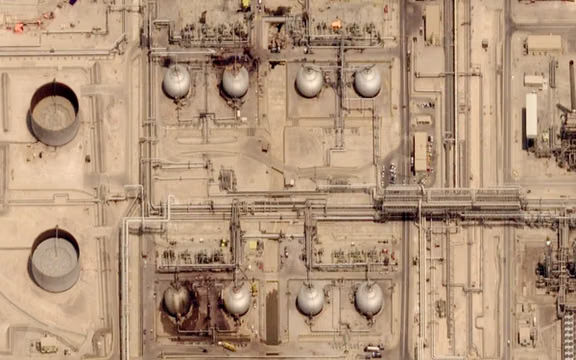 A satellite image taken July 30, 2026, shows damage to tanks at Saudi Aramco’s Abqaiq oil processing facility, which was attacked on July 27, 2026.
The Houthis and the Red Sea
After the April ceasefire collapsed, Revolutionary Guards commanders flew to Yemen on July 13 with missile and drone equipment for the Houthis, according to Reuters.
From July 16 to 18, US forces hit bridges and a tunnel on the roads to Bandar Abbas, strikes Iran International mapped in its investigation of Iran’s road and rail network.
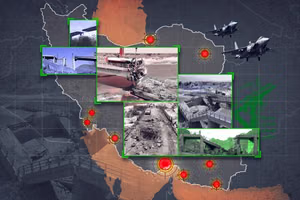 670 bridges, 380 tunnels: The network that moves Iran’s army and its missiles
The Houthis answered by hitting Saudi Arabia, knocking the Jazan refinery’s output to zero. The group has since declared a naval embargo on Saudi Red Sea ports, hit tankers and the airport in Najran, and taken the port of Mokha. On Saturday, a strike blamed on the Houthis killed 12 people at King Khalid International Airport in Riyadh.
Saudi Arabia’s crown prince asked Trump for military help in September and was rebuffed. Riyadh had already signed a mutual defense pact in Mecca with Turkey and Pakistan in August.
In 1983, a CIA assessment warned that “even a few attacks against well-chosen targets could do considerable damage” to the region’s oil facilities. Fujairah, which began full operations the same year, has since been struck at least 19 times.