
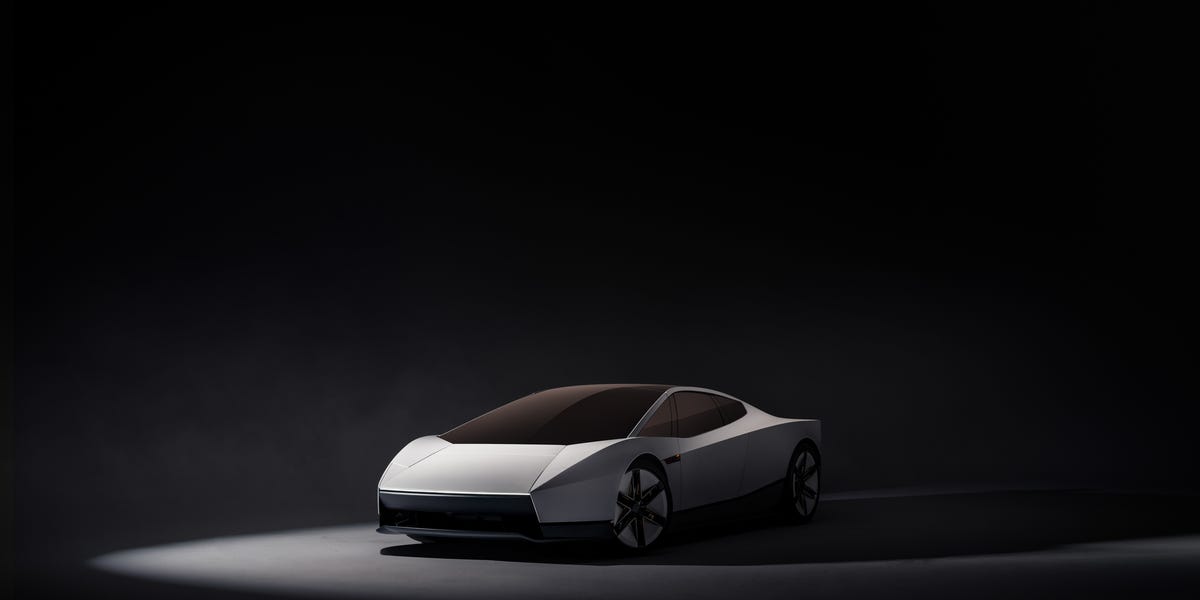
Nearly nine years have passed since the second-generation Tesla Roadster was first revealed. A long stream of updates and delayed launches followed, including a new delay off the original October 1st date for this reveal just two weeks ago. Today, though, Tesla finally revealed the car with a cold gas booster-assisted backflip.
The car itself is significant, but the booster demos are the highlight. Thanks to a fan suction system, the car was shown driving up a vertical ramp before stopping upside-down. It then returned to a starting point, went back up the ramp, drove off, inverted with the help of a burst of cold gas, then landed back on the ground with the help of additional boosters.
In a second demo, the same booster system was used to launch the car over a row of five Tesla’s models. It then completed a barrel roll in mid-air, again landing level. With ten nozzles of compressed air, which Musk says are supported by an air tank that can be replenished by the car itself. In a third demo to close the show, the car completed a side flip from a standstill using the same system.
While autonomy has long been a focus for the electric automaker, CEO Elon Musk says that the Roadster is “long term, the only manually-driven car that Tesla makes.” The jumps and flips are gimmicks, but the fan that allowed the car to drive up the ramp would seemingly produce significant downforce that could contribute to on-road performance in a way similar to the McMurtry Speirling track car that completed a similar upside-down demo last year.
The design is radically changed from the Roadster first shown in 2017, shifting from a round shape in line with Tesla’s previous design language to an angular wedge look that more closely resembles the shape of the Cybertruck and Cybercab models revealed more recently. In this application, though, the look is more directly reminiscent of wedge-shaped supercars of the 80s.
When the Roadster was first announced back in 2017, the announcement came with unprecedented claims of a 1.9 second 0-62 time, an 8.9 second quarter mile time, and a 200 kWh battery pack delivering 620 miles of range. Thanks to the help of the booster system, timing of a demo shown during the presentation showed the apparently final car reaching 60 MPH in 0.81 second. The claimed top speed over 230 MPH, but Musk said on stage that the goal was “Mach .5, maybe a little higher.” That would be 383 miles per hour. Horsepower, range, and battery details were not discussed.
Musk says that the car enters production in 2028, “actually.” Tesla’s website lists two “augments,” both of which appear to be option packages featured today. One, “thrust,” is described as a “limited release” two-seat model with the rear-mounted cold-gas thrusters used in the 0-60 demo. The other, “rocket,” is listed as “invite only” and is the variant seen flipping and leaping in the other stunts. The website states that this variant is “not approved for public road use.”
Pricing was not mentioned during the presentation.
Fred Smith’s love of cars comes from his fascination with auto racing. Unfortunately, that passion led him to daily drive a high-mileage, first-year Porsche Panamera. He is still thinking about the last lap of the 2011 Indianapolis 500.