
Emergency phone alarms blared, city loudspeakers crackled to life and newscasters urgently warned viewers to take shelter as a massive earthquake appeared imminent.
But the ground didn’t shake.
At 12:40 p.m. on Friday, an earthquake early warning was issued by the Japan Meteorological Agency, with the alert describing a heart-stopping magnitude-9.9 quake that would reach up to shindo 7 on Japan’s 7-point seismic intensity scale and be felt from Hokkaido to the Tokai region.
Two minutes earlier, a magnitude 6.9 quake was in fact recorded off Russia’s Kamchatka Peninsula, but in Japan, the only registered shaking measured shindo 1, a level at which only some people even notice. Live feeds from northern Japan showed tranquil seas and business as usual as news anchors repeated their warnings.
By 12:48 p.m., the JMA withdrew the alert, effectively issuing an all-clear after putting Japan and the world on notice about what would have been the largest quake in recorded history. The JMA is probing the cause of the mishap.
While it was not the first false alarm generated by the early warning system, it was noteworthy for the scale of the forecast and the way in which it was withdrawn. A second alarm was sounded to cancel the alert, the first emergency quake warning to ever be withdrawn, according to the JMA.

A smartphone displays a canceled earthquake early warning.
| THE JAPAN TIMES
Alerts for a magnitude 9.9 quake naturally led to shock and confusion before the all-clear was sounded. The strongest quake in history, striking Biobio, Chile, in 1960, reached magnitude 9.5. The JMA said that 9.9 is the highest magnitude figure its systems can send out externally.
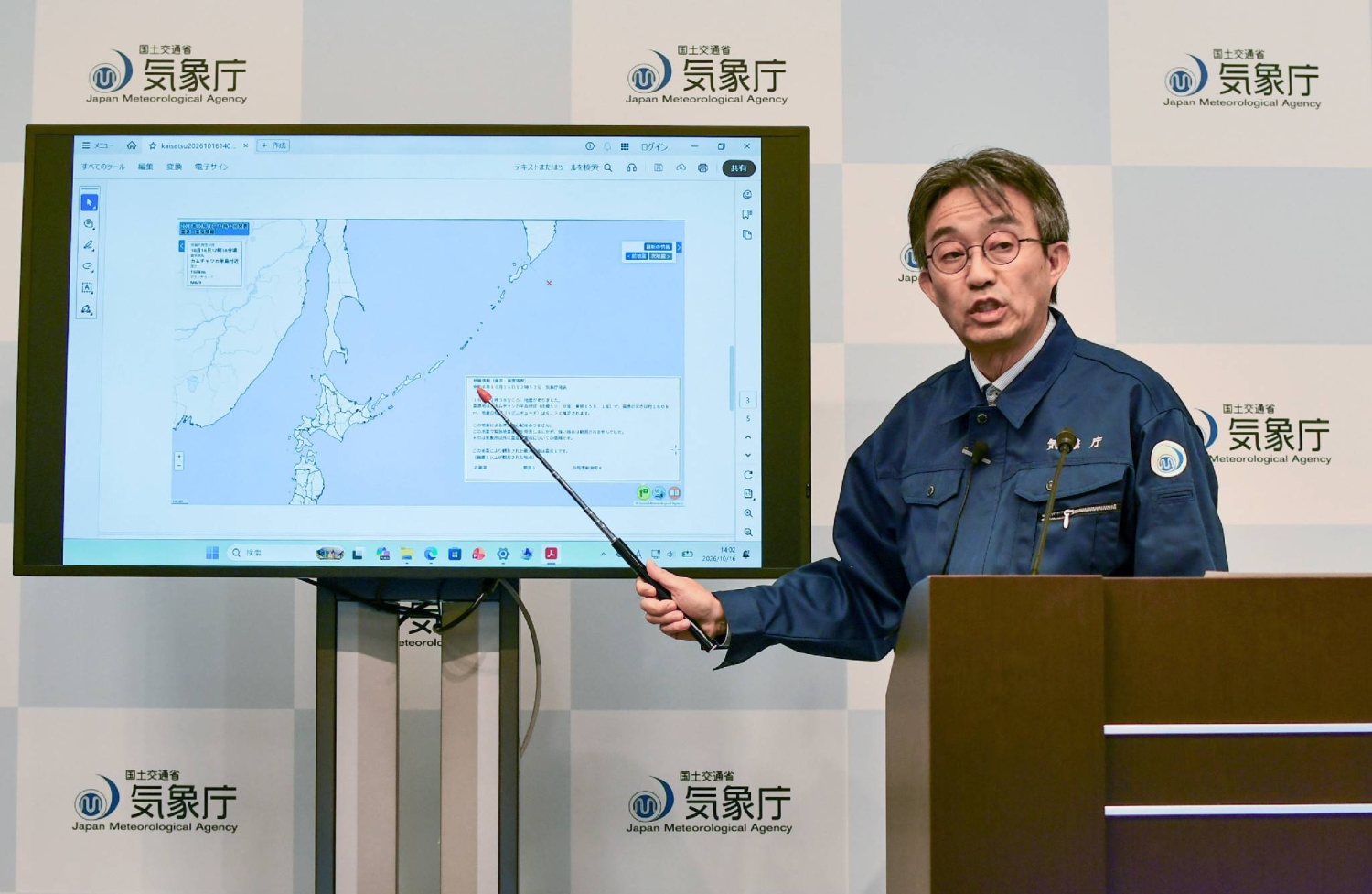
Ayataka Ebita, the head of the JMA’s earthquake and tsunami observation division, said at a press briefing that the agency’s system had erroneously placed the quake’s epicenter off the Kuril Islands and overestimated its magnitude, triggering the initial warning.
The agency ruled out a possible cyberattack.
“We are currently investigating the cause and will provide an explanation as soon as it is determined,” Ebita said.
JMA said at another briefing that the cause of overestimation was due to applying a magnitude formula designed for domestic earthquakes to one occurring far from Japan. It also used different estimated quake locations to calculate the magnitude and predict shaking, although both calculations should have used the same location. Further details remained under investigation.
Chief Cabinet Secretary Minoru Kihara told a regular news conference on Friday afternoon that the government had received no reports of damage related to the Kamchatka earthquake.
Still, he said the government “took seriously” the considerable anxiety and burden among people who evacuated or took other steps to protect themselves, as well as anyone whose travel or business activities were disrupted due to the warning.
Similar false alarms have occurred in the past. In July 2020, the JMA issued a warning to 15 prefectures, including Tokyo, after incorrectly estimating a quake’s location and overstating its magnitude.
In August 2013, noise from a seabed seismometer was mistakenly combined with data from a small earthquake, triggering widespread false warnings across the Kinki region. No shaking of shindo 1 or above was observed in the two cases, according to the JMA.
The Earthquake Early Warning system draws from seismometers located at various observation stations, aggregating data to predict an earthquake’s location, magnitude and forecast intensity.
“We do not watch the calculations in real time as each result is generated. The system produces them automatically, so we cannot necessarily observe these changes as they happen,” Ebita said.

A Meteorological Agency map shows the epicenter of an earthquake that struck off the Kamchatka Peninsula on Friday afternoon.
| Japan Meteorological Agency
According to the JMA website, false alarms in the early detection system may result from noise on the sensors, including from accidents, lightning or device failure. Ebita said that lightning was not believed to be involved in this case and suggested processing of the sensor data may have been the source of the error, while reiterating that the investigation was still ongoing.
Ebita noted that the reliability of the prediction is impacted by the number of observation stations and the quality of the reading can decrease when a quake is far from a station, as it was in this instance.
Regarding the JMA’s policy toward rescinding an alert, Ebita said that a cancellation announcement is issued when the maximum observed seismic intensity is shindo 2 or lower, or when shaking is determined to have been caused by something other than an earthquake.
In addition to rattling nerves, the false alarm impacted some public transit networks, with the Tokaido Shinkansen line shutting down for 15 minutes after an automated safety system kicked in, according to Central Japan Railway.
In Tokyo, the alert was received with confusion, with pedestrians pausing to look at their phones and see if the shaking would begin before carrying on with business as usual. Users of the NERV Disaster Prevention app were met with warnings of a magnitude 9.9 quake, with a countdown ticking down to shaking that never came.
Lola Milroy-Tompkins, a 20-year-old British student at Waseda University in Tokyo, said she was initially very concerned when the earthquake alarm went off while she was eating lunch at a cafeteria on campus.
“I have never experienced an earthquake before and I expected the grand style shaking and everything to start falling around me,” said Milroy-Tompkins.
She said as the students around her expected an earthquake, “everyone was worrying and talking to others, trying to figure out what was going on. And obviously nothing shook, no earthquake happened.”
Staff writer Maddie Baker contributed to this report.