
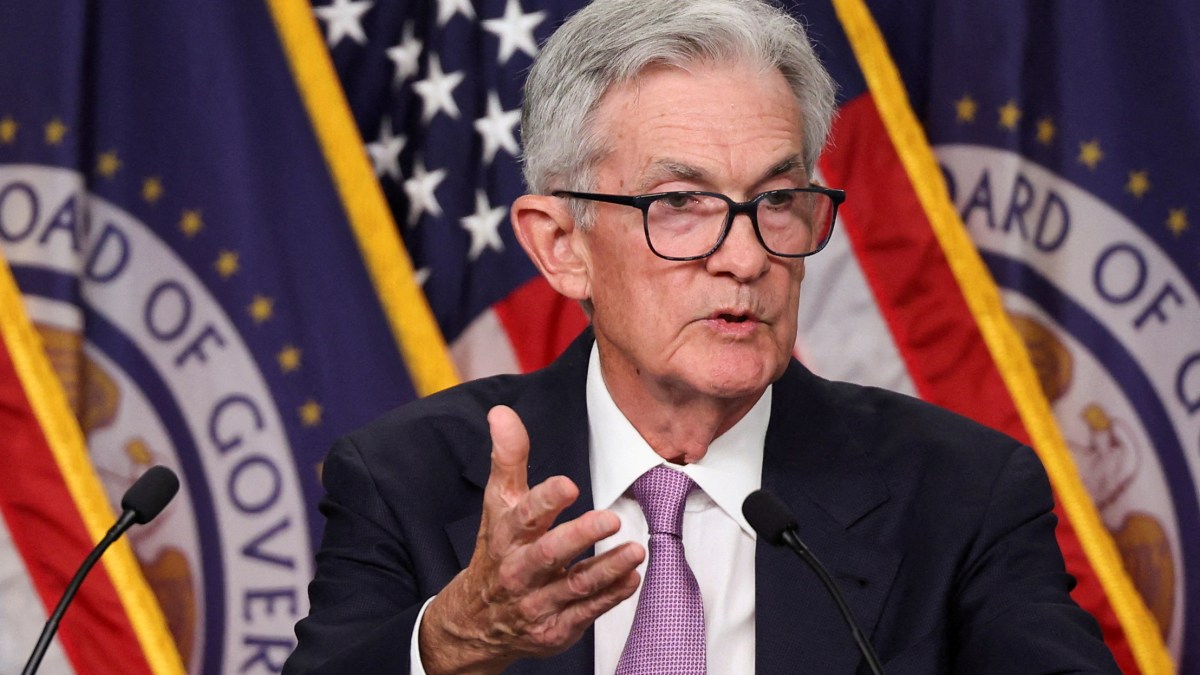
The head of the US Federal Reserve hinted at imminent interest rate cuts for the first time this year, sending global stock markets higher and boosting the pound against the dollar.
In a closely watched 40-minute speech, Jerome Powell, chairman of the Fed, said a slowing US jobs market “may warrant adjusting our policy stance” after interest rates have been kept on hold all year.
In his strongest comments yet on the possibility of lower interest rates, Powell warned that “downside risks to employment were rising. If those risks materialise, they can do so quickly in the form of sharply higher layoffs and rising unemployment.” He made his remarks at the Fed’s annual conference in Jackson Hole, Wyoming.
Traders bought US stocks and government bonds on Powell’s doveish signal, sending the S&P 500 index to an intra-day record high of 6,469 points, a jump of 1.5 per cent. The Dow Jones industrial average rose 846.24 points or 1.89 per cent, hitting a record close at 45,631.74.
The UK’s benchmark FTSE 100 closed up 12.20 points, or 0.1 per cent, at 9,321.40, and the FTSE 250, which more closely reflects the state of the domestic economy, rallied 259.39 points, or 1.2 per cent, at 22,077.23. European stocks on the Stock 600 gained 0.5 per cent.
The dollar fell against big currencies, helping the pound strengthen by 0.65 per cent to $1.35 against the US currency. The greenback slid by 0.77 per cent against a basket of larger trading currencies as lower interest rates weaken a currency.
Powell’s comments are his first since data showed the US jobs growth stagnated between May and July, while inflation from goods tariffs has yet to show up in latest official figures.
The Fed chairman, whose term expires next year, has come under sustained attack from President Trump, who has demanded immediate interest rate cuts to support the economy and labour market. Scott Bessent, US Treasury secretary, has said the Fed should cut interest rates by an outsized half a percentage point at its next meeting in September.
Powell said the Fed’s 12 rate-setters would make interest rates decisions “based solely on their assessment of the data and its implications for the economic outlook and the balance of risks. We will never deviate from that approach.”
US government bonds rallied, pushing down the government’s borrowing costs. The yield on two-year Treasury bonds fell by 0.1 percentage points and by 0.06 per cent on ten-year bonds. Yields fall when a bond’s price rises.
Traders are now betting on a more than 90 per cent chance that the Fed will cut the base rate by a quarter of a point to 4-4.25 per cent next month and then loosen policy again at the end of the year.
For most of this year, Powell has said the Fed was waiting to see if tariffs on international exports raise inflation. On Friday, he said “the effects of tariffs on consumer prices are now clearly visible” but the impact was likely to be “relatively short-lived”.
Stephen Brown, deputy chief North America economist at Capital Economics, said Powell’s remarks were “more doveish than markets were braced for”.
“Nevertheless, Powell’s lingering caution suggests that either a very positive August Employment Report or a much more concerning set of price data could still trigger a delay,” Brown said.
Christopher Waller and Michelle Bowman, who are both Fed rate-setters, supported an interest rate cut in August but were out-voted by the majority of the committee. At its next meeting, Trump ally Stephen Miran will be part of the voting committee for the first time. Miran has backed the president’s calls for immediate monetary loosening.
During Powell’s speech, the president doubled down on his calls for Fed rate-setter Lisa Cook to resign over allegations of mortgage fraud and threatened to remove her from the post. “I’ll fire her if she doesn’t resign. What she did was bad.”