
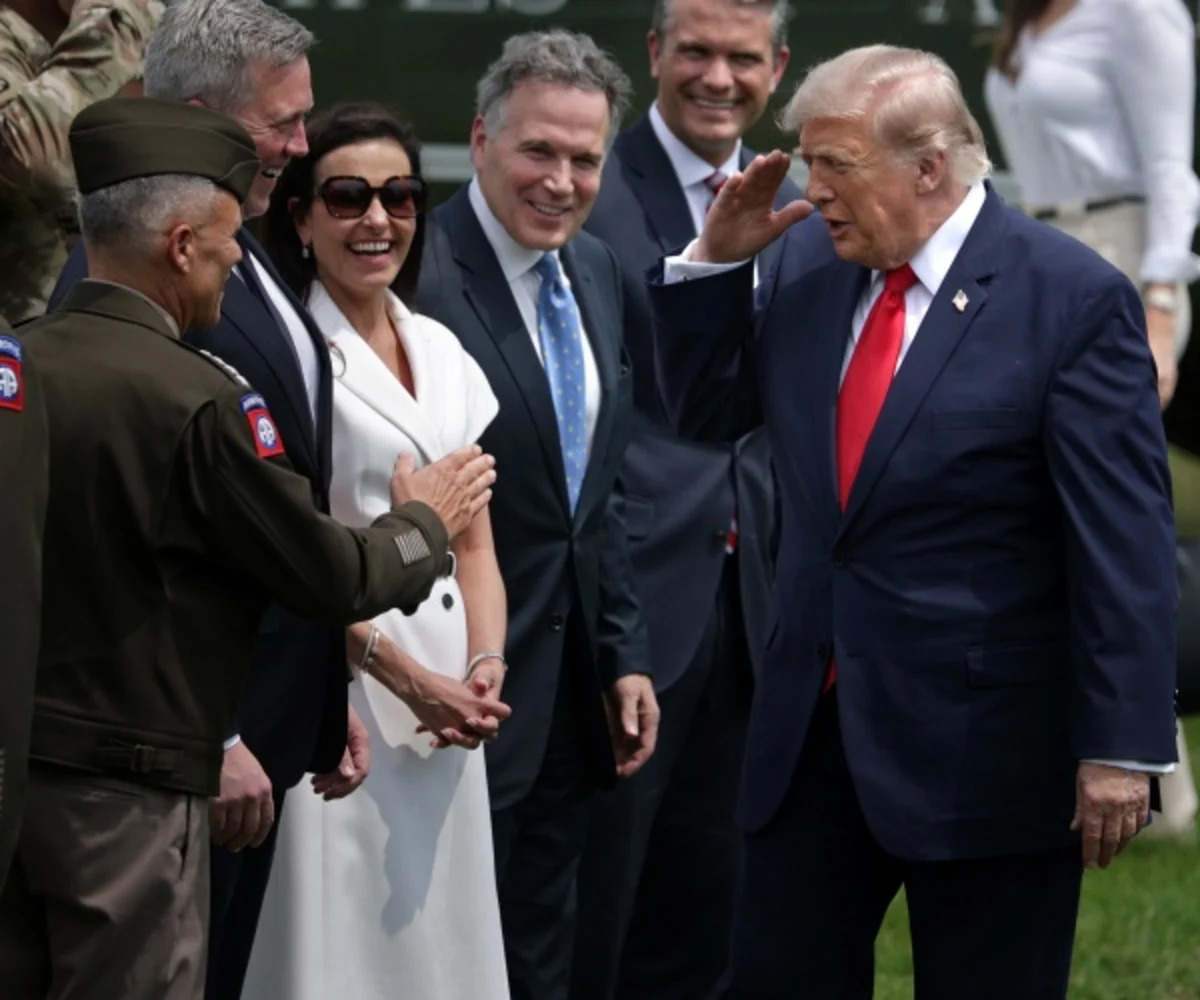

President Donald Trump on July 15, 2026 in Carlisle, Pennsylvania. (Photo by Alex Wong/Getty Images)
President Donald Trump could launch a major military strike against Iran before the Nov. 3 midterm elections, despite publicly promising to hold off, according to prominent University of Chicago political scientist Robert Pape.
Pape warns that the final days of October could become an extraordinarily dangerous period for the Middle East.
In a provocative new analysis on Substack, Pape argues that conventional political wisdom has the calculation backward: Rather than damaging Republicans at the polls, a dramatic military strike could energize Trump’s political base and boost turnout among otherwise disengaged MAGA voters.
“Everyone says a pre-election war is political suicide. The numbers say the opposite,” Pape wrote.
Trump appeared to rule out such an operation on Oct. 8, declaring that the United States “will not be attacking Iran at any time prior to the Midterm Elections.”
But Pape points to subsequent reports of military preparations, including a CBS report that the Pentagon has plans involving the Massive Ordnance Air Blast bomb, or MOAB, the largest conventional bomb in America’s arsenal.
Another aircraft carrier is reportedly expected in the region before month’s end.
When reports emerged that pre-election strikes were being discussed, Trump responded that “leakers should be shot.”
Pape contends that three widely accepted arguments against military action — higher gasoline prices, Trump’s public pledge, and the political costs of war — overlook the president’s electoral incentives.
He cites polling showing that 85% of independents already considered the Iran war a mistake in July, suggesting Trump has little additional support to lose among those voters.
Meanwhile, 77% of MAGA Republicans consider the war justified, although only 43% strongly approve of Trump’s handling of the conflict, a decline of 21 percentage points since spring.
“That is not a defection problem. It is an enthusiasm problem, and midterms are decided by enthusiasm,” Pape wrote.
A spectacular military operation, he argues, could motivate infrequent Trump voters who might otherwise skip the midterms.
“A strike before Nov. 3 is not Trump’s biggest political risk. It may be his best turnout tool,” Pape concluded.
Pape assigns a 70% probability to an American strike before Election Day, identifying Oct. 25 through Nov. 2 as the most dangerous period.
That window also includes Israel’s Oct. 27 election, creating potential political incentives for military action in both countries.
But Pape warns that Iran might move first if its leaders believe an American attack is imminent.
He identifies a possible Iranian strike against American aerial refueling tankers in the Persian Gulf as a particularly dangerous trigger.
Such an attack could force Washington to respond immediately to protect its ability to conduct air operations.
“He promised not to attack Iran. He never promised not to respond,” Pape observed.
Iranian leaders could also interpret reports of American B-2 bombers preparing for deployment as evidence of an approaching assault, potentially triggering a preemptive response.
“Every pre-election strike plan has a mirror image in Tehran,” Pape warned.
Pape, a University of Chicago professor and internationally recognized scholar of military strategy, coercion, and political violence, has extensively studied airpower, suicide terrorism, and the strategic calculations that lead nations into conflict.
Iran has shown signs of preparing for a possible new military confrontation with the United States and Israel in recent weeks, including reported ballistic missile tests, strengthened defenses around sensitive facilities, and warnings that renewed American strikes could trigger attacks on U.S. forces and Gulf Arab countries.
According to an assessment by the Critical Threats Project and the Institute for the Study of War released this week, Iranian sources reported extensive missile, drone, and air-defense testing around Oct. 11, including more than 30 launches involving medium-range ballistic missiles such as the Emad and Kheibar Sheikan.
Iranian officials have also reportedly warned that another American attack could provoke a broader regional conflict, potentially involving strikes against U.S. military personnel, American warships, and Saudi Arabian oil facilities.
Reuters reported that two senior Iranian officials acknowledged changes in Tehran’s tactics against commercial shipping in the Strait of Hormuz.
The officials said the changes had contributed to increased attacks on vessels and suggested Iran was seeking to maintain pressure on global oil markets ahead of the Nov. 3 U.S. midterm elections.
Meanwhile, The Wall Street Journal reported that Iran has been reinforcing security around sensitive nuclear and military installations, including Natanz and the underground Pickaxe Mountain complex.
The preparations reportedly include fortifications, civilian mobilization, and measures intended to keep critical infrastructure functioning during another conflict.
© 2026 Newsmax. All rights reserved.