
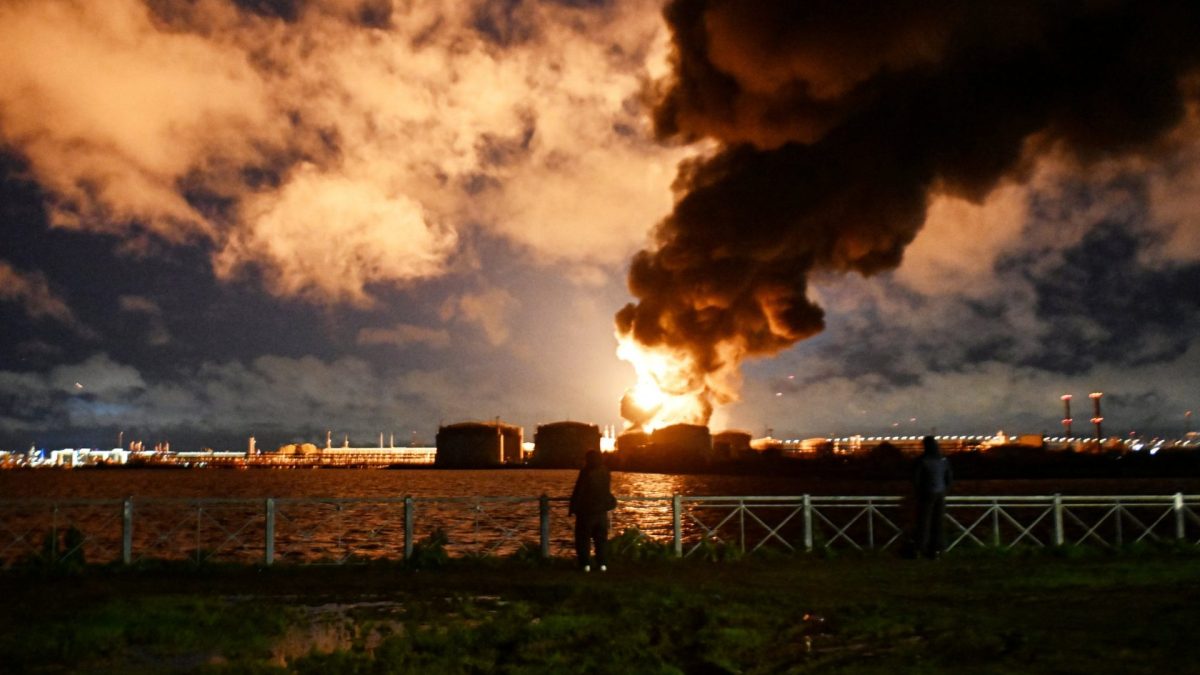
Ukraine has mounted one of its largest-ever drone attacks on St Petersburg, in what analysts said was a clear message to Vladimir Putin and Donald Trump that it will not back down.
Two oil facilities in Russia‘s second city went up in flames in the “massive” assault on Sunday, as well as a logistics centre belonging to a major online retailer, Ozon, and a social media data centre.
The overnight onslaught followed concerns in Ukraine that Trump was removing internet and intelligence access vital to its war effort.
On Thursday, Ukraine’s military encountered sudden, temporary speed limits on Starshield, the military-grade version of SpaceX’s Starlink satellite service, which it uses for its drone missions and air defences.
President Volodymyr Zelensky said on Saturday that Kyiv was investigating the unexpected restrictions, which forced Ukrainian drones to fly slower than usual, making it easier for Russian weapons to target or evade them.
SpaceX founder Elon Musk said decisions about Starshield’s use rested with the US government, while Trump and the White House said they did not order the restrictions.
Sunday’s drone attack by Ukraine hit the St Petersburg oil terminal and the Ruchi oil depot in yet another blow to the Kremlin as it fights to maintain Russian citizens’ support for the war.
It comes after Trump declared an “energy ceasefire” last week, apparently surprising both Zelensky and Putin. Since then, Zelensky said on Saturday, Russia had struck energy targets 76 times.
Ukraine’s President added that it had resumed strikes on energy facilities three days after Trump’s announcement, citing the Russian failure to comply with the ceasefire.
The decision to recommence strikes infuriated Trump, who was keen to see through a deal with the Kremlin to secure Russian diesel imports and try to alleviate soaring fuel costs in the US.
Observers suggested the restrictions on Starshield could have been linked to Trump’s anger, also indicated by the brief suspension of intelligence sharing from the US side earlier this week. On Sunday, the Ukrainian leader confirmed this exchange had resumed.
St Petersburg’s governor Alexander Beglov claimed 12 apartment buildings were hit in strikes on the city, with one person dead and five injured. Pulkovo Airport, one of the busiest in the country, was temporarily shut “for safety reasons”.
Alexander Drozdenko, governor of the wider Leningrad region, claimed 145 Ukrainian drones were shot down overnight, and said the attack left 20,000 people without electricity.
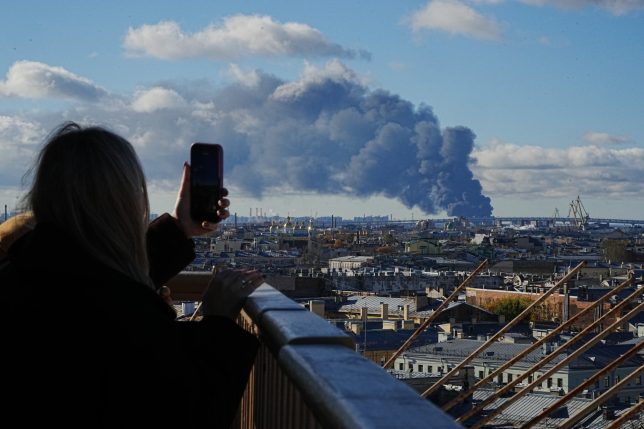 A Ukrainian drone strike on an industrial zone in St Petersburg on Sunday (Photo: UGC via AP)
‘Attacks have been getting bigger and deeper’
“St Petersburg is the third largest refinery in Russia. It’s extremely significant. It’s extremely visible because, of course, we’re in one of Russia’s best known cities,” Scott Lucas, professor of international politics at University College Dublin, told The i Paper.
Lucas said the operation was part of a Ukrainian decision to give “a very visible sign that Ukraine’s not giving up. It’s not conceding”.
Keir Giles, associate fellow of the Russia and Eurasia programme at Chatham House, said the St Petersburg attack was not a one-off special mission but part of a larger strategy. “We need to look at this as part of the longer-term trend,” he said. “Attacks have been getting bigger.”
“They have been getting deeper. And of course, there’s an advantage to mass attacks because they saturate defenses in Russia in exactly the same way as they do in Ukraine.”
Experts suggested the attack reflected Zelensky’s decision that Ukraine can no longer rely on US support.
“After a three-day pause earlier this week that followed the Trump announcement of purchase of diesel fuel from Russia, and then the apparent cut-off of early warning intelligence for attacks, Zelensky just realised that Trump had crossed a line and he might not be able to bring him back, even with flattery,” Lucas said.
The renewed Ukrainian campaign “shows that when they are assessing the relative risks of punitive measures by the United States and suspending their campaign against Russia, they’ve decided that the least worst option is to push ahead and disregard American attempts to prevent them from defending”.
In fact, Giles added, the choice of targets in St Petersburg shows Ukraine was determined to exhibit its strength and respond in kind to Russia: “This would give Russian military leaders “something to think about… Attacks on major bridges, for instance, that keep cities joined together is exactly what Russia attempted when targeting the bridges in Kyiv.”
‘Kremlin is celebrating’
If Ukraine has decided it can no longer rely on US support this would significantly change the dynamic of the war.
Giles said Ukraine had realised that “whatever they do, Trump and those around him are going to decide at some point to curtail support to Ukraine. So in a way, there’s less to lose than at a time when that might have been open to question.”
According to Lucas, the risk to the relationship has been driven by the Trump side, who in effect asked Zelensky “to give up your leverage, give up your counterattacks”.
He added: “You either have to concede to him and allow the Russians to keep hitting you with the air strikes, or you have to stand up to Trump and say, ‘No, that’s just not the way we’re going to do this.’”
He suggested the rift “could go as far as the cut-off of intelligence sharing… or Starlink”, which the US had already briefly paused earlier this week, leaving Ukraine with “no good option”.
At the Kremlin, officials would be “absolutely celebrating the fact that they have successfully manipulated Trump and his envoys”, Lucas said, adding that while the attacks on St Petersburg were a temporary blow, Moscow had secured a “huge victory with that purchase of diesel last week and then the follow-up signs with the cut-off [of] intelligence. They’ll want to try to press that advantage with the Americans.”