
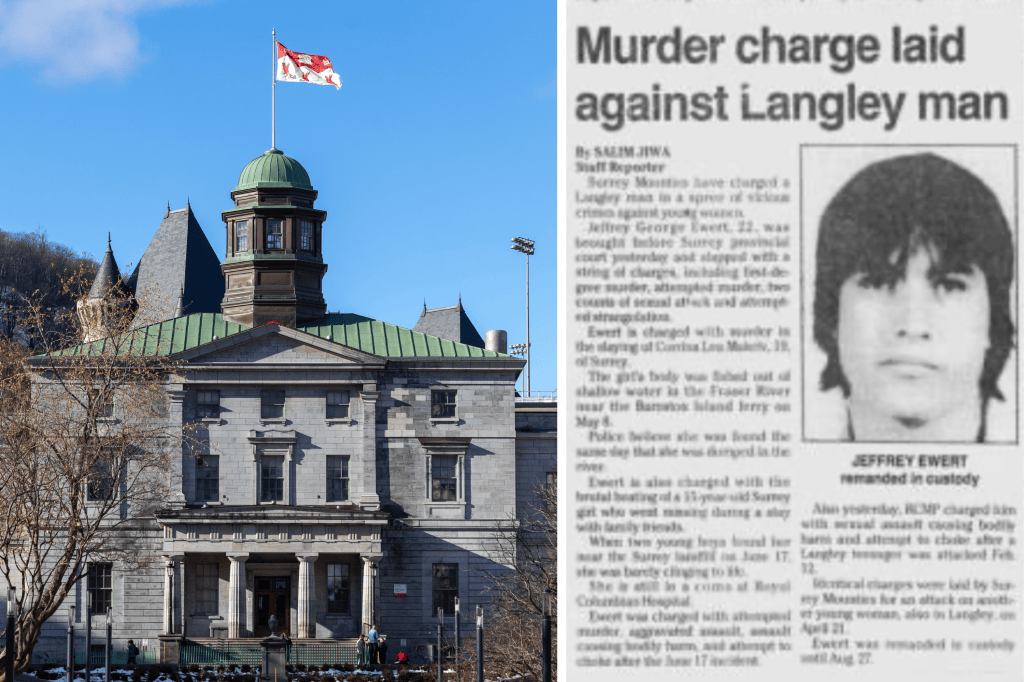
The Parole Board of Canada knew convicted murderer Jeffrey George Ewert had plans to attend a university and it made a decision this past spring to continue his day parole despite how he previously breached his release conditions, concerning his contacts with women, multiple times.
According to a report by CBC, Ewert has been taking law courses at McGill University as recently as earlier this month. The report, published online on Friday, quotes unnamed students upset “that the university did not disclose their peer’s violent history.”
In a message sent to students on Friday, McGill University provost Angela Campbell wrote: “The matter is being carefully reviewed by the appropriate authorities at the university.”
Ewert is serving two life sentences following his convictions for second-degree murder and attempted murder.
Initially, in 1986, he was convicted of first-degree murder, but Ewert appealed, had a second trial and was convicted of second-degree murder in 1996.
In a decision made on June 1, the Parole Board of Canada agreed to continue Ewert’s day parole, which began last year, despite how he had breached his release conditions multiple times since 2025 and how he was still assessed by a professional, based on a psychopathy scale, as a “moderate to high” risk of violent sexual recidivism. The risk is considered to be moderate in “a context of supervision (incarceration, halfway house) and clinical followup adapted to your situation,” the board wrote in the decision.
The parole board also knew Ewert, now in his mid-60s, planned to attend a university this fall “conditional on completing a course beforehand. You are currently gathering information (redacted) to be eligible for loans and scholarships and possibly housing.
“However, you have not taken any formal steps to date.”
In the murder case, in May 1984 Ewert met a woman at a nightclub and offered her a ride as she was hitchhiking. After they left the club, he strangled the woman inside his vehicle until she lost consciousness, and he sexually assaulted her. Her body was later recovered from a river.
Weeks after the murder, Ewert assaulted a 15-year-old girl who rejected his advances. He left her in a ditch, believing she was dead. The girl was found severely injured, having suffered extensive brain damage.
According to the written summary of Ewert’s most recent parole decision: “She continues to require intensive medical care and has never been able to live independently.”
 (Vancouver Province, Oct. 15, 1992)
Ewert’s crimes were committed in British Columbia, but he has spent his most recent years incarcerated in Quebec. In 2019, he was incarcerated at a federal penitentiary in Ste-Anne-des-Plaines, 40 kilometres north of Montreal, when he took Canada’s attorney general to court over a transfer from one minimum-security facility to another.
In February 2025, the parole board granted Ewert day parole for the first time. The release was continued later last year. On June 1 of this year, that decision was repeated.
“You were (first) released in March 2025. According to your caseworkers, you quickly began to show difficulty understanding the expectations and legal obligations. Despite multiple warnings, guidance and interventions, in May 2025, you breached your special condition requiring you to disclose any relationships with women, including any attempts,” the parole board wrote in its decision made on June 1.
“You had contacted and had collected the phone numbers of multiple women. Your attitude and behaviour toward your clinical counsellor at the CRF (community residential facility) also led to the withdrawal of their support. Your day parole was suspended.
“In August 2025, the board cancelled your suspension and imposed two additional special conditions, regarding telecommunication devices and to follow a community access program that provides additional structure and supervision. You were released to (a halfway house) to continue your day parole.”
The written summary notes how Ewert breached his conditions again, during October 2025, by failing to “disclose your relationships with women.” He had texted a young woman three times and did not inform his case management team (CMT).
“Although you had not immediately informed your CMT, it was agreed to maintain your release because you still showed transparency. You had also disclosed your offences and release status to the woman,” the author of the summary wrote.
Editor’s Picks
In December 2025, the board decided to continue Ewert’s day parole for another period of six months, and imposed “special conditions related to your relationships with women. “
He was also required to see “a mental health professional and follow a treatment plan/program addressing the sexual sphere (of his crimes).”
“You are now on a regular day parole since the beginning of March 2026. Since then, you continue to volunteer on a voluntary basis, to carry out your legal work with lawyers and to attend Indigenous activities. However, your CMT is of the opinion that you seem to be reverting to your old patterns, and you breached a special condition,” the parole board wrote just four months ago.
Ewert, who identifies as Cree through his mother, breached his conditions by registering on a dating website.
Initially, Ewert denied using the website and claimed his bank card had been hacked to access it, but he later changed his story.
“You were making comments, sharing your email and phone number and exploring the photos associated with profiles. You reported being frequently contacted by female profiles that ultimately turned out to be fake accounts or scammers,” the parole board wrote. “You stated that you were engaged in such exchanges out of boredom. You insisted that you were not thinking about it too much or fuelling any sexual desire.”
According to the CBC’s report, Ewert has not been seen on McGill’s campus since Oct. 6.