

Listen to this article
Estimated 3 minutes
The audio version of this article is generated by AI-based technology. Mispronunciations can occur. We are working with our partners to continually review and improve the results.
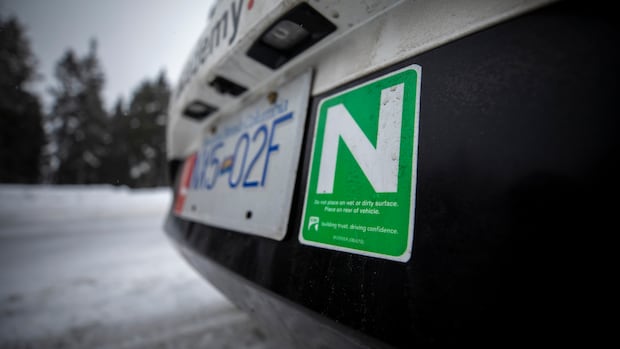
Novice or “N” drivers will no longer need to take a second road test to obtain their full licence in B.C., as of Monday.
Previously, the Graduated Licensing Program (GLP) functioned as a three-stage system, starting with a learner’s permit at age 16, followed by a road test to acquire a novice licence after one year as a learner.
Finally, drivers would take a second road test to become fully licensed.
Now, drivers who have maintained a clean driving record with their novice licence for a period of between 12 and 24 months, depending on age and previous driver training, can be upgraded to a Class 5 licence with a 12-month restricted period.
But critics have argued that clean driving records don’t demonstrate safe driving.
Kate Harris, CEO of DriveWise B.C., said the second road test was an important check on novice drivers, noting roughly one third didn’t pass it on their first attempt.
Without that test, Harris said she worries new drivers may be involved in more accidents on the road, posing a risk to themselves and others.
She said Monday is “essentially the day that the experiment begins.”
ICBC claims centre is pictured in Vancouver, British Columbia on Tuesday, February 2, 2021. (Ben Nelms/CBC)
Announcing the change in July, the province said it didn’t expect road safety to be impacted.
“Evidence shows that driving experience gained over time predicts long-term safety as reliably as a single road test,” Public Safety Minister Nina Krieger said in a news release then.
The release said Transport Canada collision statistics show that three of the four Canadian provinces with the lowest vehicle fatality rates don’t have an exit test.
The province has said removing the second road test will improve licensing access in First Nations and rural or remote communities where residents face challenges booking appointments at local ICBC branches.
Mihai Cirstea, with road safety advocacy group Vision Zero Vancouver, said the main focus should be on safety, though.
He said their group sees the province’s decision as “pretty irresponsible” and that more driver training is needed, not less.
“They have to actually show us that this is not going to lead to more deaths and injuries on our roads,” said Cirstea.
He questioned whether a clean driving record for any amount of time demonstrates an individual’s driving tendencies.
In order to monitor the effectiveness of the new system, Cirstea said the province needs to monitor collision rates among newly licensed drivers.
WATCH | Early plans to remove 2nd road test:
B.C. may drop 2nd test from graduated driver’s licence program
The province said in its July release that the new 12-month restricted period will “help flag and correct mistakes made by new drivers.”
After changes take effect Monday, anyone under age 25 will need at least 24 months of safe driving as a novice, or 18 months if they’ve completed an approved GLP course, to be eligible for an upgrade to a Class 5 licence.
The changes also apply to motorcycle riders upgrading to a combined Class 5 and 6 licence.
Anyone 25 or older will need to record 12 months of safe driving as a novice to be upgraded.
Safe driving includes having no convictions for excessive speeding or use of electronic devices, and no prohibitions or suspensions, according to ICBC.
Once they receive their Class 5 licence, drivers will then be under a 12-month restricted period requiring zero blood-alcohol and drug content while driving.