


Listen to this article
Estimated 5 minutes
The audio version of this article is generated by AI-based technology. Mispronunciations can occur. We are working with our partners to continually review and improve the results.
A fourth person has been arrested at a protest against the removal of bike lanes in Etobicoke, Toronto police say.
The person was arrested in the area of Bloor Street W. and Islington Avenue shortly after 1:15 p.m. Monday, police said in a post on the social media platform X. The post said the arrest was related to mischief and obstructing police, but there is no word yet on charges.
The arrest comes as dozens of people continue to protest daily against the Ontario government’s work to rip out bike lanes on a 1.2-kilometre section of Bloor Street W. Work is proceeding under police protection.
Three other people, all in their 20s, were arrested last week. The first and third have been charged with obstructing police and mischief, while the second has been charged with mischief and theft under $5,000.
Protest all about safety, advocate says
Michael Longfield, executive director of Cycle Toronto, a member-supported charity, said Monday that removing the bike lanes will put cyclists at risk and will make streets less safe for all road users.
Longfield said the removal will not ease traffic congestion, a fact backed by experts of the Ontario government.
“People are angry that the province is wasting all this money,” Longfield said Monday. “And I think, frankly, people are afraid that their lives are going to be put at risk without these bike lanes here.”
The city pegged the cost to remove all targeted bike lanes on Bloor Street, Yonge Street and University Avenue at $48 million, a figure disputed by the province, which has yet to provide its own.
Longfield said people are also angry that the province will not reconsider the plan and opt for Toronto Mayor Olivia Chow’s proposal to add traffic lanes while protecting lanes for cyclists.
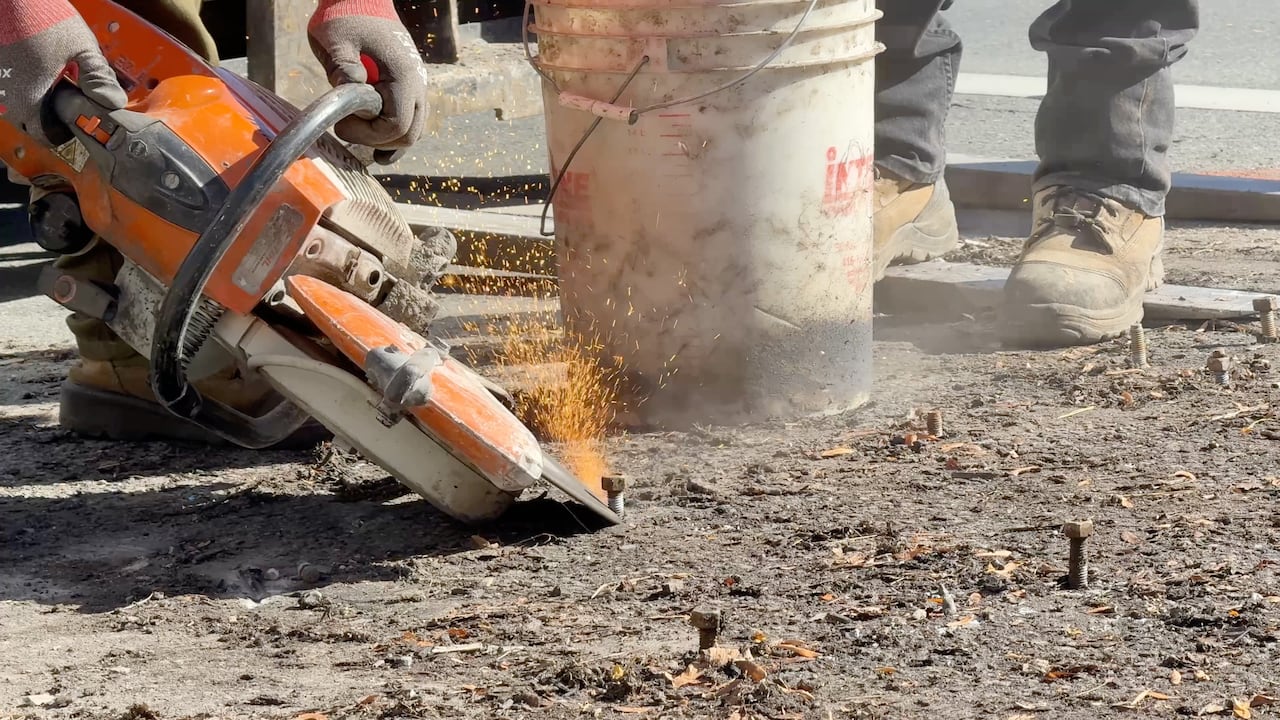
Last Tuesday, hundreds of cyclists surrounded construction trucks near the intersection of Bloor and Islington, not allowing them to move, and the protesters stopped the planned start of the work. Trucks were escorted from the street. The work, however, began last Wednesday. (Grant Linton/CBC)
Longfield added the protests have been peaceful and respectful of police and construction workers.
Last Tuesday, hundreds of cyclists surrounded construction trucks near the intersection of Bloor and Islington, not allowing them to move and temporarily delaying the work. Trucks were escorted from the street, but the work began last Wednesday.
Sculpture set up to honour lives lost to road violence
On Monday, a sculpture of bicycles, attached to a utility pole, was set up at the parking lot of Tom Riley Park at Bloor Street. The Bike Lane Memorial Sculpture, built by community members, honours lives lost on Bloor Street, Yonge Street and University Avenue.
The sculpture is a pyramid of bicycles that have been painted red.
Between 2000 and 2020, a total of 32 people died on Bloor, Yonge and University, according to Cycle Toronto. They included parents, children, teachers and friends. The deaths included 21 pedestrians, four people cycling, three people on motorcycles and four people driving. Three were school-aged children.
Longfield said the sculpture is “an echo” of the ghost bike program in which white bikes are set up when a cyclist is killed on the road.
“It’s quite a moving memorial to the memory of the people who have been killed on these roads before the bike lanes were put in. I think it shows that there are a lot of people and a lot of voices that are opposed to what it is that the province is trying to do here,” he said.
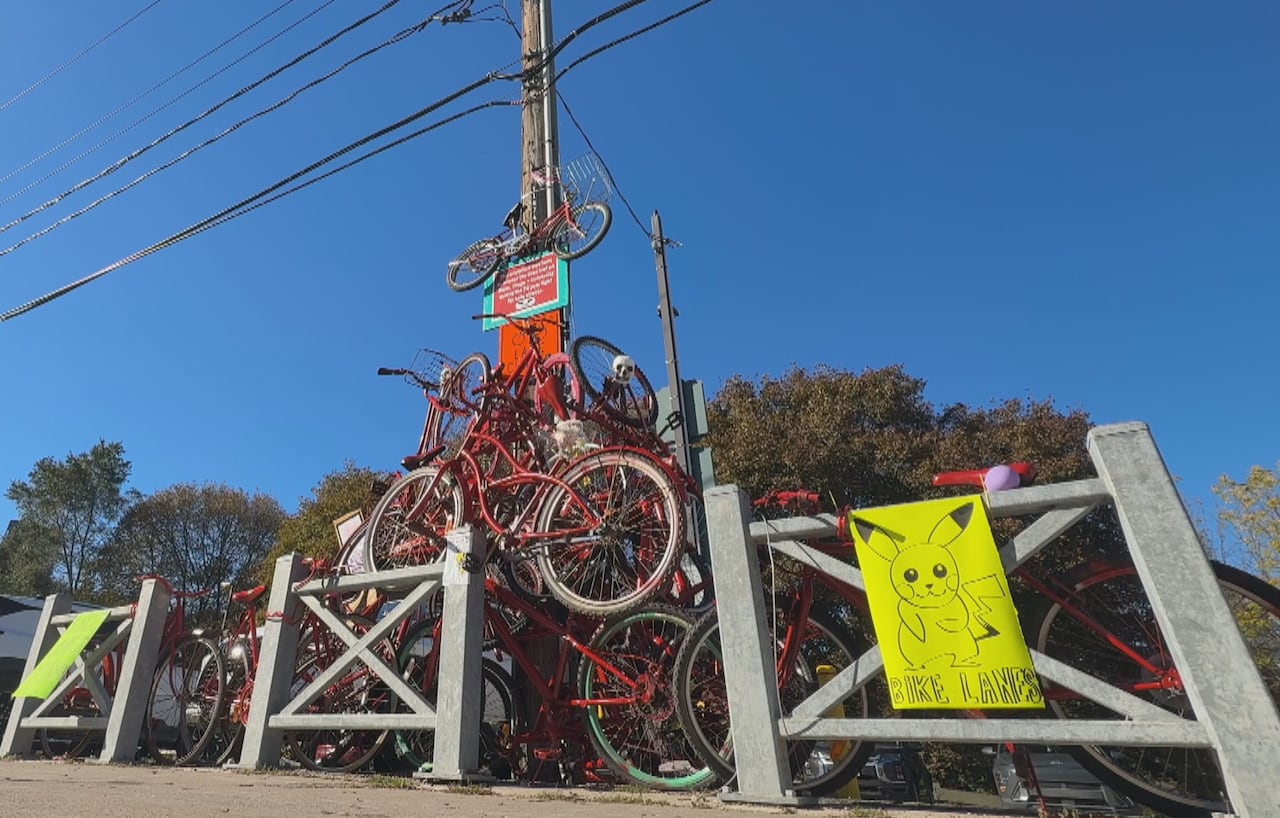
On Monday, a sculpture of bicycles, attached to a utility pole, was set up at the parking lot of Tom Riley Park at Bloor Street. The Bike Lane Memorial Sculpture, built by community members, honours lives lost on Bloor Street, Yonge Street and University Avenue. (Grant Linton/CBC)
Ontario Transportation Minister Prabmeet Sarkaria has said the protesters will not change the province’s plans.
“Make no mistake: these bike lanes are coming out,” Sarkaria wrote on X last week. “We have a clear mandate and we will deliver.”
Cycle Toronto is also trying to stop the province from removing bike lanes by seeking leave to appeal to the Supreme Court of Canada.
The move is the latest a long legal battle over a 2024 law allowing the province to take out the bike lanes. The move was framed by the province as a way to reduce congestion.
A lower court initially ruled the province’s plan to replace 19 kilometres of bike lanes with car lanes on three major roads was an unconstitutional risk to cyclist safety. That decision was overturned by the Ontario Court of Appeal in an August ruling that said the judge in the first trial had overstepped into policy-making and political considerations.
Longfield said the Supreme Court case will make no difference to the immediate removals on Bloor but it could have ramifications for the additional 19 kilometres of the city’s protected bike lane network that the province has targeted.