
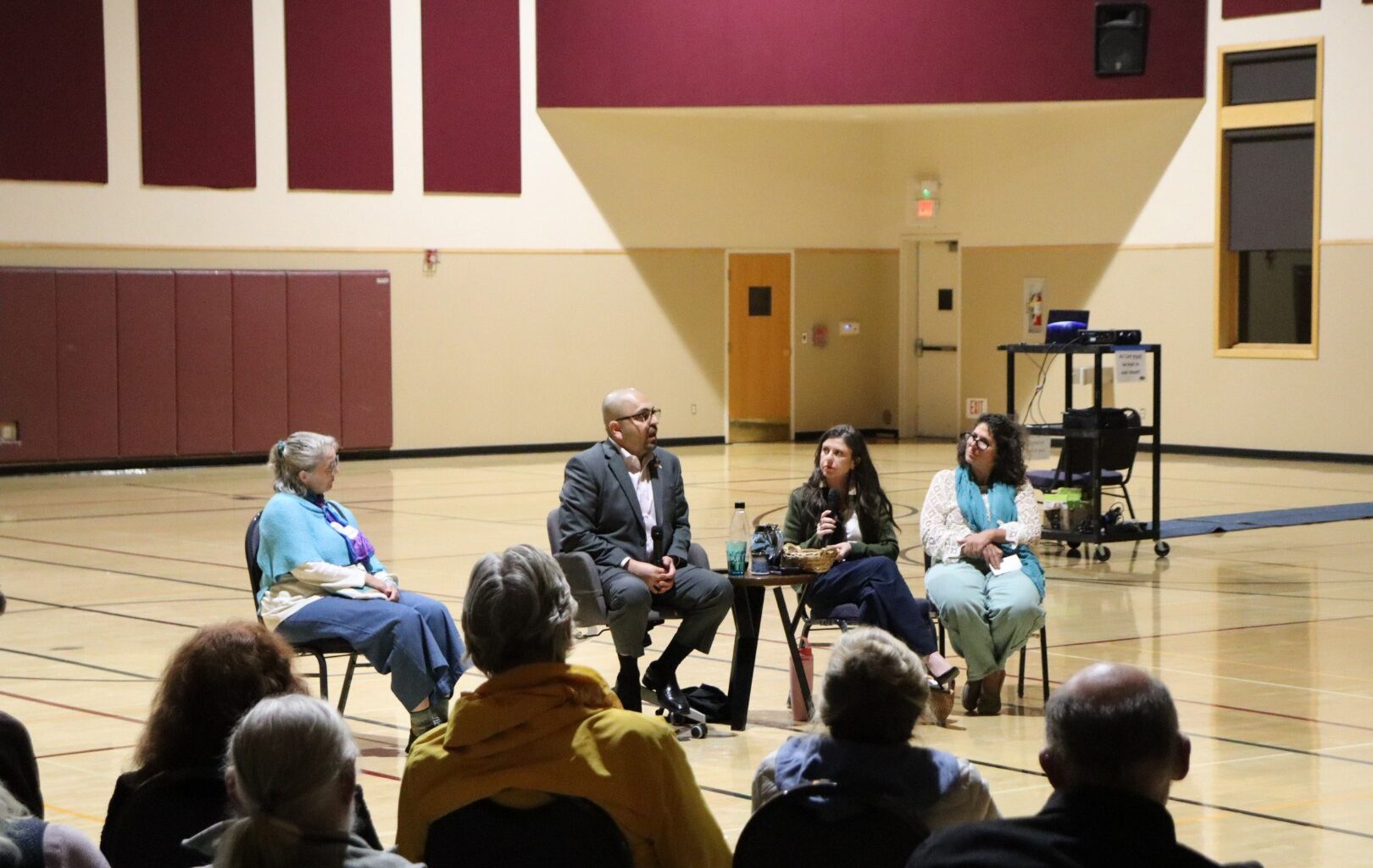
Almost 200 people filled the Arcata Community Center on Monday night for a community forum featuring a Gazan‑American advocate who asked Humboldt County residents to move past the usual absolutes that dominate conversations about the Israel-Palestinian conflict and instead try what he described as a “third space” grounded in empathy and peacebuilding.
Ahmed Fouad Alkhatib, founder of the Realign for Palestine project at the Atlantic Council, spoke to a packed audience at the Arcata Community Center during an event, “An Evening with Ahmed Fouad Alkhatib: Rebuilding Gaza and Israel: A Path Forward Through Shared Humanity,” hosted by Shalom Humboldt.
“Shalom Humboldt brought Ahmed Fouad Alkhatib to speak tonight because of his third narrative that operates outside entrenched positions of pro-Palestine and pro-Israel,” said Susan Parsons. “This third narrative speaks out uncompromisingly against Hamas and Israeli crimes in Gaza, military occupation and the settlement enterprise in the West Bank, and the dehumanization of Palestinians.”
Parsons opened the evening by acknowledging the strain Humboldt County has felt since Hamas’ Oct. 7, 2023 attack on Israel.
“Our local progressive community has struggled to maintain nuance,” said Parsons, adding that bringing a Palestinian humanitarian who models empathy for both peoples was essential to “restoring compassion, human rights, democracy, pluralism, and justice to our local conversation.”
Before Alkhatib took the stage, Tamar Krigel, an Israeli activist with Women Wage Peace, described meeting him in 2024 and recognizing “a brother” in his work to build a political future beyond fear.
“We refuse to accept the future and the reality in which our children grow up to kill or be killed,” said Krigel. “We know how much suffering has been and how much devastation must be overcome, and we know that we must build trust, relationships, and the possibility of living together in peace and security in this region. And this is where each and every one of you comes in.”
Alkhatib began the event by stressing he does not speak “on behalf of the Palestinian people.”
“I have never once claimed to speak on behalf of the Palestinian people or on behalf of the people of Gaza, and I encourage you all to actually be skeptical of anybody who ever proclaims to speak on behalf of the Palestinian people. Our folks are deeply divided geographically, politically, and otherwise; people in Gaza are very different than people in the West Bank in a variety of ways. Very different than folks here in the diaspora communities, in the Arab world, in Europe, etc.” said Alkhatib. “I want to just briefly acknowledge, and this is kind of a thing about going to a variety of communities to speak, is that I understand across the country, indeed across the world, this has been a difficult issue and challenging, and it’s torn families and friendships apart and communities apart.”
He recalled growing up in Gaza, surviving an Israeli airstrike that killed two of his friends at age 11; leaving Gaza as a teenage exchange student in 2005; and enduring a long separation from his family that began after Hamas seized control of Gaza in 2007, which led to him becoming a U.S. citizen in 2014. Alkhatib shared that 34 members of his extended family were killed in Israeli airstrikes during the recent conflict in Gaza.
“This is deeply personal,” said Alkhatib. “This is not something we can afford to be playing roulette with anymore.”
Throughout the night, Alkhatib criticized both Hamas and what he called the “pro‑Palestine industrial complex,” a term he used for activists, academics and online personalities who he said, “make a point, not a difference.” He argued that some U.S. and European activists ignore or silence anti‑Hamas Palestinians, including Gazans who protested against the group during the war.
“There’s being pro-Palestine, and then there’s being quote pro-Palestine, and I call them the quote community. And the pro-Palestine industrial complex is a network,” said Alkhatib. “To give like a definition, if you will, it is a network of activists, protesters, journalists, academics, increasingly politicians, online personalities, some Hollywood characters and personas, who are part of this apparatus that thinks they’re advocating for the Palestinian people, but are ultimately involved in performative acts of supposed solidarity; they are making a point, not making a difference. They speak over the Palestinian people.”
He also condemned Israeli settler violence in the West Bank and warned that extremist factions within Israel’s political system pose long‑term risks to both peoples.
“This is not some isolated incident,” he said of recent attacks on Palestinian farmers. “It is part of a trajectory… a devolution of the rule of law.”
Most attendees sat quietly and listened to the speaker; audience members wrote questions for Alkhatib on cards and the host read several questions aloud during the question-and-answer portion of the evening.
When asked whether Israel’s actions in Gaza constitute genocide, Alkhatib said he could not make a legal determination.
“I’m not a legal scholar,” he said, adding that the International Criminal Court’s prosecutor has stated there is “insufficient evidence for the charge of genocide.”
He argued that the genocide debate has become “a distraction” that shuts down conversation.
During the event, there were a few tense moments while attendees questioned Alkhatib. Near the end of the program, a woman and a younger man questioned the speaker’s claims. Their questions sharpened the exchange, and the speaker’s tone grew more dismissive and animated as he addressed them directly.
At one point, a woman’s voice breaks through the crowd as she directs a question at Alkhatib, saying she felt he was “leaving out context that matters” and presenting information “in a way that doesn’t match what people here have actually lived through.” Her comments sharpened the exchange, and Alkhatib responded that she was “misunderstanding the point,” prompting her to push back and ask him to address “the real‑world impact” of his claims.
“Do you think I sit there at home and obsess over the definition when my family are dead?” said Alkhatib. “Genocide as a definition is irrelevant — the results are there.”
Only a few attendees voiced disagreement, but the back‑and‑forth marked the clearest moment of tension in the room and prompted security to move toward the center. The moment grew heated as Alkhatib became visibly ruffled by the speaker, who said he saw her whispering and texting while he spoke; the two then continued to address each other during the next series of questions until Alkhatib said, “Do I need to have you removed?” The attendee then got up without saying a word and headed toward the exit.
A younger man sitting in the bleachers joined in, saying the presentation “glossed over key facts” and didn’t acknowledge how certain policies affect people on the ground. “You’re presenting this like it’s settled,” he said. “It’s not settled. People are living through this right now.” Alkhatib replied that the man was “arguing from emotion rather than evidence,” and the man countered that “dismissing people’s lived experience as emotion is part of the problem.”
“Do you think I care that it’s a genocide or war crimes when my family are dead, and when both of my childhood homes have been destroyed, and when tens of thousands of Palestinians in Gaza are dead? Do you think I sit there at home and I obsess over the definition?” said Alkhatib. “Genocide as a definition is irrelevant; the results are there.”
The exchange lasted a few minutes before the moderator stepped in and moved the program toward closing remarks. Alkhatib urged attendees to adopt what he called “radical pragmatism,” a framework that rejects ideological purity in favor of achievable steps toward peace.
“Make a difference, not a point,” said Alkhatib. “Ask yourself: Is this action actually going to help improve Palestinian lives? Is it going to win over new allies?”
He emphasized that Israelis and Palestinians “are not going anywhere,” and that any future must recognize the legitimacy and fears of both communities.
Maranda Vargas can be reached at 707-441-0504