
 MILWAUKEE —
Watch the full debate in the video player above.
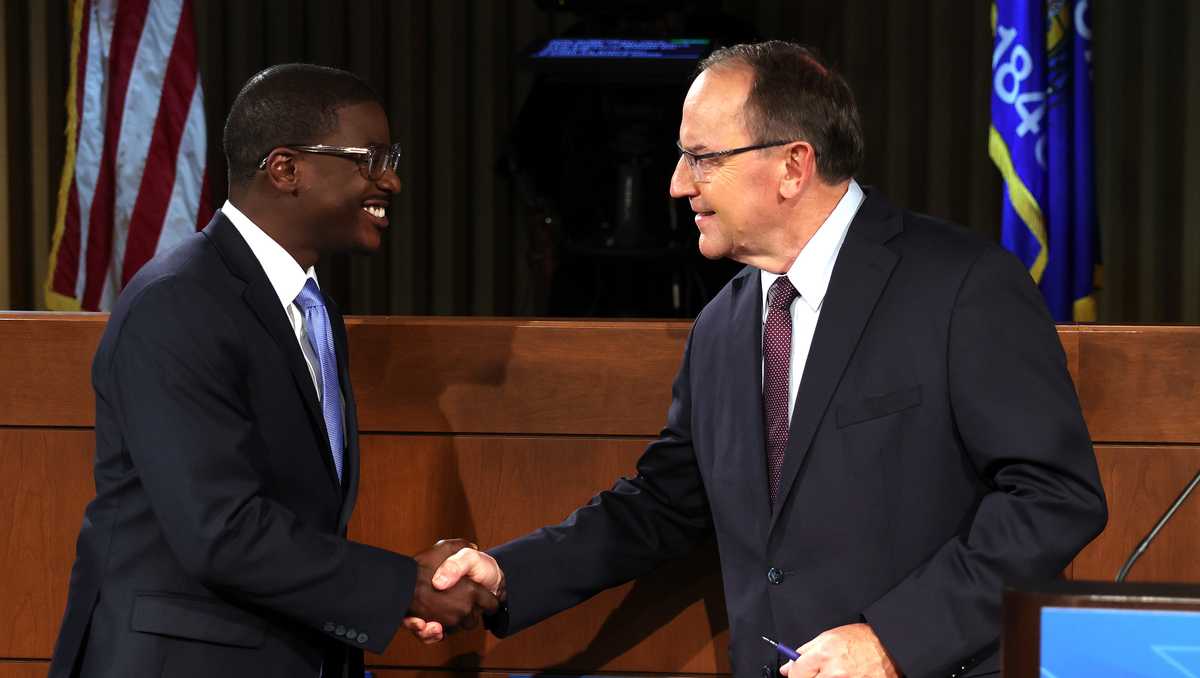
WISN 12 News hosted on Wednesday the only debate between Democratic candidate David Crowley and Republican candidate Tom Tiffany in the race to become Wisconsin’s next governor.
>> 2026 Wisconsin Voter Guide <<
WISN 12 News Political Director Matt Smith and “UPFRONT” co-host Gerron Jordan moderated the debate, which covered the cost of living, taxes, education, data centers, immigration enforcement, election security, abortion and marijuana legalization.
Watch opening statements below as candidates describe why they should be trusted.
Cost of living and taxes
Both candidates said affordability is a central concern, but they offered different approaches.
Tiffany proposed cutting income taxes for middle-income households, eliminating taxes on tips and overtime, and ending what he called a 400-year property tax increase.
“We’re going to put more money into people’s pockets,” Tiffany said.
Crowley called for a fairer tax system, saying, “We need to make sure that everybody in the state of Wisconsin can get access to groceries, can afford a roof over their head.”
He argued that Tiffany’s support for federal tax cuts benefits wealthy people while putting health care and other services at risk.
State budget surplus
Tiffany said the state should return the nearly $3 billion budget surplus to taxpayers through long-term tax relief.
“We should return all of that to the taxpayers,” Tiffany said.
He did not specify how much individual taxpayers would receive.
Crowley supported a bipartisan tax-relief proposal negotiated by Gov. Tony Evers and Republican legislative leaders.
“We need to be utilizing this surplus to provide relief, to make it more affordable for families across the state of Wisconsin,” Crowley said.
He said the money could help lower property taxes and support public schools, child care and health care.
Education and school vouchers
Tiffany said he would increase state funding for schools while requiring higher standards and greater accountability. He supported giving parents more school choice and said he would consider raising income limits for the state’s voucher program.
“I just think people should have whatever choice that they make,” Tiffany said.
Crowley opposed expanding the voucher program and said he would not support abruptly ending Milwaukee’s program.
“We cannot expand the voucher program in the state of Wisconsin,” Crowley said.
He called for more public school funding and said voucher schools should meet accountability and transparency standards comparable to public schools.
Transportation
Tiffany opposed new transportation user fees, tolls and indexing the gas tax to inflation. He said the state should fund road and transportation projects through the budget.
Crowley said he was open to new user fees and tolling but opposed indexing the gas tax. He argued that Tiffany’s proposed tax cuts would leave less money available for transportation and other public services.
Data centers
Crowley said communities should have a say in whether data centers are built and called for protections for farmland, waterways and the environment.
“If they don’t want a data center, they shouldn’t be forced to have a data center,” Crowley said.
Crowley also supported a pause on construction while an environmental review is underway and said he would support ending sales tax incentives for data center companies.
Tiffany said data centers should not raise utility rates or receive taxpayer subsidies.
“No subsidies for these data centers,” he said, while also calling for local control, transparency and keeping them off farmland.
The candidates disputed each other’s records and positions on incentives and development.
Election security
Tiffany said he objected to private funding for election administration, referring to donations from Facebook founder Mark Zuckerberg as his reason for joining efforts to overturn the 2020 election, and cited concerns about how absentee voting rules were applied. Crowley criticized Tiffany’s efforts to challenge the 2020 election results.
Both candidates said they would certify the results of the 2028 election regardless of who wins.
“I will certify the election in 2028, regardless of who the winner is,” Tiffany said. Crowley answered, “Absolutely.”
Abortion
Tiffany said he would uphold Wisconsin’s current abortion law, which bans abortion after 20 weeks. He said he would not sign a six-week abortion ban.
Crowley called for a constitutional amendment protecting abortion rights and said decisions should be made by patients and health care providers. He did not give a direct yes-or-no answer when asked whether he would sign legislation allowing abortion without gestational limits.
Immigration enforcement
Tiffany said he would require local, county and state law enforcement agencies to honor federal immigration detainers for people accused of crimes.
Crowley opposed contracts between local agencies and U.S. Immigration and Customs Enforcement and called for agents to identify themselves and obtain judicial warrants to enter jails. He said he doesn’t support a blanket ban and emphasized limits on local agencies’ involvement and the importance of community trust.
Marijuana legalization
Tiffany said Wisconsin should begin with medical marijuana and take a step-by-step approach before deciding whether to allow recreational use.
“I believe we should start with medicinal marijuana,” he said, while not clearly answering whether recreational marijuana should be made legal.
Crowley supported full legalization, with safeguards such as clear product labeling and protections for children.
“We have to go towards full legalization,” he said, arguing that legalization could keep tax revenue in Wisconsin instead of sending it to neighboring states.
Health care
Asked about a projected Medicaid shortfall, Tiffany cited federal funding for rural health care and said Wisconsin would receive additional money through the work of the state’s congressional delegation. He also said his administration would seek to improve access and quality.
Crowley criticized Tiffany’s votes on federal health care and Medicaid spending. Crowley also said marijuana tax revenue could help support health care.
Closing statements
Crowley
Crowley said he would work to lower costs, expand health care and improve schools. He criticized Tiffany before stating, “I’ll work for you.”
Tiffany
Tiffany closed by recounting an emergency landing on Lake Wausau and praising the first responders who reached him and the pilot.
“As your next governor, I’m going to make sure you see the best of Wisconsin,” he said.
The “WISN 12 Commitment 2026 Wisconsin Gubernatorial Debate” was held at the Lubar Center at Marquette University Law School’s Eckstein Hall. The debate did not have an in-person audience.
Election Day is Nov. 3, and WISN 12 News is following the races and decisions shaping Wisconsin. We’re tracking key candidates and contests at every level, and explaining what the results could mean for your community. Get verified facts, context and multiple perspectives on the issues shaping the state. Follow along on air, at WISN.com and on the WISN 12 app.