
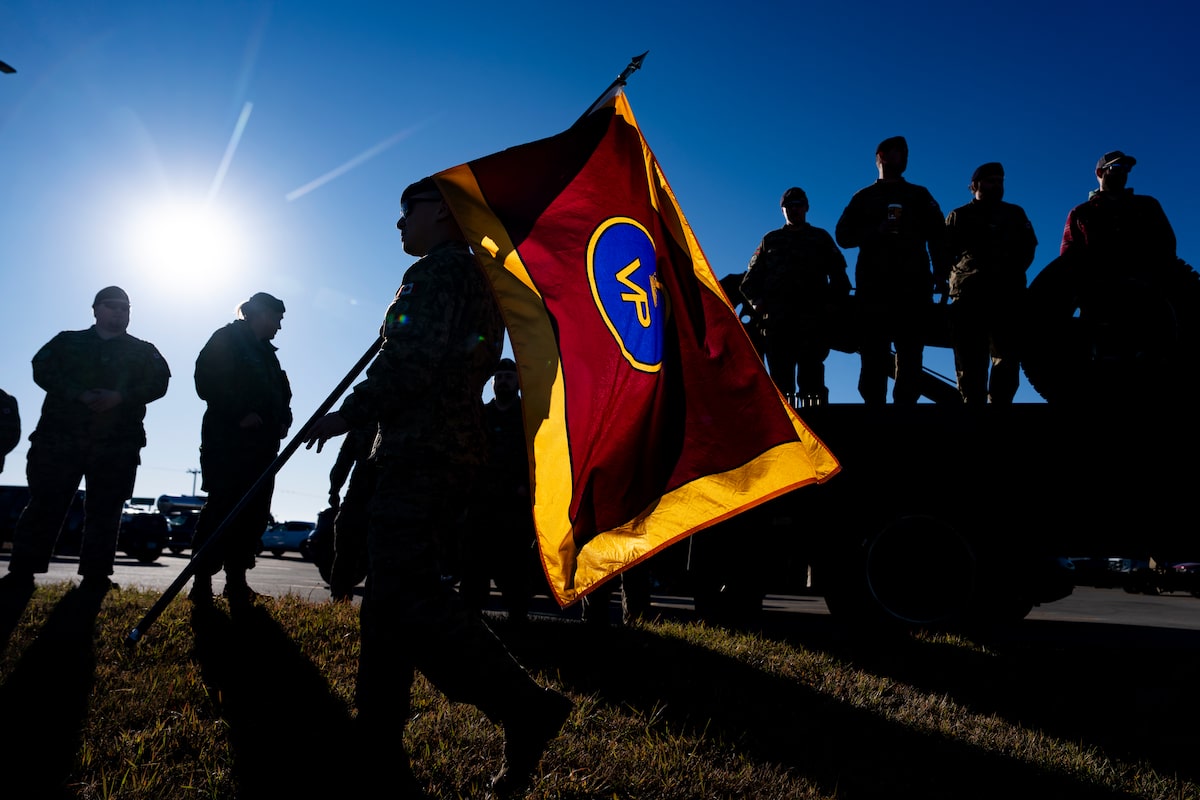
Soldiers stationed at CFB Wainwright fly the regimental flag of the 3rd Battalion Princess Patricia’s Canadian Light Infantry (PPCLI), in Wainwright, Alta., on Wednesday.Christopher Katsarov/The Canadian Press
A wildfire that killed four Canadian Forces soldiers and injured dozens more at a military base in Wainwright, Alta., on Saturday started on the base’s automatic grenade launcher range, Brigadier-General Vanessa Hanrahan told reporters on Thursday.
Brig.-Gen. Hanrahan is the Canadian Forces Provost Marshal, the top soldier in charge of Canada’s military police, which are conducting one of several concurrent investigations into the fire. The military is conducting its own board of inquiry, and Alberta’s Chief Medical Examiner is also investigating.
At a news conference Thursday afternoon, Brig.-Gen. Hanrahan said her investigation shows the fire started at what’s called the AGL range, as part of routine training in that area. She did not say whether live firing of explosive rounds ignited the fire.
Initially, the fire stayed within what is known as a “permanent danger area” of the range, which prevented firefighters from attacking it directly. According to Canadian Forces Base Wainwright’s range standing orders, permanent danger areas can be contaminated with unexploded munitions.
“It was therefore monitored throughout the day by both range control and the base firehall,” Brig.-Gen. Hanrahan said.
High winds from a forecast cold front later caused the fire to suddenly change direction and accelerate rapidly, Brig.-Gen. Hanrahan said. It spread to a different range in another part of the base and overran soldiers’ positions. Understanding exactly when, how and why that happened will be a key focus of the three investigations, she said.
Victims of Wainwright fire remembered as young people dedicated to service
The four soldiers killed were identified as Private Shaun Farrell, 23, of Prince Albert, Sask.; Pte. Aidan Goulding, 23, of North Vancouver; Pte. Hayden Lykkemark, 19, of Langley, B.C.; and Sergeant Morgan Wong, 26, of Edmonton.
Initially, 39 injured soldiers were sent to various hospitals. As of Thursday, 27 remained in hospital, according to Major-General Wade Rutland, Commander of the Army’s 1st Canadian Division.
“We are heartened that 12 soldiers are no longer hospitalized, although they will still continue to receive follow-up care,” he said. “The soldiers remaining in hospital are in serious condition.”
Maj.-Gen. Rutland said the military’s board of inquiry will work “as long as it takes” in order to be thorough and uncover what happened.
“We will not shy away from answers, and whatever hard truths they may reveal,” he said.
General Jennie Carignan, Chief of the Defence Staff, reiterated her commitment Thursday that the board of inquiry results will be made public once it has finished.
The Department of National Defence has so far remained tight-lipped about the fire itself, citing the investigation. Maj.-Gen. Rutland told reporters earlier this week that troops had been aware of the fire burning roughly one kilometre away for several hours.
On Thursday, he said the fire was “not originally assessed as a threat.”
“Canadians and families are rightly asking how that assessment was reached, what information it was based on, and whether different decisions should have been made. Those are amongst the central questions the investigation must answer,” Maj.-Gen. Rutland said.
He said eight firefighters from the base’s fire platoon responded to the blaze, but did not say when. They were later joined by a second platoon, and by firefighters from the town and municipal district.
In just minutes, tiny Wainwright hospital became scene of horrors and heroism
The wildfire risk in Wainwright on Oct. 17 was high. Data from the Canadian Wildland Fire Information System showed a measure called the Fire Weather Index, which gauges the expected intensity of a potential fire, was rated as “extreme.” Environment Canada issued warnings of high winds for Wainwright that day and data showed forest and grassland vegetation as very dry.
Maj.-Gen. Rutland, citing the investigation, would not comment on whether the scale of those risks was adequately communicated to troops on the ground.
However, internal communications obtained by The Globe and Mail told the military the “fire index,” a measure of risk, “was low” for CFB Wainwright on Saturday. The DND has not responded to The Globe’s questions about this apparent disparity, or whether the “fire index” referenced in the memo is the same as the CWFIS Fire Weather Index.
According to the base’s range standing orders, during periods when the fire hazard is rated as extreme, pyrotechnics, tracer rounds and incendiary rounds called white phosphorus are not to be used at any time unless authorized by the base commander. The document also says that between the “high-risk months” of August to October, live firing should be conducted during “early morning shoots” when “the fire hazard is normally low enough to permit the firing of most ammunition natures,” before approximately 10 a.m.
Wainwright residents line highway to salute soldiers after tragic fire
On Thursday, Maj.-Gen. Rutland characterized that as a guideline, not an order, and said officers conducting training must weigh a series of factors including weather, the type of munitions and the number of trainees before deciding whether it is safe to shoot live ammunition.
Wildfire experts told The Globe that conditions on the base, including the extreme fire weather index and forecast high winds, were unambiguously dangerous.
A similar situation in 2023 forced the chaotic evacuation of a BC Wildfire Service fire camp in the province’s Shuswap valley.
In that case, a cold front generated high winds that drove the Adams Lake wildfire more than 24 kilometres in a matter of hours. It swept down from heavily forested mountains and tore across a grassy airfield where firefighters had set up a base of operations. Some were forced to flee while their tents caught fire.
With reports from Reuters and The Canadian Press