
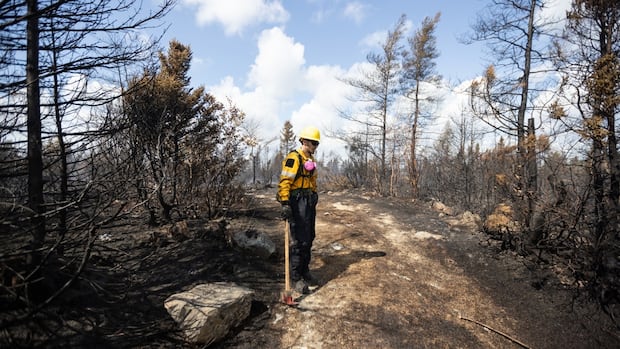
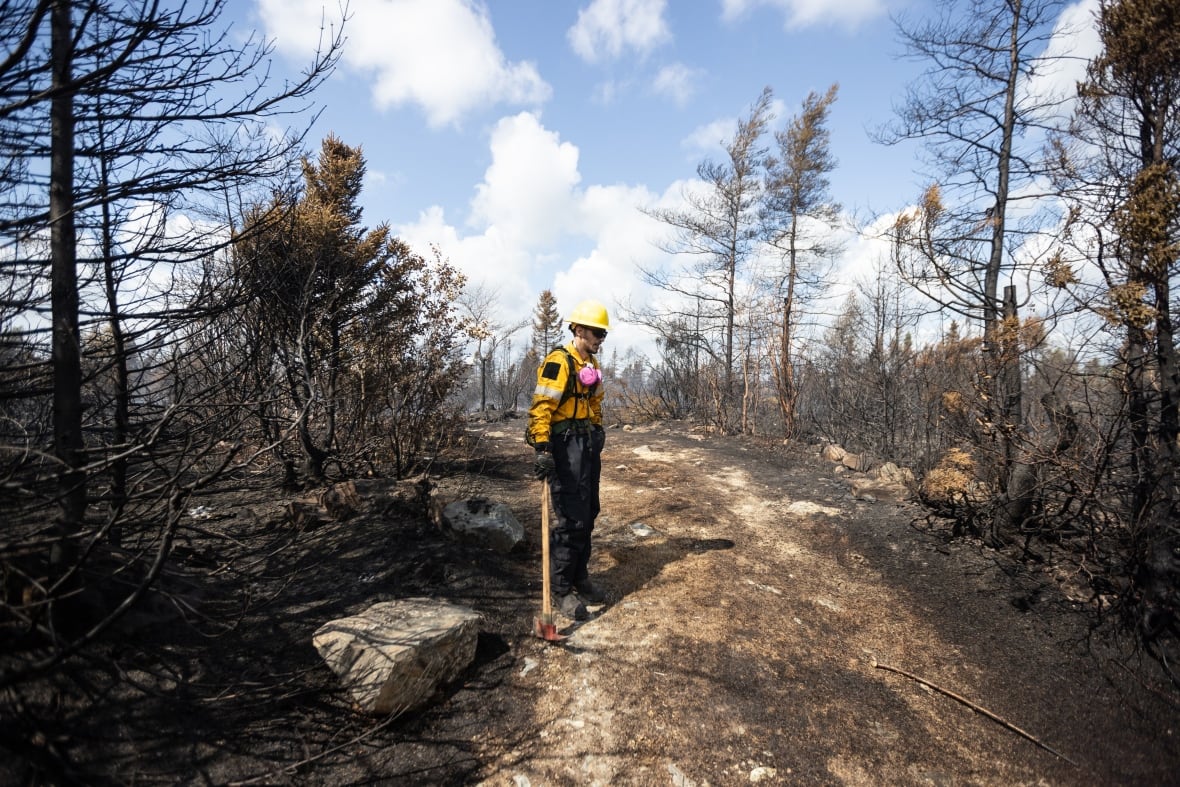
 Members of the Canadian Armed Forces are helping the firefighting efforts in Newfoundland, following three out-of-control wildfires on the Avalon Peninsula this summer. (Cpl. Terry Day/Canadian Armed Forces)
The power has to be back on, among other things, before some Conception Bay North residents can return to their homes, say government officials.
In a wildfire update on Friday, president and CEO of Newfoundland Power, Gary Murray, said 200 utility poles were compromised or destroyed by the Kingston wildfire, which has ravaged homes and other infrastructure in the area, along with forcing thousands to flee their communities.
“That is about 12 per cent of the total 1,750 poles in the fire area,” Murray said.
The utility will replace 125 of those poles now, and Murray said the remaining 75 will be left until lost properties are rebuilt.
In the meantime, he said, crews have already replaced 30 poles.
“Once poles are replaced, power will be restored to communities where government will notify residents about re-entry,” Murray said.
But that doesn’t guarantee residents will get to return home as soon as their lights come back on.
Checklist
Housing Minister Jamie Korab said working electricity is an important part of safety, but there’s more needed to guarantee a safe return to the C.B.N. communities hit by the wildfire.
“Some of these communities will look different than they were three weeks ago,” he said.
Premier John Hogan said some of the communities, like Kingston, are in bad shape.
“Even though they’re safe from the fire, from smoke, these communities, some of them are going to be very seriously damaged,” he said.
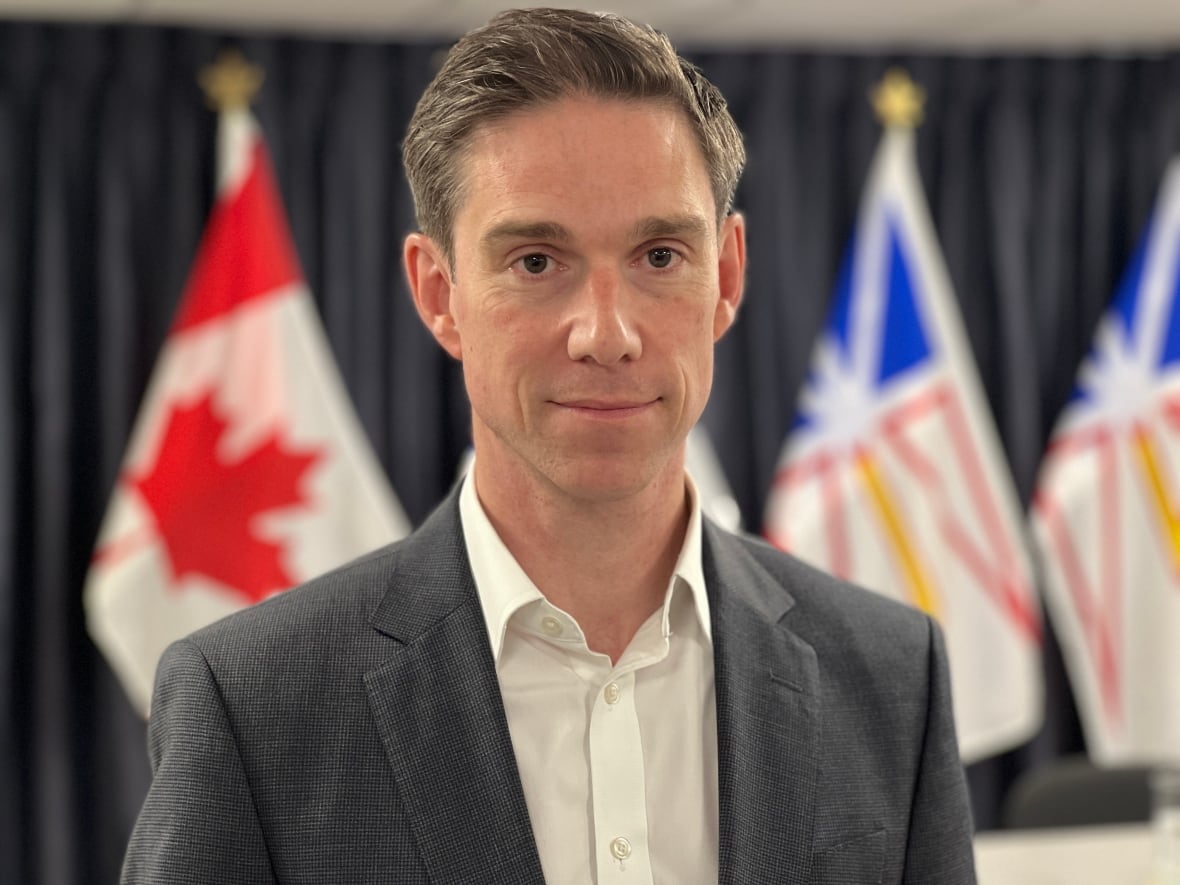 Newfoundland and Labrador Premier John Hogan provided an update on the province’s wildfires on Friday morning. (Mark Crosby/CBC)
Hogan said the province has a checklist they have to get through before letting people back into their towns.
“Hazardous materials, transportation, roads, bridges, power, water, all those things need to be assessed,” he said.
The Kingston wildfire is still burning out of control, and as of Friday morning was 10,095 hectares.
Hogan said nine water bombers, five helicopters, and one bird dog will work the fire throughout Friday, alongside ground crews of 11 Newfoundlanders and Labradorians, 20 firefighters from Ontario, 22 from B.C., and three platoon military, making up 66 personnel.
100 volunteer firefighters are also on the ground, while 22 people are working in the province’s incident command centre shared with the Paddy’s Pond wildfire, which is being held.
C.B.N. changed
Hogan said they will discuss with residents what they want their communities to look like after the wildfire is out, but anticipates not everyone will rebuild.
“If people want to rebuild, I will support that decision, and we will support them in doing so, but if people make a decision that they want to maybe move somewhere else with family members, move to surrounding communities, those are conversations we need to have,” he said.
Government has confirmed the fire destroyed 196 structures, down from the previous report of 203 structures which Hogan said is due to the crews get a better look at the damage.
In the meantime, the provincial government may offer residents a chance to see the damage by bus.
“Busing options is something that we will look at for individuals who might want to be able to drive through the community at a time when it’s safe to do that, but not safe to return home,” Hogan said.
Download our free CBC News app to sign up for push alerts for CBC Newfoundland and Labrador. Sign up for our daily headlines newsletter here. Click here to visit our landing page.