
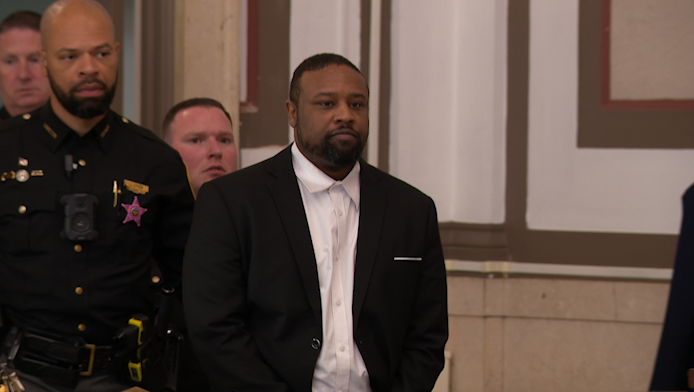


Rodney Hinton Jr. has been found guilty of murder, reckless homicide and felonious assault in the death of Hamilton County Deputy Larry Henderson.
The charges of reckless homicide was allowed to be considered as a lesser charge to the aggravated murder charges he faced.
The verdict came as jurors entered day three of deliberations Friday.
You can watch the verdict being read in full in the video above
WLWT’s Karin Johnson is in the courtroom and providing live updates. Follow along below
Hinton will be sentenced on Nov. 16 at 9 a.m.
Hinton’s lead defense attorney Clyde Bennett spoke after the verdict was read, saying “the fight is not over.”
Bennett said he was pleaded the jury chose to accept his argument and hand down a guilty verdict on reckless homicide as a lesser charge to the most serious charges he faced of aggravated murder.
He said, however, this is not a victory and he is disappointed with the verdict.
“I don’t take this as a victory, I wanted him to be found not guilty of each and every charge,” Bennett said.
Bennett said they do plan an appeal.
“When I was hired by the Hinton family, I looked at Mr. Hinton and told him I was going to fight for him and I’d see it through and I’m not done doing that,” Bennett said.
Hinton stood accused of intentionally driving into and killing Hamilton County Sheriff’s Deputy Larry Henderson. Hinton is facing charges of aggravated murder, murder and felonious assault. Jurors will also be permitted to consider the lesser offense of reckless homicide.
See previous coverage below
What jurors did not hear
Local trial attorney Jay Clark, who has followed the proceedings but is not involved in the case, said one aspect of the trial stood out: Jurors were not shown a recorded police interrogation of Hinton.
“Generally, it’s very uncommon,” Clark said. “Usually, if there’s any statement that the defendant has made to police or anybody in law enforcement, especially on these facts, I think they would normally play it.”
Clark said he also expected jurors might see body-camera video documenting law enforcement’s initial contact with Hinton following the crash. No such video was played during the trial.
Jurors instead heard three psychologists recount statements Hinton made during their evaluations. They never heard those interviews in Hinton’s own recorded voice.
“I don’t know if the jurors picked up on it. I don’t know if they realize it or not,” Clark said. “And it might be something that maybe the defense brings up in their closing: Why haven’t you heard what he said immediately after?”
WLWT previously obtained body-camera video showing Hinton being taken into custody after leaving the hospital. He spoke only briefly in that video, which did not document officers’ initial contact with him at the crash scene.
Hinton did not testify
Hinton did not take the witness stand, but he had no obligation to testify.
The judge is expected to instruct jurors that Hinton had a constitutional right not to testify and that they cannot consider his decision against him.
“The jury instructions will cover that,” Clark said. “There’ll be an instruction that says the defendant did not testify. You’re not supposed to consider that in any way. He has a right not to testify.”
Clark said jurors may naturally want to hear from a defendant, but he believes modern juries better understand that defendants are not required to testify.
“Human nature, though, is such that we always want to hear the other side,” Clark said. “But I think jurors are more sophisticated now about that than they were maybe 20 or 30 years ago.”
Insanity defense at center of trial
The psychologists who evaluated Hinton agreed he has a serious mental illness. Their disagreement centered on whether that illness prevented him from understanding the wrongfulness of his actions.
The defense’s expert witness testified Hinton did not know right from wrong at the time of the crash.
The state’s rebuttal witnesses testified that Hinton was grieving, angry and in extreme emotional pain—but still knew his actions were wrong.
Reckless homicide gives jurors another option
The judge has agreed to allow jurors to consider reckless homicide as a lesser offense.
Clark said that option could make a unanimous verdict more likely by giving jurors an alternative to the more serious charges. However, he said it could also create another potential point of disagreement during deliberations.
“The reckless homicide is—I don’t want to say a middle ground—but it’s a lesser of the murder,” Clark said. “That also then gives another option that could cause it to hang because now you have three options instead of just your typical guilty or not guilty.”
Under Ohio law, reckless homicide is a third-degree felony carrying a potential prison term of nine to 36 months. A judge would determine the sentence, and Hinton would generally receive credit for time already served.
Why jury instructions matter
After closing arguments Tuesday, the judge will instruct jurors on the charges, the insanity defense, the burdens of proof and the rules they must follow during deliberations.
Clark said the instructions may sound technical, but they provide the jury’s legal road map.
“The instructions are the law,” Clark said. “The jury decides factually what happens. They apply it to the law that the judge gives them, and that’s the way the system works.”
Clark described the jury as attentive throughout the trial, including during lengthy testimony involving complex psychological terms.