
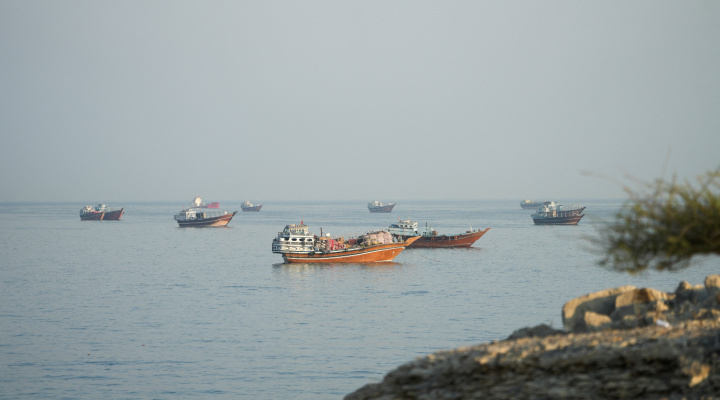
Vessels at the Strait of Hormuz, as seen from Musandam, Oman, Oct. 23, 2026. Photo: REUTERS/Stringer
Tehran has drawn up detailed plans to target undersea communications cables in the Gulf if the United States and Israel attack Iran again, two senior Iranian security officials told Reuters.
Their comments followed warnings by Iranian officials that undersea cables in the region could become targets in any renewed conflict if diplomacy with Washington collapses.
The two Iranian security officials, speaking on condition of anonymity, gave few details and did not say how or where exactly Tehran would carry out such attacks. But one of them said Iran would aim to prevent repairs after any attacks to prolong disruptions to communications, including internet connections.
“If Iran is attacked, there will be no more red lines … from undersea cables to military bases, including covert ones,” one of the officials said.
The official warned Washington not to “play with fire,” and said Iran had full access to the undersea cables and could easily destroy them.
Yadollah Javani, the deputy head of political affairs for Iran‘s Islamic Revolutionary Guard Corps (IRGC), said on Wednesday that Iran could target seven major internet cables beneath the Strait of Hormuz if Iranian infrastructure came under attack.
Undersea cables carry around 99% of global internet traffic, according to the International Telecommunication Union, a UN agency. But the global impact of such attacks by Iran could be limited as less than 1% of international bandwidth passes through the Strait of Hormuz, said Alan Mauldin, research director at telecommunications research firm TeleGeography.
The strait separates Iran and Oman, linking the Gulf to the Gulf of Oman and Arabian Sea.
The US Department of State and Iran‘s Foreign Ministry did not respond to Reuters’ requests for comment on the Iranian security officials‘ remarks. There was no immediate comment from Gulf states.
‘STRONGER RESPONSE’
The plans for possible attacks on undersea cables reflect a conviction in Iran‘s leadership that a renewed US military campaign would have to be met with a stronger response than before.
Top security official Mohsen Rezaei warned this month that US-linked digital infrastructure across the Gulf, including data centres and AI facilities, could be targeted in a renewed conflict.
Washington’s Gulf allies have invested heavily in such infrastructure and they “should hold Washington, not Tehran, responsible for any damage to undersea cables,” the second Iranian security official said.
Alex Vatanka, director of the Iran program at the Middle East Institute in Washington, said such threats were intended to deter renewed conflict and put pressure on Washington by making Gulf governments and US companies fear for their investments in the region.
“Tehran wants Gulf states and corporate executives to press [US President Donald] Trump over the risks his policies pose to their investment plans,” said Vatanka.
Multiple cable cuts could slow internet services and disrupt financial transactions, e-commerce and cloud computing, analysts said. The impact would depend on how operators rerouted traffic and the capacity available on alternative connections, Mauldin said.
Restoring connections during wartime could be difficult, experts said, and higher insurance costs and delays in obtaining permits to enter territorial waters could further complicate repairs.
The Red Sea could offer a more significant target than the Strait of Hormuz, particularly if Iran had support from its Houthi allies in Yemen, though Tehran has made no public statement indicating it plans to target cables there.
The Red Sea carries data between Europe, East Africa, and Asia, with capacity routed through it accounting for about 3% of global international demand and around 10% of traffic traveling between regions, Mauldin said.
Gulf governments have been investing heavily in technology to diversify beyond oil and become global artificial intelligence hubs, deepening ties with US technology firms.
Iranian strikes directly hit two Amazon Web Services facilities in the UAE in March and damaged infrastructure near one of its facilities in Bahrain. The IRGC named US tech companies including Microsoft, Google, Apple and Nvidia as legitimate targets at the height of the war in March.
Land-based connections can provide alternative routes for internet traffic, and Gulf states and US technology companies are investing in additional infrastructure to improve resilience.
Microsoft plans to invest more than $400 million in subsea and terrestrial connectivity across the Middle East by 2030.
SHIP ATTACKS IN HORMUZ HIT RECORD HIGH
Amid the Iranian threats, October has been the worst month for attacks on commercial shipping in the Strait of Hormuz and nearby waterways, according to data compiled by a Washington-based think tank that has tracked maritime security incidents worldwide since 2017.
“October has seen the highest number of ship attacks on record,” said Noam Raydan, a senior fellow at the Washington Institute for Near East Policy.
Raydan, who maintains the institute’s interactive shipping incident map, has recorded 28 confirmed and reported attacks in the Strait of Hormuz and surrounding waterways in October and 113 since the US-Israeli war with Iran began on Feb. 28.
The institute’s map shows most of the attacks that took place in September and October were in the Strait of Hormuz.
AROUND 3.5% OF WORLD SUPERTANKER FLEET ATTACKED
The tally broadly aligns with data from the International Maritime Organization (IMO), which recorded a total of 120 incidents in the Strait of Hormuz and the wider Middle East since the conflict with Iran began.
The IMO lists more than 30 supertankers, or Very Large Crude Carriers (VLCCs), that were damaged during the attacks, including 11 in October alone, a Reuters review of the IMO list and MarineTraffic vessel data showed.
Each VLCC can carry about 2 million barrels of crude. The listed vessels account for about 3.5% of the total global VLCC fleet, which exceeds 900.
More tankers came under attack as shipowners became increasingly willing to load cargoes inside the Gulf, lured by daily freight rates exceeding $1 million and steeper discounts offered by regional producers against dated Brent.
“October 2026 has emerged as the most intense period of maritime attacks in and around the Strait of Hormuz since the escalation of hostilities in March,” Greece-based consultancy Marisks said.
Between Oct. 5 and Oct. 11, a dozen ships were attacked, marking also the highest weekly number of attacks since the conflict began, it also said.
NOT ALL ATTACKS MAY BE CAPTURED IN DATA
By intensifying attacks, Iran is seeking to slow the recovery in shipments and maintain pressure on global energy markets ahead of November’s US midterm elections, Raydan said.
Earlier this month, Reuters reported about Tehran adopting such tactics, citing two senior Iranian officials.
UKMTO, the British maritime security service, which recorded 135 incidents related to the US-Iran conflict as of October 16, said it was struggling to capture the whole picture due to insufficient voluntary reporting by shippers.
The UKMTO data also showed a sharp rise in ship damage caused by attacks in October.