
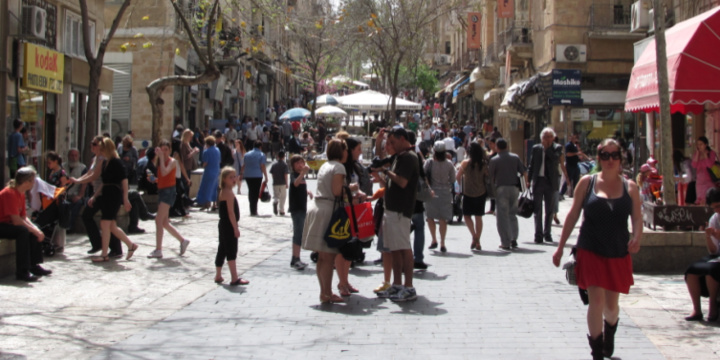
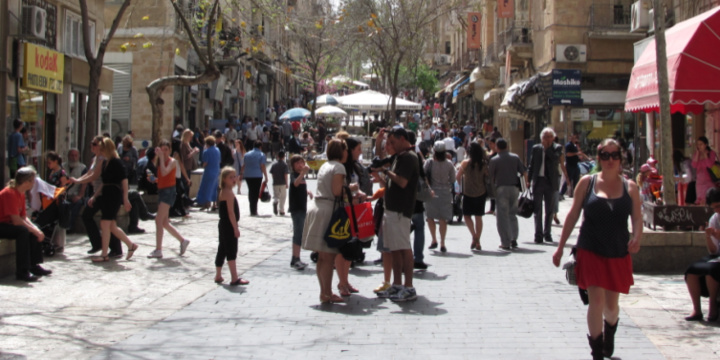
Ben Yehuda Street in Jerusalem. Photo: Wikimedia Commons.
In the late 1870s, a young man named Eliezer Yitsẖak Perlman dropped out of yeshiva in Belarus, where he had spent his days immersed in ancient Hebrew and Aramaic texts. But he didn’t leave the language behind. Even though it had not been a spoken language for nearly 2,000 years, he tried to use it with fellow Jews. Eventually, he moved to the Holy Land. He developed new words, based on the linguistic roots of Biblical Hebrew, to describe modern concepts. He wrote a Hebrew dictionary. He published newspapers in the emerging language and renamed himself Eliezer Ben-Yehuda.
In just a matter of decades, Ben Yehuda with the help of many others managed to create a modern spoken Hebrew that became the official language of the State of Israel in 1948, and the mother tongue of millions born there. It was a linguistic, cultural, and political rebirth. Modern Hebrew has allowed Jews to reinvent themselves as Israelis, as a people who have a state.
Today we need another Hebrew revolution, one that goes beyond the borders of Israel and has nothing to do with politics.
Born and raised in a secular family in Israel, I admit that I have taken Ben Yehuda’s Hebrew for granted for most of my life. The language, combined with growing up in a country where life moves somewhat according to the Hebrew calendar no matter your thoughts or opinions on religion — with buses ceasing and shops closing Friday afternoon, no school on Jewish holidays, doughnuts everywhere during Hanukkah, and the streets clear of cars making way for bikes on Yom Kippur— just naturally made me who I am, a Jew not very connected to Judaism and not overly concerned about Zionism or the concept of Israel. It was just where I lived.
But outside of Israel, where more than half of the world’s Jews live and where more Israelis like me now spend an increasing amount of time, things are not as simple. In the wake of Oct. 7 and the ensuing wars, the word “Israel” inside and outside of Jewish communities has become divisive. At the same time, Jews abroad are searching more intentionally than ever before for what being Jewish means for them. Some have embraced religious rituals in order to connect. Some have rejected them. Some have donned Star of David necklaces; others have tucked those necklaces under their shirt so no one else can see them. Some advocate tirelessly for Israel; others proclaim they are no longer Zionists.
Amid all of this, more Jews outside of Israel are signing up to learn modern Hebrew. I see this firsthand through running Citizen Cafe, the online language school I founded eight years ago while still living in Tel Aviv. Back then, most of the students were in Israel, or planning to come soon; they needed the language for work and the practicalities of life. Students ranged from excited new immigrants to devoted romantic partners of Israelis to non-Jewish business executives in the country temporarily. We still have those kinds of students, but we also have many who have never been to Israel and have no concrete plans to visit or move there. They simply want to learn Hebrew as a way to connect with and explore their Jewish identity.
This is a trend all Jewish leaders and educators should be paying close attention to, and helping to nourish, no matter where they stand on the religious or political spectrum. I don’t mean they should open more ulpans to train people to function in Israel, or more Sunday schools to prepare for bar and bat mitzvahs. I am referring to making the teaching and use of modern Hebrew, and the Israeli culture around it, a core part of Jewish life.
At this moment in history, when Jews are so deeply divided, scared, and confused, modern Hebrew can be a vehicle to bring us together, bridging all sorts of divides. Hebrew offers a way to grow closer to being Jewish without having to consider other concepts that can feel like emotional baggage or just too complicated to sort out, especially if your friends or family are not on the same page.
Modern Hebrew does not require any connection to religion, although it can help those who like to pray better understand what they are saying or make it easier to follow services. But modern Tel Aviv Hebrew does not need to remind one of their bar or bat mitzvah or be a way to measure one’s devotion to or acceptance in any specific Jewish community.
Unlike in Ben Yehuda’s day, it is easier and even natural to take Hebrew beyond Israel and what Israel means. While developing a modern, spoken Hebrew was an essential practicality and ideology in order to found and set the course for the State of Israel, today I am grateful that Hebrew can just be the language my children, friends, and I speak, a language for arguing, negotiating, and describing the food of Tel Aviv. Hebrew is also increasingly spoken outside of Israel, as Israelis who travel and live abroad at higher rates than ever before take it with them wherever they go. This maturity and independence of the language from where one physically stands or lives means that people can learn, study, and speak Hebrew with each other even if they have vastly different opinions on Israel. Learning the language allows people to engage with living culture without needing to endorse or debate state politics or ideology.
Importantly, modern Hebrew is rooted in the present and is relevant now — as well as for the future. At a time when the Jewish world and the world around us are changing rapidly, we should not just focus on our past, but on our present. And making such a tool as modern Hebrew available as a way to increase our connections with each other and with our Jewishness in the present is essential. For those of us worried about helping our children connect to being Jewish, encouraging them to learn modern Hebrew can be an excellent path to helping them explore and connect with their identity.
Now it is our turn to build on the work of Ben Yehuda. All languages evolve. But with the case of developing modern Hebrew, it obviously took enormous amounts of effort. This language that we have is really a gift from previous generations. Now we need to deliberately deploy Hebrew more widely across the Jewish world. I am sure that new words or expressions will emerge in that process. But more importantly, more Jews will be able to connect to their identity and to each other.
Tamar Pross is the founder of Citizen Café Tel Aviv.