
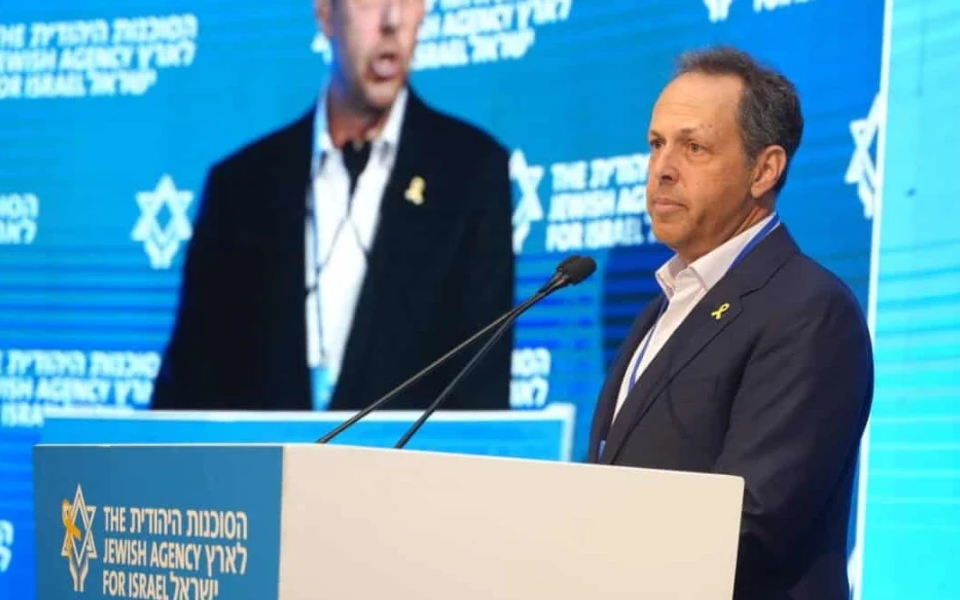
When Mark Wilf was elected chairman of the Jewish Agency’s Board of Governors, the Jewish world was in the midst of a crisis. Russia had just invaded Ukraine, home to one of the largest Jewish communities in Europe, sparking a massive wave of aliyah. The Jewish world was also still emerging from a crisis — the COVID-19 pandemic — which had threatened the survival of Jewish schools, synagogues and other institutions.
At the Board of Governors meeting in Tel Aviv next week, Wilf will end his tenure, and his successor, J. David Heller, will be voted into office.
A real estate developer through his family’s firm, Garden Homes, and the president and co-owner of the NFL’s Minnesota Vikings, Wilf has been a fixture in the Jewish communal world for decades, serving and having served on the boards of numerous institutions in the United States and Israel, including Yad Vashem, Yeshiva University and Jewish Federations of North America, where he also served as board chair.
From his office in New Jersey, Wilf sat down with eJewishPhilanthropy this week as he wraps up his time at the helm of the Jewish Agency, discussing the values of strong Jewish communal infrastructure, the organization’s response to the Oct. 7 terror attacks and his hope for the Jewish future.
The interview has been lightly edited for clarity.
Judah Ari Gross: Your term is wrapping up. It’s certainly been an eventful, to say the least. Let’s start with your topline takeaway from this period.
Mark Wilf: In July 2022, when I took the role, I could not have anticipated the extraordinary challenges that would come about, particularly in the aftermath of [the Oct. 7 terror attacks]. But I will say the Jewish Agency has really demonstrated a unique ability to mobilize the Jewish world, respond to crises and translate all the generosity that was in response to Oct. 7 into really meaningful impact. It strengthened a lot of trust among our partners, donors and the communities we serve. Even though we’re a nearly hundred-year-old institution, we really showed our relevance, effectiveness and ability to deliver when it matters most. Maybe since the founding of the state, it’s one of our strongest moments, I think, as an organization and as a people in terms of responding.
I’m a big believer in strong Jewish institutions, strong infrastructure. And so I think all the partnership and cooperation that we’ve seen since Oct. 7 really remain indispensable for the Jewish People.
JAG: You are what I think of as an “institutional giver,” with ties to Jewish Federations of North America, Yad Vashem — the large, storied institutions. What is the motivation behind that? Why the focus on that kind of communal infrastructure?
MW: I think when you have the kind of large-scale issues that Israel is facing — there are dozens, hundreds of nonprofits that do incredible work — you need the large infrastructure, the relationships, the partnerships to respond quickly and effectively during a crisis. You have to be ready to go. I quote Eric Fingerhut, who’s been saying, “You don’t build a fire department when the house is on fire.” You need the fire department in place already, and that’s a lot of what the large-scale institutions represent.
World Jewry and the entire Jewish Agency board… is committed to Israel, and of course, the recovery is a long-term one, and we need to stand by all the communities in Israel as people rebuild their lives. And we’re uniquely situated to do that because we have the relationships, we have the trust and we have the track record.
The Jewish Agency predated and led to the State of Israel. It’s in the DNA of JAFI to continue that Israel continues to thrive and be a strong society. And we also want [Israel] to be the state for the Jewish People as well, and that connection to Diaspora Jewry is very strong.
JAG: You came into office at the peak of the Ukraine invasion crisis, and the Jewish Agency played a major role in that because of the wave of aliyah. But soon after you came in, the Israeli government that was in place collapsed. It seems as though there has been an amount of tension between the Jewish Agency and the government over the past three years. What has the relationship with the government been like?
MW: I’m not sure exactly what you’re referring to, but there’s always been a very dynamic relationship between the government and the Jewish Agency for decades. And I think actually our cooperation at the ministry level — support within the budget and recognition of the trusted nature of the Jewish Agency — has led to a dramatic amount of cooperation and coordination with the government. So I’m not sure what kind of thing you’re referring to.
JAG: I was referring to the coalition’s votes on the Western Wall and non-Orthodox conversions.
MW: A sizable portion of our budget is coming from the government because we’re building Israeli society. We’re involved in resilience… in rebuilding. We’re working with the government in so many ways, in so many aspects, among so many people.
So I think it’s been healthy, and I think our donors should know that it’s a win-win. The Jewish Agency is going to work with the government of Israel regardless of politics because the Jewish Agency is about building the state and connecting to the Jewish Diaspora and growing pride in the Jewish community and involvement.
I can highlight a couple of key areas, if that’s all right.
JAG: By all means.
MW: We have the Victims of Terror Fund. There’s the financial assistance aspect — we have had tremendous support from JFNA, Keren Hayesod and others — but it’s also about the solidarity that the fund represents. And I’ve been privileged in unfortunately tragic situations to deliver checks to victims and to see what it means to them, not just the money, but the fact that they’re part of an extended family and get that solidarity.
We’ve had Communities2Gether [connecting Israeli communities with North American ones] since Oct. 7. Many [Israeli] communities have had great, great support for rebuilding and recovery. And the Jewish communities [abroad] — and I’ve been privileged to see it — they’re not just giving money to these communities that they’re partners with, but they’re really leaning in. They’re active partners in their planning, and the relationships are very supportive emotionally, too.
There’s also small business assistance. That’s been a big lean-in for us, especially loan funds, grant programs for reservists and their families.
One that I’m really proud of, which was a byproduct of Oct. 7, was Campers2Gether. It was [offered as] respite for young Jews [from the Gaza envelope and northern Israel] to go to summer camp around the world, to take a break from the horrors of Oct. 7. The next-generation engagement has been dramatically increased. We’re close to 2,000 shlichim (emissaries), and there’s a bond you see between young people that is energizing. It’s a two-way street, both [Diaspora Jews] experiencing trips to Israel and Israelis coming to camps and communities around the [world].
JAG: Have you seen any distancing from donors during your tenure, of people who once supported the Jewish Agency but are now pulling away because of politics?
MW: I’m not sure about the things you’re talking about in terms of the data. To my mind, there was a tremendous surge of activity from donors and from outreach and support in response to Oct. 7. Naturally, after anything of that magnitude, there might be a subsequent leveling off, but I have not seen firsthand any pullback because of the political situation in Israel.
As far as my seat at the Jewish Agency, we have a tremendous donor base. We have partners that are very supportive, and their support has not waned. In fact, like I said, it’s increased and grown, realizing the scale that we can bring and the effectiveness we can bring.
We’re still responding to a lot [after Oct. 7]. The trauma is still very real, and we’re focusing on recovery and rebuilding. It’s going to be years of that. And I think we’re well-positioned.
JAG: Have you seen any shifts among your supporters, new types of people coming on board or smaller numbers of donors accounting for more of the donations?
MW: We’ve been very engaged with our communities. I’m proud that in our last four years, we’ve really upped our game with the members who sit on our board of governors. We’ve been very intentional in terms of making sure we have board members and people around our collective table that are highly engaged in our work, who are effective, many of them significant donors and supporters, but also they’re people that are leaders in their spheres. And that even goes for national institutions.
We now have cooperation at the highest level in our history, perhaps, with WZO, with Keren Kayemeth LeIsrael-Jewish National Fund. We are getting support from national institutions, financially, maybe more than ever before because of the strength of our programs.
I think a lot of people woke up, who were not necessarily connected to the Jewish community. You can call them Oct. 8 Jews — or whatever the term of art is these days — but many people awoke to the realities, and the fact is it’s in many people’s faces.
There’s antisemitism, there’s protests. You watch the news, and see what’s going on in countries around the world.
JAG: When you came into this position in July 2022, what was your vision? What did you hope to accomplish? Was anything derailed by the past three years of war?
MW: We’re in a new reality, and when I took on the JFNA chair role [in 2018,] the COVID-19 pandemic happened, and we had to shift into gear to rescue hundreds, if not thousands, of Jewish institutions that needed funding. So our history is full of challenges, and Oct. 7 might be the greatest challenge the State of Israel’s people have faced since the founding of the state.
One of my goals was to focus on our next generation. I believe that the goal then was to double or triple the capacity for engagement. Like I said, some of it because of Oct. 7, some of those goals became accelerated to achieve things like Campers2Gether and the next-generation engagement. Unfortunately, the Israel experience trips have not been as strong. Many young people in the Diaspora over the last three years have missed the opportunity to spend meaningful time in Israel, and that’s something that we need to get back to.
But I’m very proud of the expansion and effectiveness of the work we’ve done with Campers2Gether, our shlichim network and our [post-high school] Shinshinim program. I’ve gone to meet them, spend time with them and every time I see them… I wish every donor, every Jewish person could see the energy, the passion, and the hope they give me, and they should give to all of us.
Also, one of my goals was that Israeli and Diaspora Jews should be better connected and better aware of each other. And I think in Israel we’ve developed a little bit more awareness, but many people in Israel really are not familiar with the Diaspora and the communities, and we need to do more of that.
JAG: In terms of the trajectory that you see the Jewish Agency on as you hand over the keys, so to speak, what areas do you hope that the organization preserves and what do you want to see strengthened? You mentioned broadening the awareness in Israel of the Diaspora.
MW: I’ve been speaking about the trust and the sense of partnership. We have to continue supporting Israel’s recovery. I think we have a base now to do that from. We need to be strengthening the broader mission of connecting Jews to Israel and to one another. That’s very important.
Of course, we can’s allow antisemitism and crises to go unanswered or to define our future. So we have to invest in Jewish identity and education and leadership and connection.
So the Jewish world is very diverse. We have religious practices, identities, and they’re all around our table. We are the global Jewish table, and I think we’re positioned to tackle all those issues together.
I didn’t mention aliyah, but that’s also a continued core mission of the Jewish Agency. I know tens of thousands have made aliyah even since Oct. 7. And I know for [Jewish Agency Chair Doron Almog] and all of us that’s a goal.
JAG: Going back to the issue of communal infrastructure, like you said, a lot of the big institutions really did prove themselves in the early days, weeks and months after Oct. 7, when people really needed help. But since then, a lot of criticism has returned about them, that they’re bloated bureaucracies and require 15 committees to make a decision. How has the Jewish Agency been receptive to those critiques? How do you make Jewish communal infrastructure more efficient and more responsive?
MW: I think with Doron and [CEO] Yehuda Setton in charge, there has been a great push to modernize so many aspects of the Agency. Our aliyah processing system just received an award from the Israeli business community, and I think the Victim of Terror Fund did as well. I think there’s a recognition in Israeli society and even in the world that the Agency is efficient.
Yes, we have committees, bt we’ve also streamlined committees.
There’s now a lot being done in terms of the infrastructure of our computers and AI and all our processes. So we’re modernizing on a lot of fronts.
Again, there’s going to be growing pains when you’re talking about an organization that in six years’ time its budget nearly doubled.
So these are dramatic shifts, and there needs to be adjustments on all fronts to it. And we’re doing a lot of the work with, in many cases, only a small increase in the number of staff.
I want to just point out that, on a personal basis, one of my great privileges in this role is to get an understanding about Israel, which I love so much, in a new capacity. And the resilience of the Israeli people and the Jewish People — but Israelis in particular — since Oct. 7 has been so inspiring to me. It really reflects to me the heroism of our professionals, of our staff. Despite all the personal challenges they have — we had employees whose family members were hostage and all the rest — yet they continued their mission.
Those are the things I’ll take away with me
JAG: And what are your plans for the future?
MW: So I’m not going that far away. My wife, Jane, and I are going to be supporting and chairing the Jewish Agency’s centennial campaign. The centennial is coming up in 2029 to even further strengthen this foundation for our next chapter.
And I’ve got plenty going on here [in the United States.] I am still engaged in our real estate business and sports businesses and all that. Of course, I sit on different boards as well.
I will miss this role, but I feel really good about the fact that the Jewish Agency is poised for a great future and most importantly Israel and the Jewish People are poised for a great future.
I go back to my parents and grandparents, who were Holocaust survivors, and they went through the greatest tragedy to befall the Jewish People and out of that, they always remained optimistic. They were hopeful and that’s how we need to be — and that’s challenging.
But when you are around the table with the people I’ve been privileged to be around the table with for the last four years, I’m highly optimistic and feel strong about our future.