
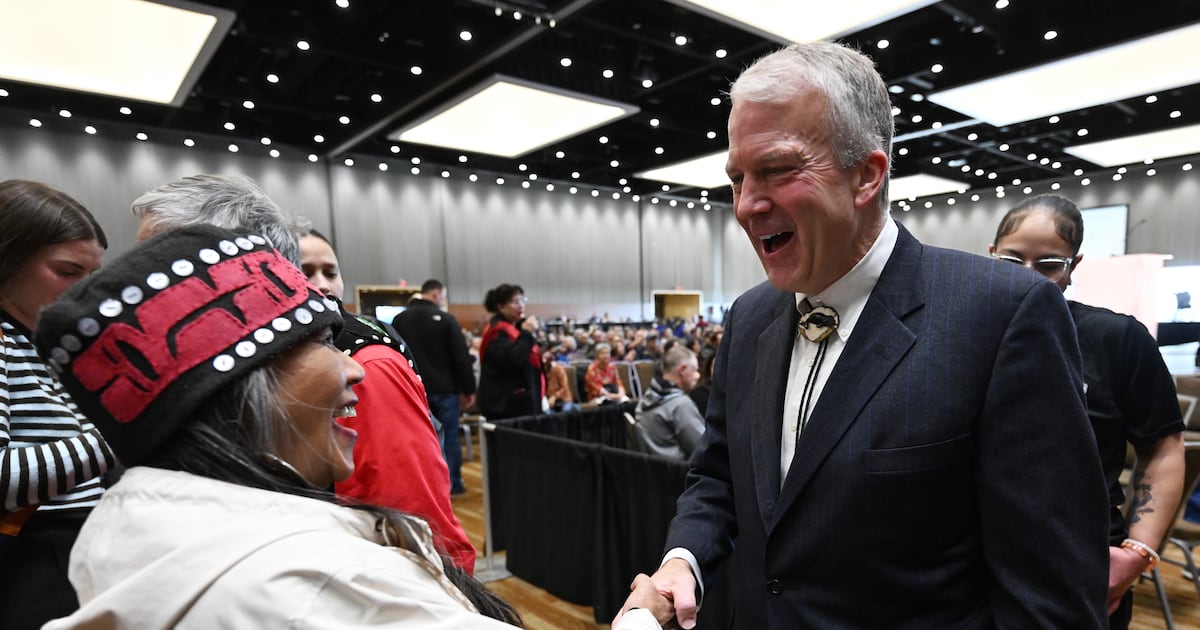
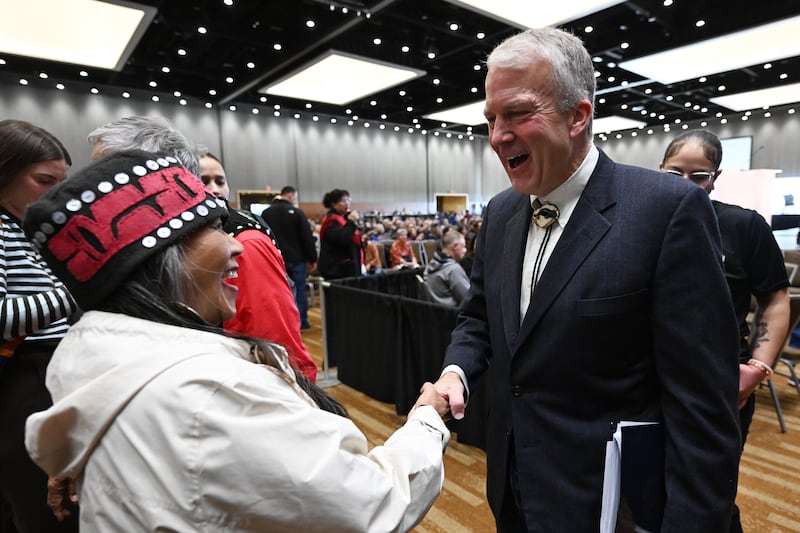
 Paulette Moreno greeted Sen. Dan Sullivan after he gave remarks at the 60th annual Alaska Federation of Natives Convention at the Dena’ina Center in Anchorage on Thursday, Oct. 22, 2026. (Bill Roth / ADN)
First of two parts.
Super PACs are spending fortunes on attack ads in Alaska’s closely watched U.S. Senate race, looking to smear candidates over issues involving transgender surgery and self-dealing schemes.
But the tight race between Republican Sen. Dan Sullivan and Democrat Mary Peltola, an Alaska Native and former U.S. representative, may come down to the economy.
Soaring energy prices and bills are voters’ top concern, polls show, leaving Sullivan — who is seeking his third term — potentially vulnerable as the incumbent.
The toss-up race has seen record levels of spending, with Democrats eyeing the seat as one of four they hope to pick up to regain control of the Senate.
Meanwhile, President Donald Trump, an ally of Sullivan, is fighting desperately to keep Sullivan in power. Trump and Vice President JD Vance have both stumped in Alaska for the senator while Trump ordered his administration to file a lawsuit Thursday to challenge the election results if Sullivan loses.
Critics point out that Sullivan has steadily backed the president’s tariffs and the Iran war, key contributors to high inflation.
Trump has mocked voter concerns about affordability as a Democratic “con job.” But Sullivan, in speeches and debates, has acknowledged that Alaska families are struggling under high costs, before he ticks off steps he’s taking to fight high prices.
Sullivan has pointed out that the spikes in inflation started under former President Joe Biden, although inflation subsided at the end of Biden’s term, only to rise again, albeit to much lower levels under Trump.
Sullivan argues that more Alaska energy production, something Trump has aggressively backed, is the answer to lowering costs, though analysts argue that’s generally a long-term solution that won’t yield quick results. He declined to participate in an interview for this story.
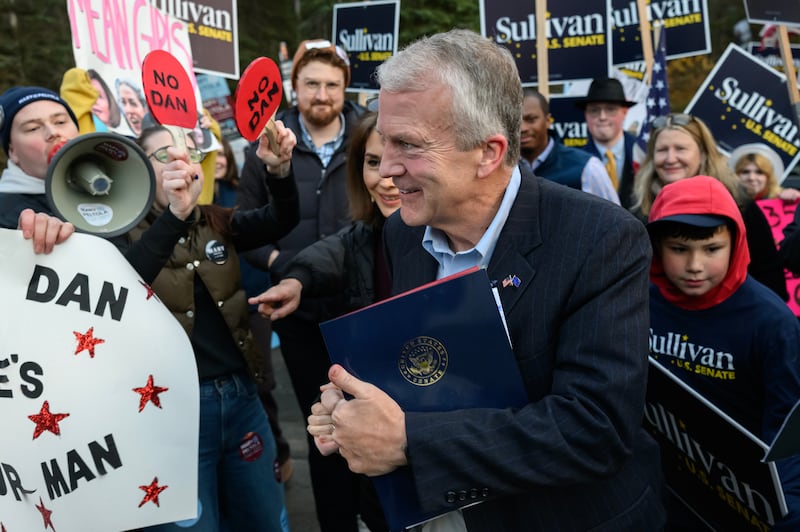 Sen. Dan Sullivan arrives at the Alaska Public Media studio in a crowd of both his own supporters and those of his opponent, Mary Peltola, before the Debate for the State broadcast on October 15, 2026. (Marc Lester / ADN)
His campaign spokesperson blamed Iran for the high energy costs, although Trump initiated the conflict eight months ago.
“Alaskans know exactly what’s driving fuel prices: the Iranian regime has held the world’s oil supply hostage in the Strait of Hormuz,” Nate Adams said in a statement.
“That’s the strongest argument there is for producing more energy in Alaska, by Alaskans, for Alaskans,” Adams said. “That’s exactly why it matters that America, and Alaska, produce more of our own energy instead of depending on the world’s most dangerous regimes.”
[Campaigns, attorneys weigh in on Trump’s DOJ suit to block election results if Sen. Sullivan loses]
‘Stupid people’
Analysts have called the midterms a referendum on Trump, who said during his recent campaign rally in Wasilla that critics complaining about affordability are “stupid people.”
Trump pointed out that Alaska now has “the highest income per individual,” with 2025 data from the Federal Reserve Bank of St. Louis showing an 11.4% rise in the state’s household income.
Still, voters are very aware of their financial hardship, said Todd Belt, a professor at George Washington University’s Graduate School of Political Management.
They also know that that Trump has failed to fix inflation as promised, he said.
In Alaska, prices for diesel and heating fuel have hit record highs with winter coming, while bills for health insurance, utilities, consumer goods, rents and mortgages keep rising.
“People don’t like it when you tell them things are good and they know it’s not,” Belt said, noting that Biden did that and his Democratic Party paid the price in 2024.
“This isn’t like any other policy issue because people know how much money they have in their bank accounts, they know what they’re spending on gasoline, and they go to the grocery store,” he said.
“You can’t out-message the economy for people when it comes to prices,” Belt said.
Meanwhile, another controversial Trump policy — cuts to the federal workforce under DOGE, or the Department of Government Efficiency — has contributed to a soft labor market and, starting this year, declining wages in Alaska, said Brett Watson, an economist with the University of Alaska system.
Consumers and voters are “really honed in” on rising prices right now, he said.
Sullivan’s far-off solutions 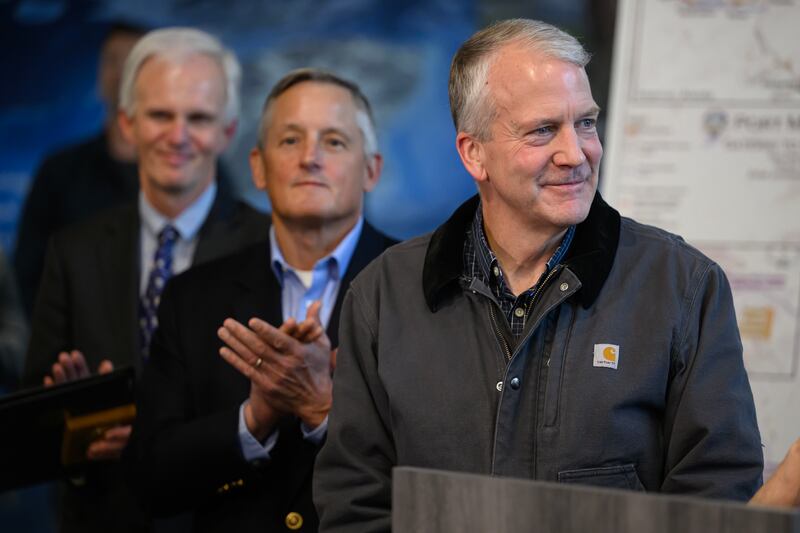 Sen. Dan Sullivan joined U.S. Transportation Secretary Sean Duffy and others as Duffy announced $250 million in federal funding for the construction of a rail line connecting Port MacKenzie to Alaska Railroad’s mainline during an event in Palmer on Oct. 19. (Marc Lester / ADN)
Sullivan, at the Trump rally, said Alaska has economic “challenges” but they’re outweighed by “opportunities” that he’s working on, such as a “historic military buildup” in the state.
He’s pointed to long-term solutions that could take years to pay off, including new drilling opportunities he’s helped create under Trump on federal lands in Alaska, such as in the National Petroleum Reserve-Alaska, where oil companies this year bid on leases at historical levels. He’s also worked to shift significantly more royalty revenue to Alaska from those lands, though that won’t start in 2034.
“But here’s the thing, Alaska, and we have to be aware of this,” Sullivan said at the Wasilla rally. “All of these opportunities will come to a screeching halt if the Democrats in D.C. retake the House and Senate.”
Peltola, for her part, has argued that she supports more oil and gas development in Alaska, and played a key role in getting ConocoPhillips’ huge Willow project approved under Biden.
Sullivan also cites the Alaska LNG megaproject, which Peltola also says she supports, as another opportunity for Alaska. But it’s unclear if the project will ever be built after similar efforts have failed for generations.
Adams, Sullivan’s campaign spokesperson, said that Trump’s tariff-based trade policies with countries such as South Korea have given the U.S. leverage that’s helping Alaska LNG.
Trump announced that South Korea and Taiwan will invest in the project, but the countries have said they are reviewing Alaska LNG for potential investment, sparking criticism that Trump is lying or exaggerating the status of the discussions to support Sullivan.
“Alaska is seeing the payoff: our allies are poised to make major investments in Alaska LNG,” Adams said.
[Trump administration announces hundreds of millions in federal funding for Alaska as election nears]
Though Sullivan has supported the tariffs, his brother Frank Sullivan, CEO of the family’s company, RPM International, described the impacts of tariffs, the war in Iran and the more than 40-day government shutdown in 2025 as contributors to instability that have impacted the company — and led to an increase in prices, according to The New York Times.
Sullivan also points out the federal Department of Energy has announced a $150 million investment to improve the state’s Railbelt electrical grid with construction of a 223-mile transmission line from Beluga to Healy.
That’s another project that will take years to complete. It also requires an additional $268 million in matching grants, from as-yet-unidentified sources.
Those long-term solutions may be hard for voters to grasp, given that they are years away, compared to immediate measures like a proposed tax cut, Belt said.
“That’s generally more effective politically than if you say something that voters can’t put their mind around,” he said.
Tax breaks, Medicaid cuts
Sullivan says last year’s One Big Beautiful Bill Act has put more money in Alaskans’ pockets, in part through its tax breaks on tips, on overtime and for seniors.
But studies have shown that other Trump policies are offsetting the savings, such as the tariffs that have boosted consumer costs.
The Republican-backed federal reconciliation package also made huge cuts to food benefits and Medicaid through stricter eligibility requirements and shifts burdens to states to pay more for food assistance benefits, though Sullivan says it does not cut Medicaid funding for Alaskans.
The program, which serves one in three Alaskans, starting Jan. 1 will implement those additional work standards and require recipients to prove their eligibility twice per year, rather than once. A report issued earlier this year by the Alaska Department of Health estimated these changes could cause 9,000 Alaskans to lose access to the program.
 Sen. Dan Sullivan reacts as President Donald Trump speaks during a rally at the Menard Memorial Sports Complex in Wasilla on Oct. 13. (Bill Roth / ADN)
Sullivan also says that last year he bucked his party and “voted to extend the premium tax credits on Obamacare,” though the effort ultimately failed to pass the Senate.
He also cites his efforts in creating the $50 billion Rural Health Transformation Program in the reconciliation package, with Alaska poised to receive a disproportionately high $1.4 billion share.
The program’s funding does not offset cuts to programs like Medicaid. Federal rules prohibit using the funds for some of the most urgent needs facing the state, like building new facilities and paying providers.
Small steps to lower energy prices
Sullivan has also moved to lower energy costs with actions that could have a quicker payoff, though the benefit of those steps is limited to certain sectors.
He recently said fishermen are eligible for the federal government’s new Harvest Fuel Relief Program, which makes available $8 billion nationally in one-time payments to provide relief for high costs.
He has called for a ban on U.S. exports of diesel products, saying “the cost of diesel is just too damn high.” But Trump rejected that approach.
[‘This is not right’: Murkowski slams high energy costs in AFN speech]
He says he has secured more funding for low-income energy assistance for Alaska households, doubling the federal contribution with an additional $10 million. The program reached only 4,300 households or so in Alaska last year, a fraction of the state’s 270,000 households.
Sullivan also said he helped secure an emergency waiver from the Environmental Protection Agency to increase the diesel fuel that’s produced on the state’s North Slope oil fields.
The step reduces the need to truck tens of thousands of gallons of diesel fuel to the oil fields from Fairbanks, his campaign said.
 Sen. Dan Sullivan waves at passing cars along the Seward Highway near Northern Lights Boulevard on primary election day, Aug. 18. (Marc Lester / ADN)
But diesel gasoline prices are still high in Fairbanks.
A gallon cost $6.57 a gallon this week, slightly lower than the previous month but nearly 60% more than a year ago, AAA reported.
Tim Brennan, with the International Brotherhood of Electrical Workers Local 1547, which has endorsed Peltola, said recently that union members from Fairbanks are struggling with the cost of “simply living.”
“Working families of the Interior must make difficult choices,” he said. “Do I put money away for my kids’ education? Or do I use it to keep the heat on? These aren’t abstract numbers, these are the real decisions being made by Alaska families.”
He spoke at an event organized by the Alaska Democratic Party in Fairbanks, as a counter-protest to the campaign rally that Vice President JD Vance held primarily to boost Sullivan, days before Trump visited Alaska.