
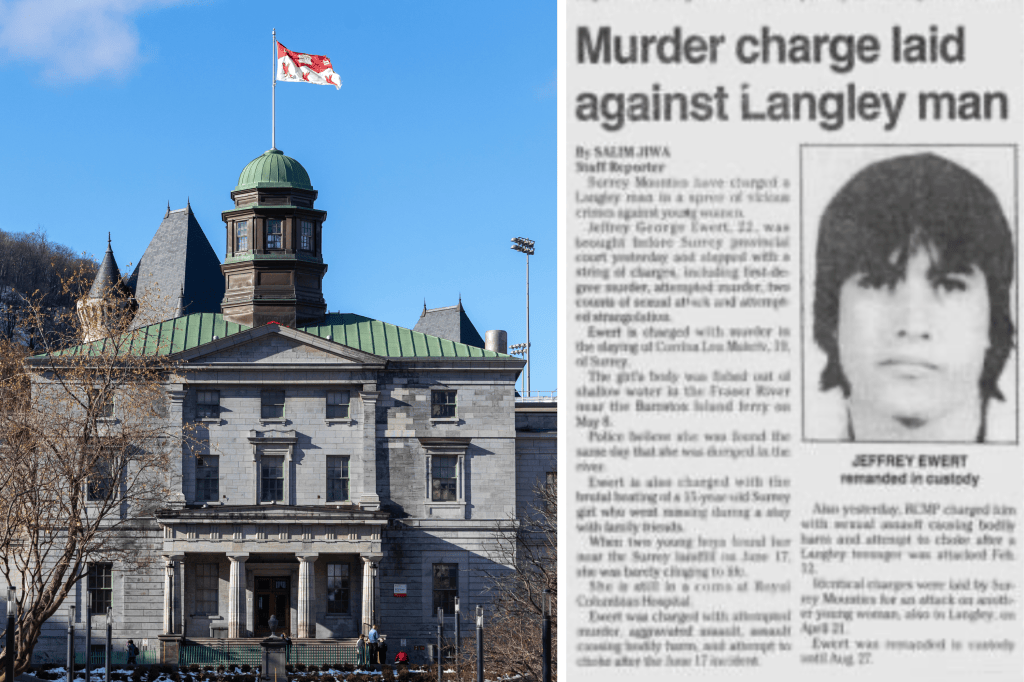
A convicted murderer who had been attending law classes at McGill University was taken into custody Friday after his parole was suspended.
Jeffrey George Ewert, who is serving two life sentences for murder and attempted murder, was detained over breaches of his release conditions, Correctional Service Canada (CSC) confirmed Saturday evening.
CSC said a suspension warrant had been issued and Ewert had returned to custody “while a more thorough assessment of the situation is being conducted.”
“The CSC may suspend an offender’s conditional release when there are reasonable grounds to believe that the offender has breached a condition of release or that the risk they present can no longer be safely managed in the community,” a statement from the agency reads.
It was not immediately clear which parole conditions led to his latest detention. The CSC declined to disclose the circumstances of Ewert’s suspension, citing privacy laws.
“When concerns arise regarding an offender’s behaviour, compliance with release conditions, or ability to be safely managed in the community, CSC takes appropriate action. If the risk can no longer be safely managed in the community, CSC may suspend the offender’s release and return them to custody.”
News of Ewert’s attendance has thrown McGill’s administration and students into turmoil, spurring opposing petitions over whether he should be allowed on campus.
Ewert, now in his 60s after spending four decades in prison, was convicted of second-degree murder and attempted murder after attacking and sexually assaulting two women in British Columbia in 1984. One woman was killed; the other, a 15-year-old girl, survived but suffered extensive brain damage and has never been able to live independently.
Ewert was granted day parole in 2025. And despite repeated breaches of conditions governing his contact with women, including registering on a dating website, the Parole Board of Canada extended his release for another six months in June.
According to parole documents, an assessment placed his risk of violent sexual reoffending in the “moderate to high” range, though close supervision and clinical follow-up could reduce that risk to moderate.
In August, he began his first year at McGill, studying in its prestigious law faculty, where applicants compete each year for about 180 places.
Ewert had not been on McGill’s campus since early October. Students supporting him said they witnessed two security guards escort him off campus.
In a message to students earlier this month, McGill provost Angela Campbell said the university had received information that “could compromise a safe learning environment and student wellbeing” and had taken “measured, decisive action.”
In a statement, the university declined to discuss individual cases, citing privacy laws.
An open letter signed by dozens of law students has since called for Ewert to remain off-campus while the university develops safeguards for his possible return.
The letter, obtained by The Gazette, detailed allegations from women who said encounters with him had left them feeling “uncomfortable” and “unsafe,” alongside screenshots of social media activity attributed to Ewert that the authors said raised concerns about his attitudes toward women and girls. The allegations have not been independently verified by The Gazette.
However, other students rallied to support Ewert. In another petition, signed by more than 120 current and former law students, the students argued excluding him undermined rehabilitation. The petition said Ewert “was taken from his family and community as a child, and he has carried the weight of that rupture, and the harm that followed, through the rest of his life.” It described his incarceration as “inextricable from the colonial institutions in which he was born” and his case as a test of the law school’s commitment to reconciliation and rehabilitation.
The Gazette has contacted Ewert’s lawyer, Nora Demnati, for comment, but did not receive a response before publication.
Editor’s Picks