
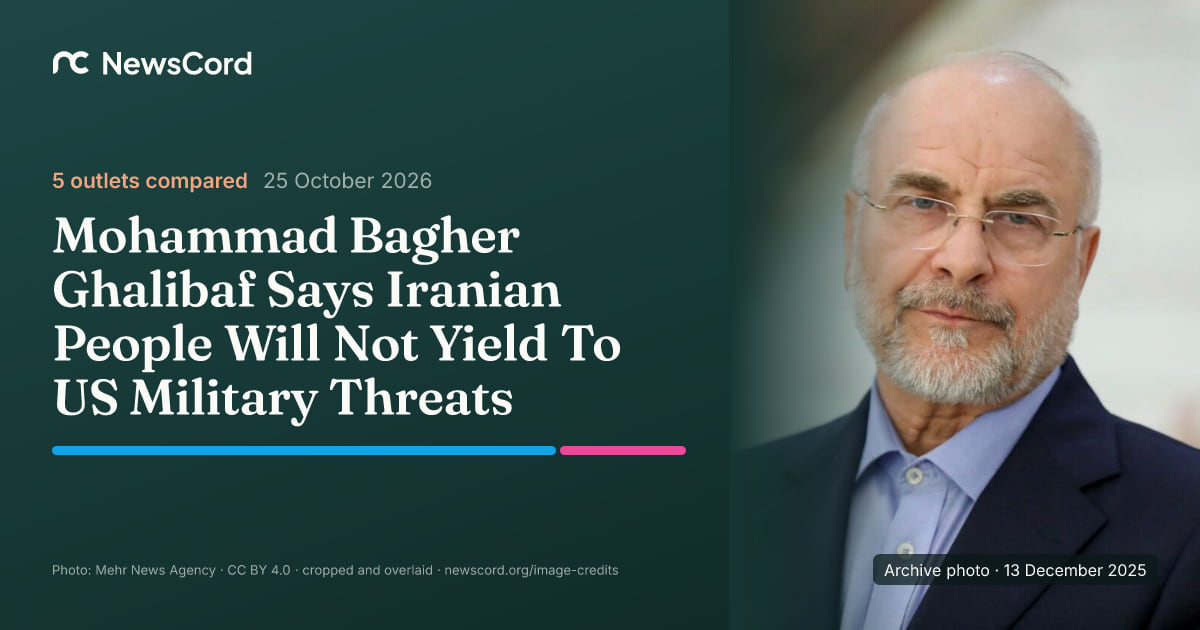
Parliament rejects US threats
Iranian Parliament speaker Mohammad Bagher Ghalibaf told lawmakers on Sunday that “Iranian people will not give in to the US military threats or pressures under any circumstances,” and he tied that stance to US behavior. Ghalibaf said, “Until the US changes its behavior, stops its bullying and makes good on its broken commitments, its claims will have no credibility,” and he added that Iran would “deliver an unimaginable response” to any violation of Iran’s territorial integrity.
What some reports left out
Iranian parliament speaker says no intimidation by the US
Not found in 4 outletsView outletsHide outletsWANA News Agencyشفق نيوزThe Maritime ExecutiveIran International
Ghalibaf argued that the United States “miscalculated and plunged itself into a quagmire” by waging war against Iran, and he said it was “up to the Americans” to take steps to get out. Ghalibaf maintained that Iran would not be intimidated and said, “Threats of large-scale war or assassination will not cause the Iranian nation to back down from their inalienable rights and interests,” while he framed Iran as an “impregnable fortress” of resolve.
Pressure hits borders and trade
WANA said increasing U.S. pressure on Iran and neighboring countries, alongside military movements and the deployment of American forces across the region, added new dimensions to the security situation surrounding Iran. WANA reported that border restrictions were being implemented by Iraq and Pakistan, while it also said that “the Iran-Pakistan border has reopened.”
Shafaq News said Iraq closed the Al-Sheeb border crossing last Wednesday, and it said Pakistan barred trucks from entering from Iran through the Gabd and Taftan crossings over the weekend. Shafaq News added that US Treasury Secretary Scott Bessent said the United States was working with Pakistan and Turkiye to restrict Iran’s land trade routes as part of what he described as a campaign of “total isolation,” and it said the closures threatened to raise transportation costs and delay essential imports.
Blockade and regional escalation
The Maritime Executive said the U.S. naval blockade on Iran was “nearly 100 percent effective” and said Iran had not been able to export oil for many weeks.
The Maritime Executive reported that U.S. Central Command highlighted on Thursday, October 22, that it was marking 100 days since U.S. forces resumed the naval blockade, and it said that as of mid-month U.S. forces had redirected 138 commercial vessels.
WANA said Iranian officials were monitoring increased U.S. military activity in the region and factored it into Tehran’s defense planning, and it said reports indicated increased U.S. military transport flights and military exercises in the airspace of countries neighboring Iran.
WANA also said that, according to the Iranian side, maritime traffic through the Strait of Hormuz had come to a complete halt, and it said Iran warned that vessels violating its restrictions would be targeted regardless of their size or location.