
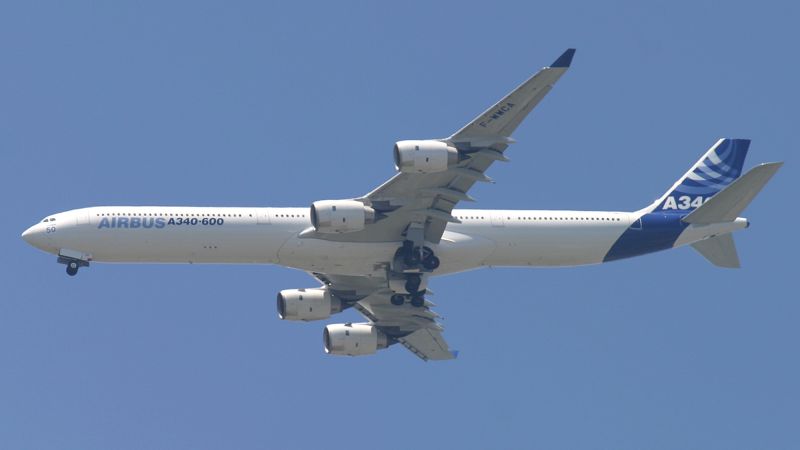
For most of the three decades it’s been flying, the Airbus A340-600 has been seen as a commercial flop — an uneconomical aircraft that was bettered by rivals soon after its launch. Its four engines were thirsty, its record-breaking length required special runway clearance and its quirky design gave it a reputation for eyebrow-raising inflight activities.
But you wouldn’t know that from the fanatical reception one of the few remaining A340-600s got this month when it arrived at Washington Dulles International Airport for a flight that would mark the end of German carrier Lufthansa’s relationship with the aircraft.
As the 17-year-old jetliner, tail number D-AIHW, rolled up to the gate in front of architect Eero Saarinen’s famous jet-age Dulles terminal and control tower, a crowd of aviation enthusiasts swarmed to the windows before joining the crew for a photo with banners highlighting the occasion.
“It’s very sad,” said Chris Godenschwege, who traveled from Berlin to Washington for the final flight to the German city of Frankfurt. “It’s an aircraft with a powerful look.”
Timothy Raemann, from Stuttgart in Germany, was among six friends, all wearing self-made “4 engines 4 long haul” T-shirts, also in Dulles to board the final flight on October 18, and to deliver a cake to the crew. “Four engines for long-haul is always nice,” he said.
It’s not uncommon for a modern passenger plane to have a cult AvGeek following, but the A340-600 is perhaps unusual in being a popular jet that failed to meet commercial aspirations. Even the A380 superjumbo that came after it enjoyed a brief heyday before falling out of favor.
Behind that popularity are several fascinating idiosyncrasies of engineering.
When it debuted in August 2002, the A340-600’s 247-foot-long fuselage made it the world’s longest commercial passenger plane — a title it surrendered eight years later when Boeing introduced the five-foot longer 747-8 Intercontinental. Operating an aircraft of such stretched dimensions called for special dispensations.
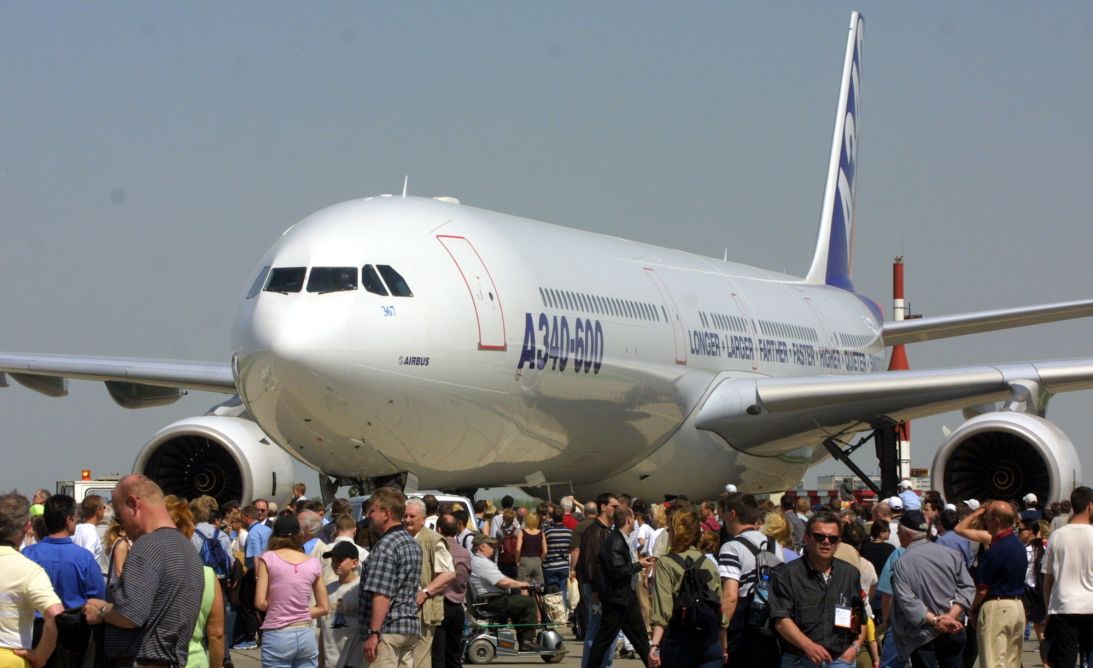
The jetliner needed to be fitted with the airplane equivalent of backup cameras for pilots to see their surroundings while maneuvering on the tarmac. When visiting airports, it also required an extra layer of admin to ensure that taxiways and runways could handle its oversized proportions.
Such were its unusual specifications that in its autumn years, when fewer and fewer of the aircraft were plying the skies, Lufthansa’s A340-600s often had to fly with their own tow bars on board in case the destination airport didn’t have a compatible one.
But its elongated appearance, replete with four Rolls-Royce Trent 500 engines and a wider wingspan, was much admired.
Unusual for a commercial airliner was the interior design eccentricity that gave the aircraft a downstairs lavatory carved out of below-deck space usually reserved for cargo. While this freed up room in the main cabin for more seats, to some more risqué flyers it also created a Mile High Club opportunity.
“The A340-600 is really a special aircraft,” Francesco Sciortino, the captain of the final flight and a member of the Lufthansa Group board, said in an interview before takeoff. “In its time, it was the longest airplane in the world. We flew it now for 23 years, more than 40 million passengers around the world.”
But while fans and aircrews loved the A340-600, the airline industry was more pragmatic in its response.
Airbus launched the A340-600 because it said customers were demanding a large, long-range jet. Airlines from China Eastern to Iberia, South African Airways and Virgin Atlantic agreed, ordering dozens of the new stretched A340. Virgin Atlantic operated the first revenue flight in 2002.
“We see the A340-600 as the ‘classic’ 747 replacement and an alternative to the 747-400 more than a 777X competitor,” Alan Pardoe, the A330 and A340 product manager at Airbus, told the trade magazine Aviation Week in 2000.
But it was never a big seller — the global fleet peaked at just 95 aircraft in 2009, data from aviation analytics firm Cirium shows — and is widely seen as a commercial disappointment.

When Airbus was launching the A340-600, its then-CEO Noël Forgeard predicted that “passengers prefer” the four-engine setup. Airlines didn’t, though, and it proved to be a losing bet as markets shifted.
The A340-600’s advent coincided with the arrival of Boeing’s stretched 777-300 and longer-range 777-300ER — the “777X” Pardoe was referring to.
Those models, with a seating capacity comparable to the stretched A340, met airlines’ desire for a large jet capable of intercontinental journeys, powered by a more economical twin-engine configuration. Boeing went on to sell hundreds of stretched 777s, turning the plane into a bestseller for the American planemaker.
The relatively few A340-600s that did take to the air have become an increasingly rare sight over the past few years. China Eastern flew its last A340-600 in 2015. Iberia and Virgin Atlantic followed in 2020, while South African’s planes held out until 2021.
Mixed fortunes aside, the A340-600, or at least its wider family of aircraft models, is credited with a legacy that helped forge a strong future for its European manufacturer.
“Despite its shortcomings, the A340 was essential to Airbus’s development into a world player,” Pierre Sparaco, Aviation Week’s former Paris bureau chief, wrote in a 2011 commentary piece. The plane, while not a commercial success, laid the groundwork for the double-decker A380, a traveler favorite since it entered service in 2007.
Fans of the A340-600 can still find a few plying the skies. Venezuela’s Conviasa and Iran’s Mahan Air still fly several planes, Cirium data shows. And Lufthansa’s last four models, while immediately sent to storage in Düsseldorf, may end up in the hands of a charter airline before making their way to the scrap heap.

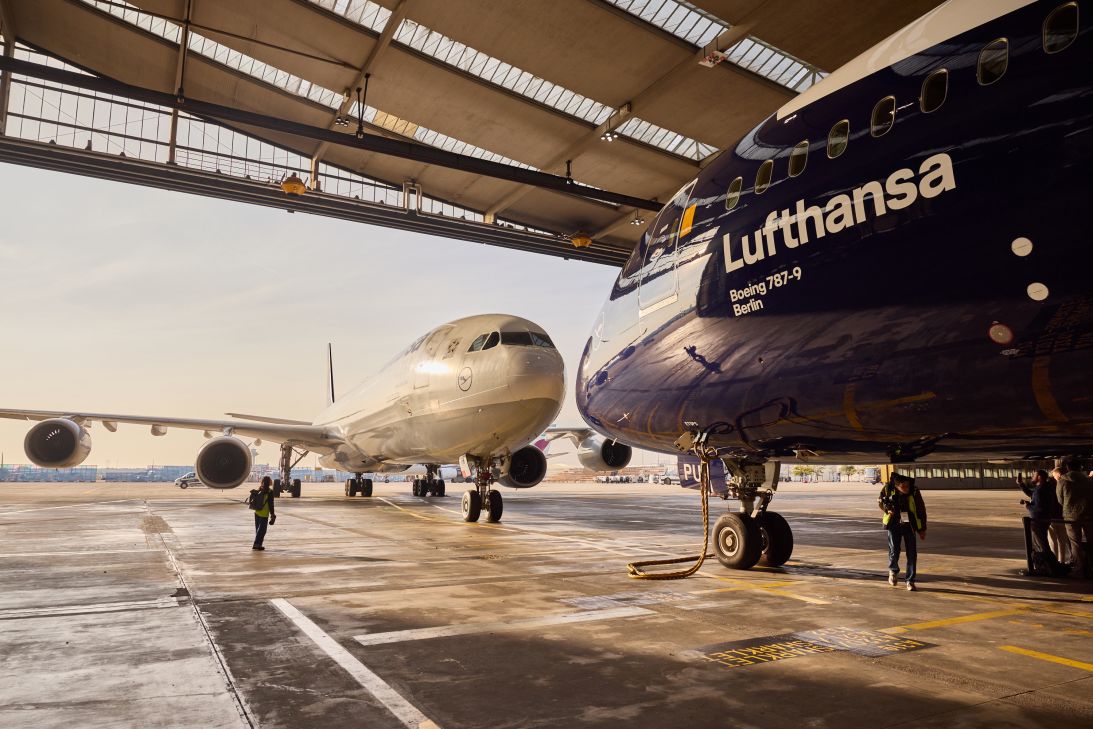
Lufthansa will replace its A340-600s with the Airbus A350-1000, the first of which is expected in December, and Boeing’s long-delayed 777-9 sometime in 2027. Both new planes are not only significantly more fuel efficient but also feature the latest in traveler comforts, including Lufthansa’s new suite of Allegris first, business, premium economy and economy seats.
The same shift is, slowly, coming for the A380 and remaining 747s. Twin-engine planes are as capable as, if not more than, four-engine types with significantly lower operating costs. That’s important to airline managers in good times and especially today with kerosene prices topping $4 a gallon.
“The future is the twin engines,” Sciortino said.
Even so, a small but mighty cohort of flyers will miss the A340s when they are gone.
“It’s very emotional,” Bryn Jennings, an AvGeek who flew in from the UK for the final flight, said while waiting to board in Washington. “To be able to be on the last flight is a privilege.”
He, like Raemann and his friends, sported his own self-made A340-600 goodbye T-shirt.
“To you, the A340-600, thank you for a wonderful 23 years,” Sciortino said in his last remarks before landing the final flight in Frankfurt.
Auf Wiedersehen.