
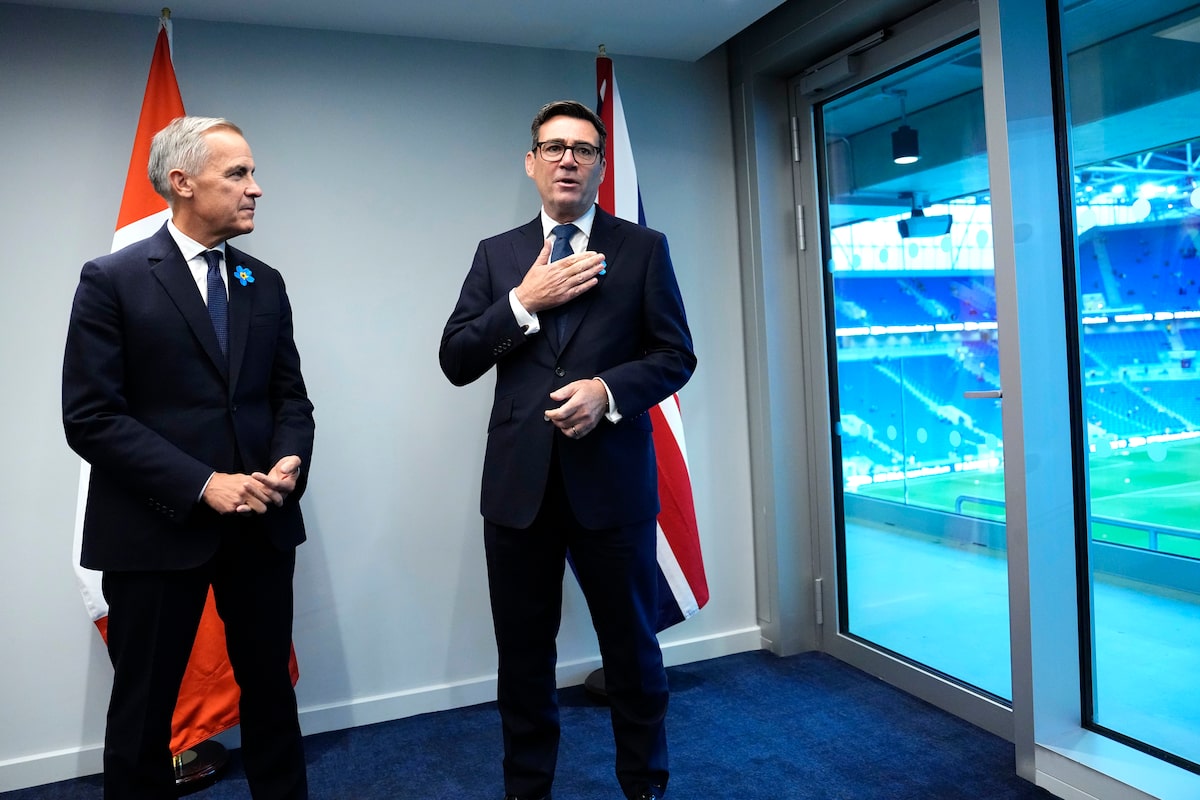
Prime Minister Mark Carney, left, meets with British Prime Minister Andy Burnham at Hill Dickinson Stadium in Liverpool, England, on Sept. 16.Justin Tang/The Canadian Press
Britain will not join the planned Canada-led multinational defence financing bank, opting instead to work toward a separate defence procurement entity after weeks of negotiations.
In a joint statement released Sunday, the two countries said they have “mutually concluded that it is best to develop two distinct but complementary institutions that work in partnership.”
A senior Canadian government official confirmed that Britain will not be joining the institution, known as the Defence, Security and Resilience Bank (DSRB). The official said the two sides determined that it would be better to have the Canadian-headquartered bank focused on providing low-cost capital and the British initiative focused on procurement issues.
Meanwhile, the DSRB is working toward being operational by next year, with a charter-signing ceremony set to take place in the last week of this November, according to two other Canadian sources with knowledge of the situation.
The Globe and Mail is not identifying the sources as they were not authorized to comment publicly on the matter.
The development adds to growing pains for the DSRB, envisioned as a way for NATO members and other allies to work together on raising the capital needed for vast military buildouts as geopolitical dangers multiply.
Canada, Turkey announce strategic partnership to deepen energy, defence and trade ties
The nascent institution so far consists of a small group of founding countries: Canada, Albania, Belgium, Greece, Latvia, Luxembourg, Romania, Turkey and Ukraine.
The bank’s creation was first proposed in 2024, and Canada was announced as the host country in April of this year.
Negotiations between Britain and Canada broke down after government officials spent much of the summer working on a potential merger of the two countries’ defence-finance and procurement mechanisms: the DSRB and the Multilateral Defence Mechanism.
Britain’s MDM is not dissimilar to existing programs within the European Union and NATO. For example, there is the Security Action for Europe instrument, which Canada can also participate in.
The mechanism currently has four countries committed: Britain, the Netherlands, Finland and Poland. It is working toward being set up by 2027. However, little has been said publicly about it since early July, and few details have been made available about its structure.
Britain has been touch-and-go on joining the DSRB since last year. In September, 2025, Britain’s Treasury told Reuters that it had ruled out joining the initiative. A year later, after a change in government, the door to Britain joining seemed to reopen. Prime Minister Mark Carney even headed to Britain to catch a soccer game with British Prime Minister Andy Burnham to help seal the deal of the country’s decision.
Finance Minister François-Philippe Champagne also met with his British counterpart, Chancellor of the Exchequer John Healey, in London the same week to discuss the subject.
However, despite the concerted effort by Ottawa, the sources with knowledge of the negotiations said ultimately that Britain made Canada an offer it could not accept. This included moving the headquarters from Canada to Europe and changing the mandate of the DSRB to focus more heavily on procurement, rather than financing.
Doug Saunders: The West’s dependence on Washington’s defence tech has become a grave threat
At least nine countries will be present at the DSRB signing ceremony planned for November, with the possibility for others to still join before then. After the signing of the charter, further details, such as the Canadian city where the bank will be headquartered as well as the name of its chief executive officer, will follow.
For now, Canada and Britain have agreed to continue working on their respective initiatives to improve defence financing and procurement, with the caveat that one does not compete with the other.
The rest of the countries participating in the DSRB were informed of the breakdown of negotiations between Canada and Britain on Saturday, the sources say.
In the joint statement released Sunday by Canada and Britain, the two sides said they have been working closely to consider how the Canadian bank “can best advance our shared objectives.”
The statement said that as they are operationalized, the two institutions will be designed “to work in close partnership, so that they can support each other on emerging industrial priorities, investment opportunities and strategic financing challenges. Together, they will provide complementary tools to strengthen the defence-industrial base and enhance collective defence readiness.”