
Editor’s note
A court publication ban now prohibits identifying the 17-year-old suspect in the Belinda Sarkodie homicide. His name and photo were previously released under a temporary court order.
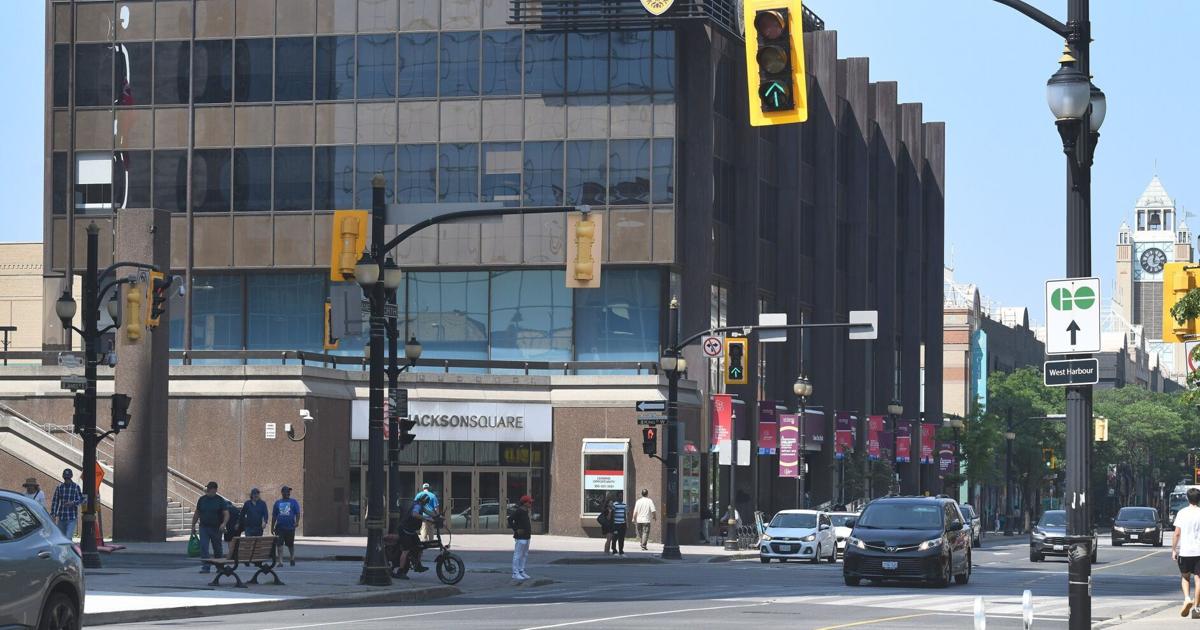
Belinda Sarkodie was headed for the bus home near Jackson Square when she was killed in broad daylight.
Alexander Circiumaru had just left a provincial government office building when he was gunned down on the sidewalk on a weekday at noon.
Both were victims of daytime shootings near two of Hamilton’s busiest intersections on King Street West.

Innocent victim was killed in a shooting outside Jackson Square July 11.
Despite happening steps away from each other, the incidents have their differences — Sarkodie, for example, was a bystander in the July 11 shooting, while Circiumaru, 19, was the intended target of a yet-to-be-charged shooter on March 6, 2024.
But they share one common after-effect: fear.
“When these things happen, when someone is shot in a busy area of a downtown with lots of people around, there is hesitation to go there,” said Pierre Filion, a longtime urban planning professor at the University of Waterloo. “You have that reaction because people are afraid. They think it could have been them.”
Belinda Sarkodie, 26, was fatally shot downtown Hamilton.
Hamilton Police
When Sarkodie was caught in the crossfire of last week’s shooting, thousands of people were a few blocks away, milling about at the James Street North Art Crawl.
Innocent people were also around when Circiumaru was gunned down on the sidewalk last year. As were they three months later, when, in the same city block, a man was seriously injured in a daytime shooting at King and MacNab. The same goes for this past March, when a man robbed a Hamilton Farmers’ Market vendor and fled with a knife — a day after another man was attacked with a knife outside Jackson Square.
A vigil on the King Street West sidewalk where 19-year-old Alexander Circiumaru was gunned down in 2024.
The Hamilton Spectator file photo
Incidents like these do little to help an ailing downtown in the throes of transformation.
As Hamilton grapples with a triple-crises of homelessness, addiction and mental illness, major developments like the $280-million revitalization of the downtown arena, TD Coliseum, promise a bold new era for the core. City plans also offer optimism, such as a still-developing 10-year strategy to address office vacancies, empty storefronts and diminished foot traffic.
Alexander Circiumaru had just left a provincial government office building when he was gunned down on the sidewalk in 2024.
The Hamilton Spectator file photo
Beyond urban planning, attention has also been paid to safety. A specialized Hamilton police unit dedicated exclusively to foot patrol around the core has come to the delight of frustrated business owners who for years complained about safety, thefts and vandalism.
And yet the common perception that downtown is unsafe persists — despite statistics suggesting otherwise.
Police data provided to The Spectator show calls for service in its core patrol area — a 1.3-square-kilometre stretch bordered by Wellington, Cannon, Bay and Hunter streets — have declined so far this year.
Between Jan. 1 and June 30, officers responded to 500 violent incidents in the core, down from 573 over the same period in 2024. Property-related calls also dropped in the first half of 2025, with 266 recorded compared to 320 in 2024, while social disorder calls — think mischiefs, public intoxication and drug use and trespassing — only slightly decreased.
The statistics also suggest the downtown isn’t significantly more dangerous than other parts of the city. Less than 12 per cent of the city’s total violent crime calls this year have originated from the core, where more than nine per cent of the population resides.
For Filion — who has decades of experience as an urban planner, including in Hamilton, where he used to take his undergraduate students for field trips — favourable crime numbers and work on the ground can only do so much to get people comfortable with going downtown.
Instead, it’s the reputation that needs fixing, he said.
“If people have the perception that a downtown is dangerous — even if the numbers show otherwise — they won’t go there because they want to feel secure,” Filion said.
Hamilton police statistics suggest the downtown isn’t significantly more dangerous than other parts of the city. So why do people think it is?
Cathie Coward/The Hamilton Spectator
As a group of people sat against the wall of a vacant downtown building Wednesday, keeping cool under some shade, kids around the corner skipped through bursts of water at the Beasley Park splash pad.
“That’s the first time we’ve seen that in a while,” Hamilton police Const. Tyler Strangest said on a routine patrol of the area.
“It’s a good sign,” added his colleague, Const. Nicole Barton, about the children playing.
Const. Tyler Strangest joined Core Patrol earlier this summer. Downtown business owners have lauded the program and the increased officer presence has made their staff and patrons feel safer.
Sebastian Bron/The Hamilton Spectator
The pair are two of six members of Hamilton police’s core patrol program, a specialized unit created in 2023 amid mounting concerns from downtown shops over vandalism and thefts.
Split into three teams, officers rotate on 10-hour shifts Monday to Saturday, patrolling a concentrated area and hitting hot spots, like Beasley Park, Ferguson Station and Jackson Square.
The unit knows the core and its residents well.
Part of their job is to pop into businesses and speak with staff; so far this year, they’ve visited downtown locales more than 1,800 times, according to police statistics. Another part is helping the scores of vulnerable residents they come across — some of whom they know by name.
The boosted presence has made a difference, shop owners say.
Const. Nicole Barton approaches a group of homeless people next to a vacant building at Beasley Park, asking them if they need water or help connecting with outreach programs.
Sebastian Bron/The Hamilton Spectator
“Before we used to have problems all the time with people coming in and disrupting,” said Rizgar Rada, owner of Lulu’s Shawarma on John Street North.
“We don’t see those problems as much thanks to those guys,” he added, pointing to Barton and Strangest.
Recently, Barton has seen differences in the downtown. When she first joined core patrol in April 2024, she said she would often hear from concerned parents about drug paraphernalia in parks.
“Lately, they’ve expressed they see a difference with us constantly being here,” she said, pointing to the kids in the splash pad as one small example of progress.
Here’s what four people said about their sense of safety in light of the shooting.
But Barton is also aware that police presence alone can’t bring more foot traffic to the core.
Asked if the downtown gets a bad rap, she said: “Absolutely.”
“My friends will always ask, ‘Oh that happened, oh this happened.’ But I just explain to them that the core is good, it’s safe, and that we still need to come down here and support our businesses,” added Barton, who grew up in the city.
“Because that’s the only way things will get better.”
There is no dispute that some people fear downtown.
At a recent general issues committee meeting, Coun. Brad Clark said “categorically the vast majority” of Ward 9 residents don’t go downtown and consider the area “dirty.” He added crime in downtown is “really scaring people.”
“You hear about the crime, you hear about the violence, you hear about the shootings,” Clark said at the meeting, which took place before the latest fatal shooting. Although he noted violence and shootings happen “all over the city,” he suggested “predominately, the statistics point to downtown.”
Police statistics don’t suggest it’s quite so stark.
There have been two shootings in the core patrol area this year compared to 20 across the city — including three in Clark’s ward. Additionally, only nine of the record-setting 60 shootings in 2024 occurred in the core, according to police data.
In an interview, downtown councillor Cameron Kroetsch said it makes sense people have a constant eye on the core given it’s the heart of Hamilton.
“But it’s not the only place we’re seeing these kinds of issues and violence; it’s something we’re seeing city-wide,” Kroetsch said, arguing not enough is discussed about the precursor to the downtown’s present troubles — namely the pandemic. “It had a massive impact on downtowns across the country.”
Kroetsch pointed to plenty of work done in recent years to heighten downtown safety, from increased policing and a “clean team” to lighting improvements, office space incentive programs and pedestrian safety initiatives.
Unfortunately, crime knows no boundaries.
The common perception that downtown is unsafe persists — despite statistics suggesting otherwise.
Cathie Coward/The Hamilton Spectator
Consider the death of 21-year-old Harsimrat Randhawa, who was killed by a stray bullet in April while waiting for the bus on the Upper James Street — far from downtown. Like Sarkodie, police said she was an innocent bystander, caught in the wrong place at the wrong time.
During an interview this week for Placeline Hamilton, a podcast hosted by Spectator columnist Scott Radley, deputy chief Ryan Diodati said criminals don’t take “backdrop” into consideration when they try to take out a rival or send a message.
“They have a goal. They have an objective. And the peripheral, that’s not something on their list to worry about,” he said.
But where that backdrop is plays an important part in how people perceive a neighbourhood — especially if it’s downtown, the focal point of most mid-sized cities.
“That perception of fear is amplified when something happens in a dense space like downtown,” said Greg Dunnett, president of the Hamilton Chamber of Commerce. “And it sends a ripple effect across the community, particularly for businesses.”
Dunnett said last week’s fatal shooting is a reminder that work remains to change the reputation of downtown.
It comes at an important time, he added.
The downtown stadium will soon reopen as a flashy centrepiece for downtown. Paul McCartney is set to perform to a sold-out crowd in November. Under-construction condo buildings are progressing by the day. And down the pipeline, the long-awaited LRT has been touted as a catalyst for economic renewal.
“We have this opportunity to change that narrative with these things coming up,” Dunnett said. “But we have to take the right steps for progress and invest in things that help create a safe space downtown.”
—With files from Mac Christie