
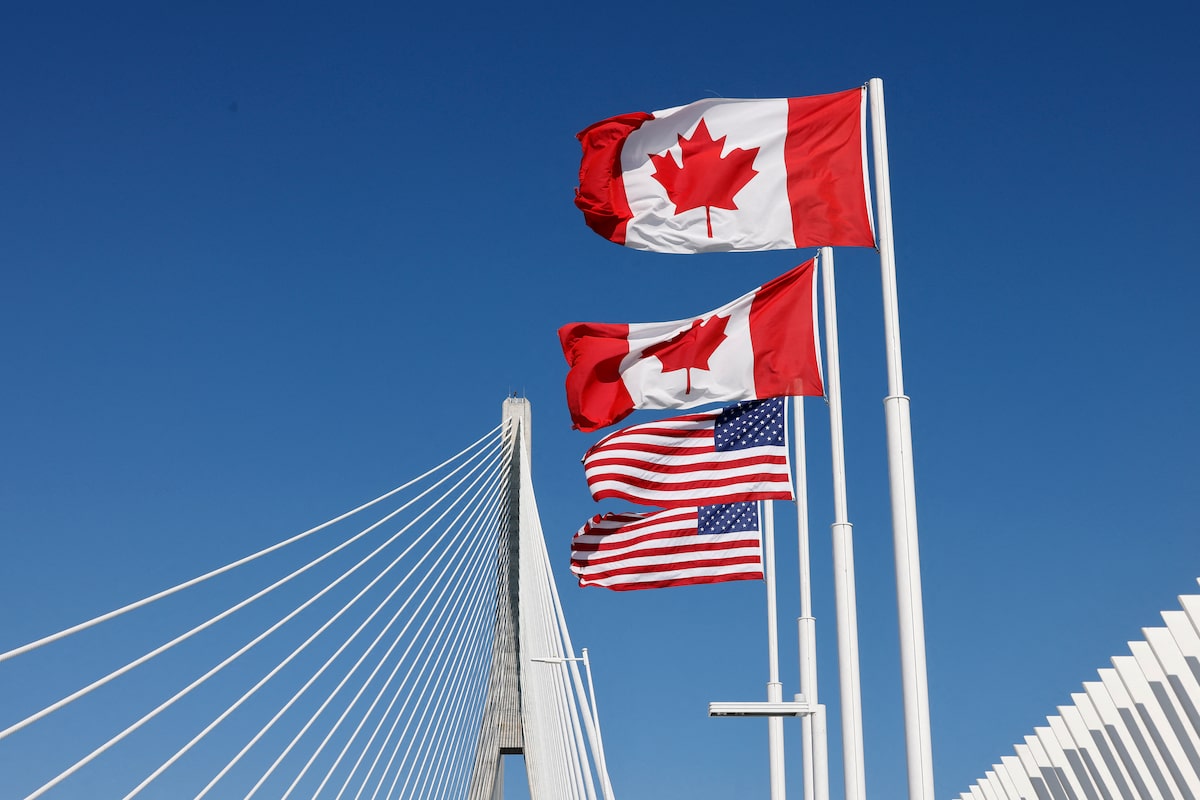
Flags fly over the Gordie Howe International Bridge between Windsor, Ont., and Detroit. The lifting of some U.S. tariffs and the addition of 100 new categories will have a roughly equivalent monetary impact.JEFF KOWALSKY/AFP/Getty Images
The shifting front line in the U.S-Canada trade war will lessen the economic pain in border states while still targeting Canadian manufacturing capacity, experts say.
The lifting of 50-per-cent tariffs on 22 categories of goods by the United States and the addition of 100 new categories will have a roughly equivalent impact in terms of dollars – about $2.5-billion in goods were exempted with about $2.6-billion newly targeted – but will also shift some of the focus away from products U.S. businesses need for their own operations.
Senator Susan Collins of Maine has taken credit for lifting the tariffs on some packaging products, which she said had impacted Maine businesses such as apple and blueberry growers.
Alongside its tariff adjustments, the Trump administration has also said that it’s nearing a trade deal with Canada. Kevin Hassett, the top economic adviser in the White House, told Fox News on Sunday that negotiations are “gathering steam” and that Commerce Secretary Howard Lutnick has been speaking with Canadian officials “all week.”
No timeline to resume formal trade talks with U.S., chief negotiator says
According to Wolfgang Alschner, a law professor with a specialty in business and trade at the University of Ottawa, there are lots of examples of integrated cross-border supply chains where tariffs hurt U.S. businesses and consumers as much or more than they strike at Canada.
“With tighter North American integration, it made total sense for states like Maine to trade with Quebec for supplies for local industries. Now of course with the border being a harder border you really have to re-evaluate those relationships,” Mr. Alschner said.
He said some of the new tariffs are on finished retail products such as shampoo, which won’t have a strong localized impact in any particular geographic market – such as a border state with a tense and close Senate election battle raging.
“I think that makes perfect sense from a defensive point of view. You ideally want to spread out the pain,” Mr. Alschner said.
In depth: Once solidly Republican, Iowa is becoming a swing state again
Some other new tariffs could turn up the pain on specific industries in Canada.
One example is in the hardwood flooring market, where U.S. tariffs against China and Vietnam have caused those countries to shift exports to more open nations such as Canada.
According to William Pellerin, partner with law firm McMillan LLP and co-leader of its international trade group, even before the new tariffs on Canadian hardwood, his group of eight flooring manufacturing clients based mainly in Quebec and Ontario were struggling to compete domestically against imports.
“[China and Vietnam] totally flooded the market at prices that are ludicrously low. The Canadian producers have been able to survive by selling products to the U.S.,” Mr. Pellerin said.
Many of the companies are benefiting from federal work-share programs to keep the lights on. “A lot of the companies had layoffs, a number are on work-share, with workers on maybe three days a week,” he said.
But in the longer term, Mr. Pellerin said restricting imports of overseas hardwood may be the only path forward.
Obama criticizes Trump’s tariff war with Canada at U.S. midterm rallies
Kyle Peacock, principal at Peacock Tariff Consulting, said he has identified another pattern in the types of industries that are being targeted: U.S. companies with Canadian manufacturing sites that could see production shifted back to America.
“We had that on lip balm,” Mr. Peacock said. Since the first round of tariffs, he said five of seven Canadian sites making the wax or other parts of lip balm have either stopped shipping to the U.S. or are planning to relocate. In New Brunswick, social media darling Eclair Lips announced in October it would no longer make its lip balm in Canada, moving production to Vermont.
But even trade relief doesn’t necessarily change the case for manufacturers “re-shoring” operations back to the U.S.
A week ago, Polyethics Industries in Orillia, Ont., announced 118 layoffs, which Mr. Peacock said is part of the company shifting capacity to its factory in Antwerp, Ohio. The company makes polyethylene plastic products such as garbage bags that are now subject to tariff relief, but while Mr. Peacock has consulted with them, he still expects the company to move the remaining production to the U.S. in the coming weeks.
According to him, the company faced other rising costs, such as soaring diesel prices and transportation costs thanks in part to the U.S. war with Iran. Tariff relief won’t be enough to move the needle.
“That’s one piece of a very big pie that’s making us move,” Mr. Peacock said he was told.