
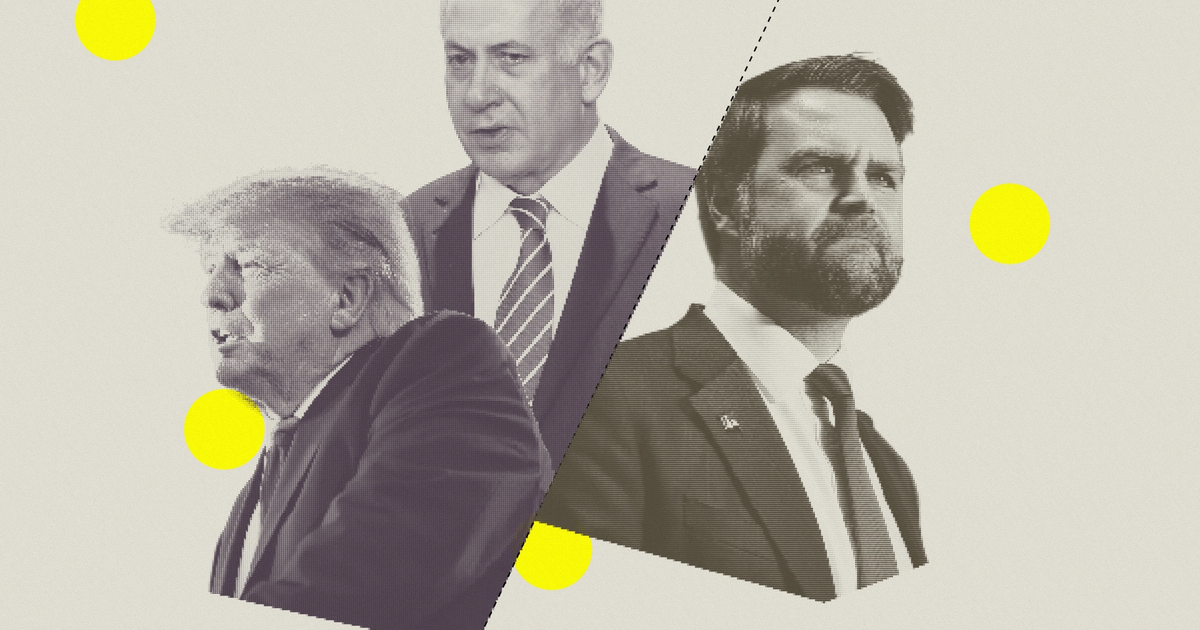
Donald Trump’s wartime alliance with Benjamin Netanyahu is exposing a divide within his party that will outlast his presidency — over what “America First” really means for the US-Israel relationship.
Making peace between the GOP’s pro-Israel establishment and its restive right wing will pose an early challenge for Vice President JD Vance, who’s positioning himself for a posible 2028 run. But any Republican looking for the nomination to succeed Trump will have to sidestep the same sort of internal clashes over Israel that have bedeviled Democrats.
Trump’s position is clear: The US president, even amid open tensions with the Israeli leader, has aligned tightly with Netanyahu and endorsed his reelection. A White House official, in a statement to Semafor, emphasized Trump’s “great relationship” with the prime minister.
Yet that position, unpopular with factions in both parties, is also unpopular with some inside his deeply loyalist White House.
“At the mid-level and upper levels of the administration, there is not only real frustration, but real anger with Netanyahu’s government,” said one Trump administration official. “There’s a feeling that they oversold what they could do vis-a-vis Iran, and about how fragile the Iranian regime was. There’s a feeling that we had to bear a lot of the brunt for actually defending Israel.”
The next president, regardless of party, will face specific questions about how much to sustain the long tradition of direct US military aid to Israel and deep US integration with its military.
Netanyahu himself, as he prepares for an election that could end his leadership in its current form, acknowledged as much in a Friday interview: “Tens of billions of US aid dollars to the defense budget — get used to it — won’t keep coming. Because America has changed. Not because Israel has.”
And as Trump nears his lame-duck era, partisans on both sides of the Israel debate are watching every 2028 hopeful, including Vance. Texas Sen. Ted Cruz, a longtime backer of the Israeli government, could try to cut into Vance’s advantage with likeminded donors if he runs; others in the party are hoping Secretary of State Marco Rubio jumps into a primary for the same reason, though it’s less likely.
Vance, meanwhile, is trying to balance Trump’s level of support for Israel against a populist right wing that’s increasingly questioning the current relationship.
In private conversations and public meetings, Vance has sought to assure pro-Israel Republicans that he holds no animus toward the Jewish state, while arguing that the relationship should be more explicitly guided by US interests. Earlier this year, he compared the US relationship with Israel to that of countries like France and the UK.
“When we’re partnered, great, let’s work together. And [when] we’re not, let’s just be honest about it,” he said.
Vance declined last week either to endorse or to criticize Netanyahu (Trump appeared unconcerned, telling reporters it’s “up to him”). As Vance put it to Joe Rogan in July, he’s merely a “guy advocating for a normal relationship with a normal country.”
That posture may not please either side, but it has helped mollify his critics, to an extent.
“I do not think he hates Israel. I don’t. I don’t think he’s an antisemite, not by any stretch,” said Sid Rosenberg, a conservative radio host who met privately with Vance last month at the White House amid the VP’s charm offensive on the subject. “But I don’t think he has the same passion for Israel moving forward as somebody like Marco or Ted would.”