
Ever since I lived in Israel in 1989 and reported on Israeli politics, every election has been billed as existential.
Mundane stuff like housing, irrigation, taxes or energy costs, that keep most of us busy in other countries before polling day, are overshadowed by the big questions: what kind of society should Israel be? Do Israel’s neighbours threaten it with extinction? Does Israel wage war with its neighbours or make peace?
What can it offer the 5.3 million Palestinians who live under occupation and don’t get a vote for the Knesset’s 120 members? What room is there for an ultra-Orthodox Jewish community that does not believe in sending its boys to the army because it doesn’t believe the Israeli state should have been founded before the return of the Messiah.
You’re reading the latest edition of FourGround, a bespoke newsletter brought to you by Channel 4 News’ experienced journalists reporting on the ground from locations across the world.

The Bible and the Torah play an outsized role in politics here. Not least because the number of Israelis who believe that the occupied West Bank and Gaza Strip should be part of a Greater Israel now far outnumbers the Israelis who believe the Palestinians deserve their own state.
Jewish tribal divisions are everywhere. Even the ultra-Orthodox are divided between Hasidic Jews of European descent, the United Torah Judaism list and Shas, the ultra-orthodox party from the Sephardic or Mizrahi community.
Some parties, like Avigdor Lieberman’s Israel Homeland, represent the one million or so Jewish citizens who left the Soviet Union after the collapse of communism. Russian is their first language.
Israeli Palestinian citizens make up 21% of the population and have their own political parties. They should be courted assiduously as kingmakers but aren’t because, they claim, most Israeli parties are fundamentally anti-Arab and racist.
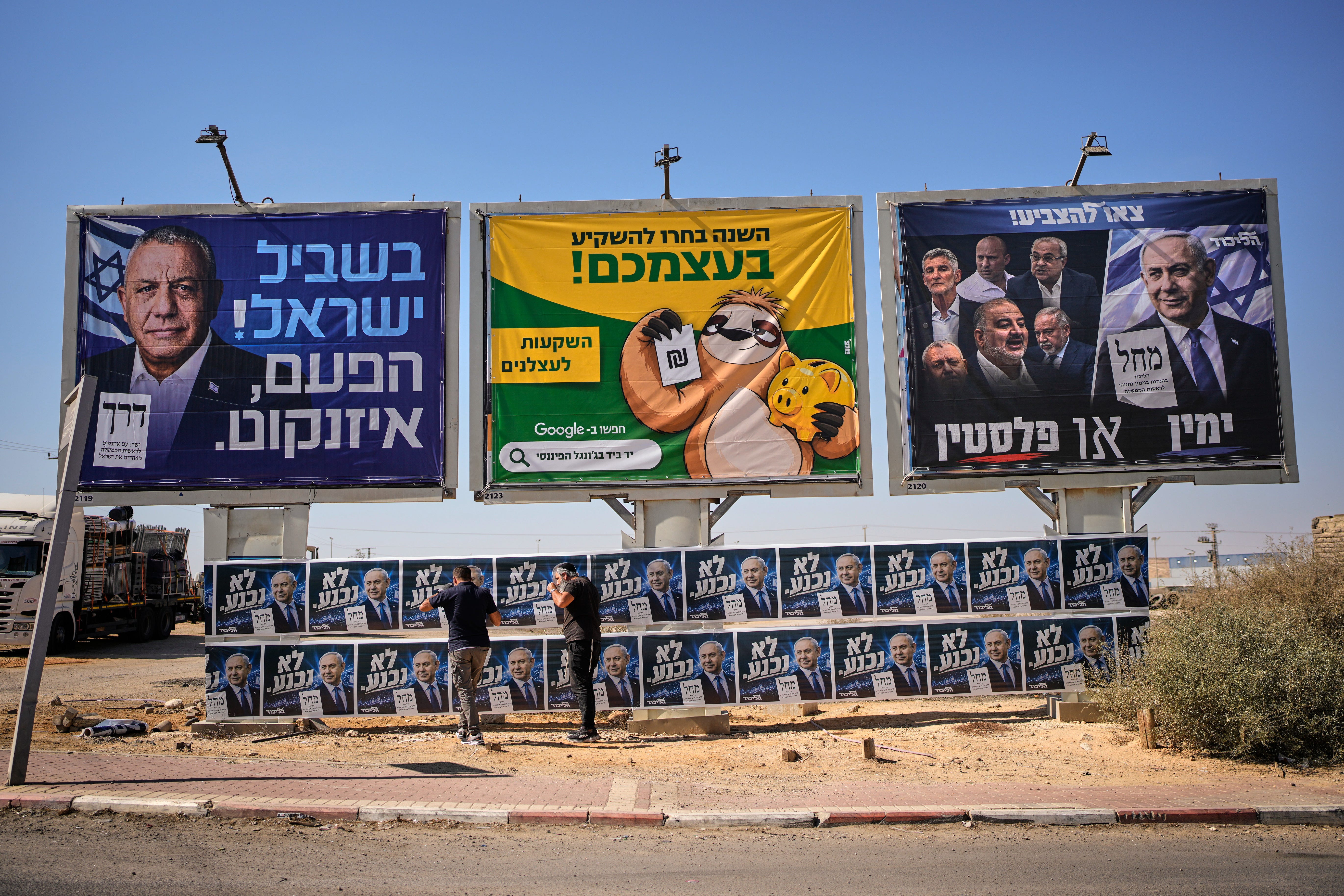
The main slogan of Netanyahu’s ruling Likud Party is: Jamin or Falastin. Right wing or Palestine. In other words: unless you vote for us, the right, Israel becomes Palestine.
This is clearly not true. But Likud appears to have calculated that many voters hate Palestine more than they hate the veteran survivor Netanyahu, pictured above, and his baggage of alleged corruption.
The division between Ashkenazi Jews of European descent – the traditional ruling class from which every Israeli prime minister has hailed – and Sephardic and Mizrahi Jews of Hispanic or North African descent – represented this time round by the man most likely to unseat Prime Minister Netanyahu, Gadi Eisenkot – is also significant.
A Jew of Moroccan origin from a working-class background who ended up heading the IDF, Eisenkot is the anti-Netanyahu candidate. His gritty origins are part of his appeal, as is his personal sacrifice.
He lost a son and two nephews in the Gaza war. He is bound to his electoral base by grief. But he is not in favour of a separate Palestinian state and indeed he came up with the military doctrine of inflicting disproportionate civilian casualties to achieve military aims against Hamas in Gaza. This rolled the pitch for tens of thousands of deaths after the October 7 massacre.
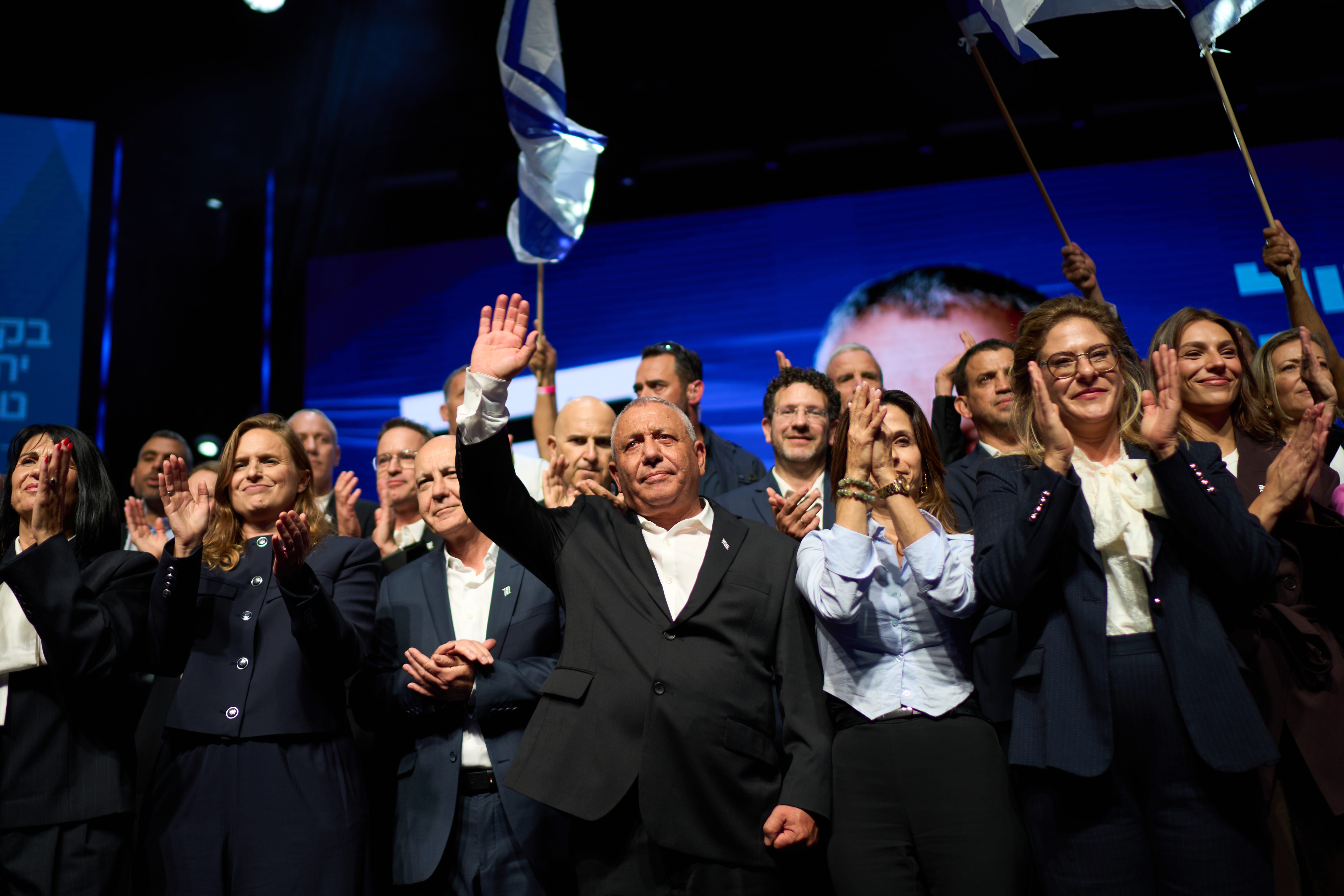
Eisenkot, pictured below centre, is not a charismatic speaker like Netanyahu. A lack of verbal varnish is also one of his appeals. Nor is he versed in the dark arts of coalition building. He may have to learn fast after election day.
One of the country’s leading pundits on the TV channel closest to the government described him as a “Moroccan monkey”. This racist insult has only boosted Eisenkot’s support and exposed the tribal snobbery at the heart of Israeli society.
All these divisions are almost as old as Israel itself, but they have been heightened after almost three decades of on and off government by Netanyahu. What’s more, the massacre of October 7 has reminded Israelis just how vulnerable they are. But the resulting rage and revenge has also limited the response to more military than political options.
Every Palestinian issue is a nail. Every solution is an Israeli hammer. When I lived here almost four decades ago, a slim majority of Israelis believed in a two-state solution. That is no longer the case.
Gaza has mainly cropped up on the campaign trail as a set of competing promises about destroying Hamas. Hardly any party is talking about a horizon of dignity for 5.3 million Palestinians, who might as well live in a separate universe behind walls and fences under skies filled with drones, but whose daily lives are wholly dependent on the whims and wills of the Israeli occupation.
This glaring dark reality rarely impinges on the conscience of ordinary Israelis. The Israeli economy is booming, despite war. The beach in Tel Aviv is heaving with sunbathers and families who have mastered the survival skills of resilience.
But one hour down the same beach is Gaza, rendered a primeval wasteland of devastation with a mass grave, two million refugees and no obvious future.
All these divisions have festered at the heart of Israeli society. Add to them the key fissure in this election between those who think only Netanyahu can protect Israel from its many enemies, with the help of his best friend Trump, and those who think he has exposed Israel and made it weaker as a pariah state abandoned by even its best friends in the West.
 How support for Israel in US is declining
Those who see his power as paternalism and those who abhor it as corrosive corruption. Bibi versus anti-Bibi (to use his nickname): that is the definition split at the heart of this election.
But Israel’s system is not presidential. It is parliamentary, based on pure proportional representation – there are no constituencies – with a 3.25% hurdle to prevent the smallest parties from getting into the Knesset.
And yet small parties like the ultra-Orthodox or the extremist settlers of the Jewish Power party, behind the abrasive and frankly racist Security Minister, Itamar Ben-Gvir, tend to hold the balance of power. They are the kingmaker and they can demand a steep price. Just ask Bibi.
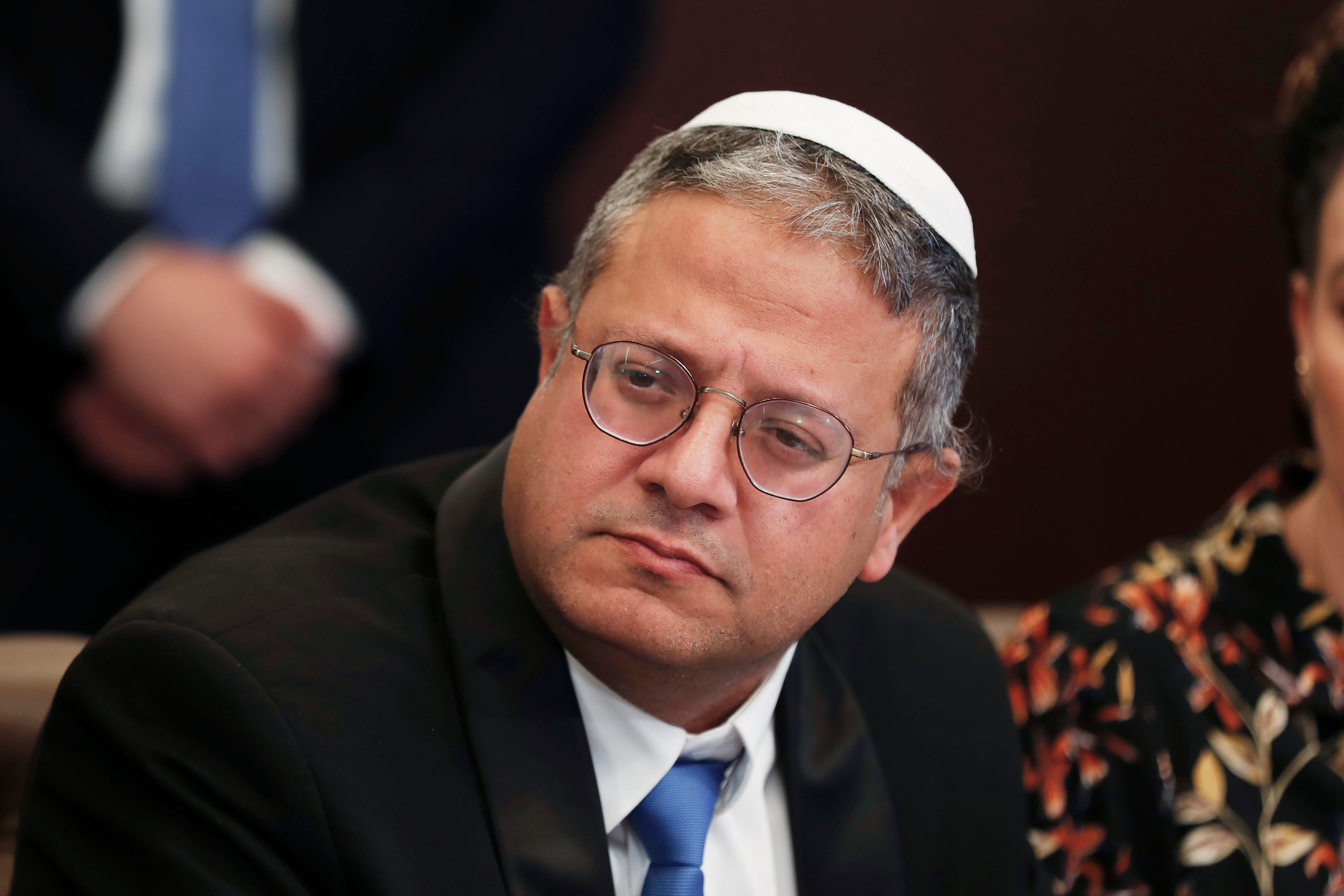
More annexation of the West Bank, for instance. This has been advocated by Ben-Gvir, pictured below, and the other settler minister Bezalel Smotrich. Such a move would be explosive, not just here but in the whole region. A third intifada would be all but inevitable.
Or how about a law to exempt the ultra-Orthodox from performing military service even if seven out of 10 Israelis find their exemption abhorrent. They are having children at a much faster rate than the rest of society and if Israel is to continue fighting wars on multiple fronts, their refusal to fight enshrined in law will become political dynamite. The wish list of unreasonable demands is real and dangerous.
The true contest to form the next government will kick off once the ballot boxes close and the balance of numbers is clear. The party with the biggest votes does not necessarily get the nod to form the government. You come to the table of power with your majority block.
It’s all about the deals, the pay-offs, the betrayals. The governing sausage may be a distortion of the popular will. And making that sausage is always unappetising.
It could also be futile. If no majority emerges, Israel could be back at the polls in less than three months. It happened four times between 2019 and 2022.
But while the parties haggle, the Palestinians of the Gaza Strip and the West Bank are ringside observers in a drama that will determine their future without a vote and without hope.
They are kept out of sight and out of mind, watching as what used to be the rump of a once promised future state is munched away by aggressive settlers and an army of diggers.