
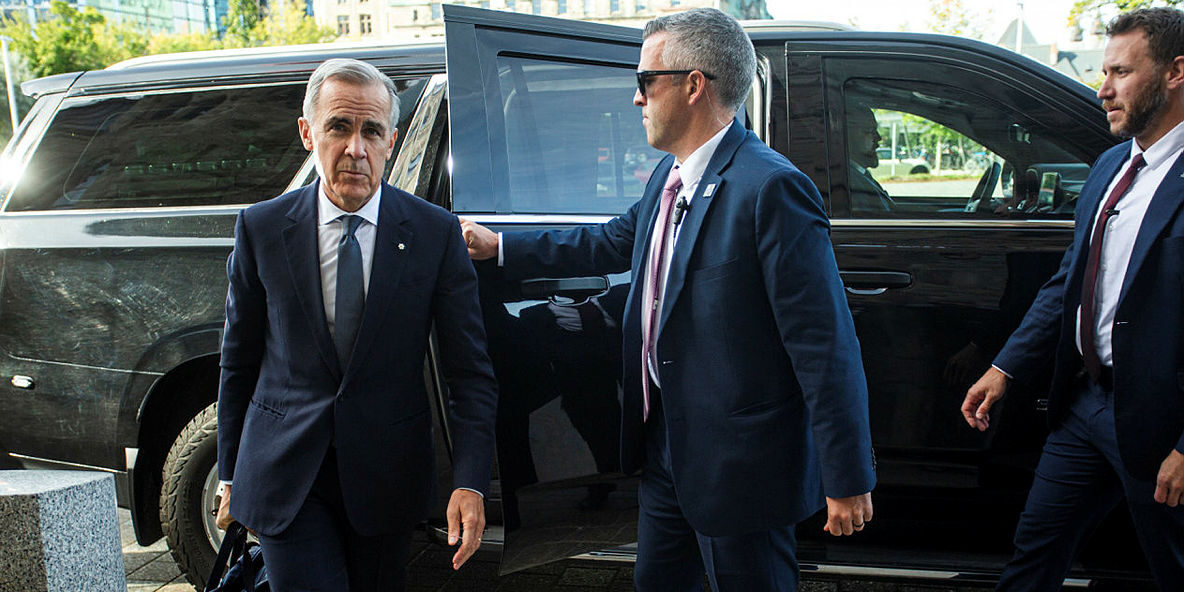
A decisive win for the “stay” side in last week’s Alberta referendum, the prime minister’s high personal popularity, and the emergence of a new Alberta-focused right-of-centre federal political party could help the governing Liberals win as many as 10 to 15 more seats in the next election, say some politicos.
“Mark Carney is a big winner from this [referendum],” said Duane Bratt, a professor of political science at Mount Royal University, in an interview with The Hill Times.
“I mean, you can imagine if it was 55 to 45 [per cent], people would be blaming Mark Carney for it. So if it’s 75-25, then Mark Carney’s got to get some credit for this, and the fact that he is the most popular politician in the province, speaks to that.”
Bratt said that, based on the current political landscape in Alberta, Prime Minister Mark Carney’s (Nepean, Ont.) Liberals could win five to nine more seats in Calgary and Edmonton’s major urban centres in the next federal election.
Alberta’s Oct. 19 separation referendum yielded a clear victory for the “stay” side. In the referendum, Albertans rejected holding a proper referendum on separation from Canada by a three-to-one margin. Around 75 per cent of voters indicated they wanted to stay in the federation, while about 25 per cent voted to start the legal process to hold a binding referendum.
The wording of the separation question stated: “Should Alberta remain a province of Canada, or should the Government of Alberta commence the legal process required under the Canadian Constitution to hold a binding provincial referendum on whether or not Alberta should separate from Canada?”
According to Elections Alberta, a total of 2,045,704 Albertans voted on the separation question. Of these, 1,535,368 voted to remain part of Canada, and 510,336 voted to start the legal process for a binding referendum.
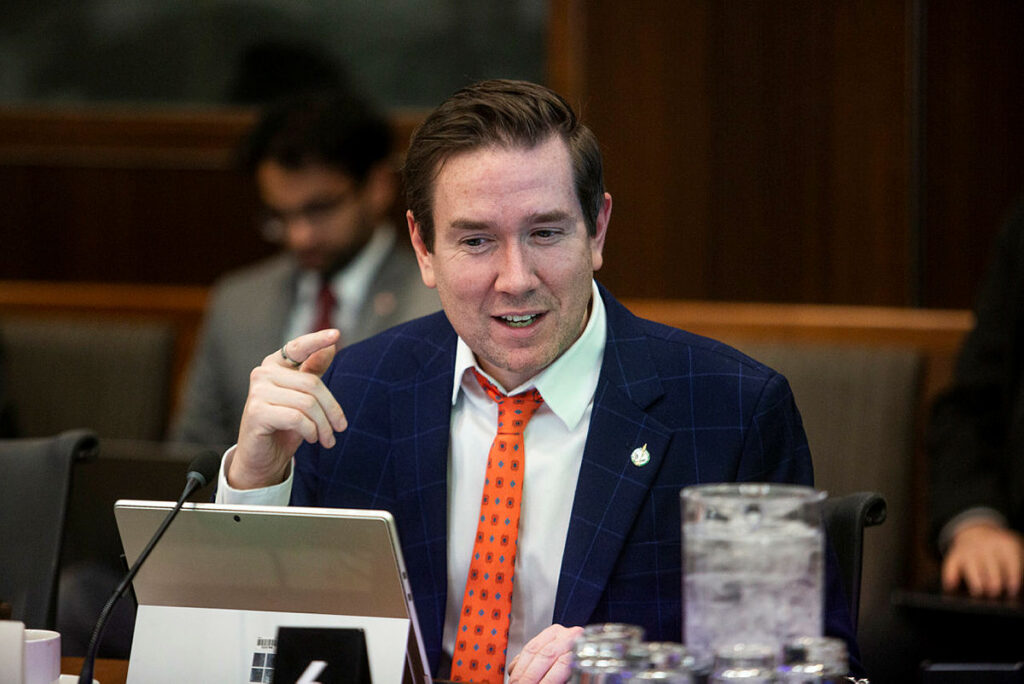 Corey Hogan is the only Liberal MP who won a seat in 2025 in the Alberta city of Calgary. Pundits are now saying the Liberals could win more seats in that province in the next general election. The Hill Times photograph by Andrew Meade
Voter turnout in the referendum was 65 per cent. In comparison, 93.5 per cent of Quebecers voted in the 1995 separation referendum.
In addition to the separation question, Albertans also voted on nine other questions on issues like immigration and constitutional reforms. Elections Alberta is scheduled to announce the official results of all 10 questions on Oct. 29.
A Sept. 18-22 Ipsos poll of Alberta residents suggested that Carney was the most popular politician in that province. The poll found that 51 per cent of Albertans had a favourable view of the prime minister, ahead of Conservative Leader Pierre Poilievre (Battle River-Crowfoot, Alta.), whose popularity was at 44 per cent. Alberta’s NDP Leader Naheed Nenshi was at 35 per cent, and Alberta Premier Danielle Smith at 34 per cent.
‘Everything in Edmonton and at least five in Calgary’: Stephen Carter
Stephen Carter, a high-profile Alberta strategist and an architect of several come-from-behind victories, said that if the current polling numbers persist for Carney until the next election—which may not happen for another two years—the Liberals could win at least 10 more seats in Edmonton and Calgary. According to Canada’s fixed date election law, the next federal election is scheduled for Oct. 15, 2029. The law, however, allows the prime minister to call an earlier election if he wants.
“An additional 10 [seats] for sure, and possibly as many as 15,” said Carter in an interview withThe Hill Times.
“Almost a full sweep of Calgary and Edmonton in terms of the number of seats that would be taken. It’s massive. Everything in Edmonton. Every Edmonton seat is now in play. And at least five in Calgary: McKnight, Skyview, Centre, Confederation, and possibly even like a Crowfoot.”
Carney’s Liberals already hold the Calgary Confederation riding. The Conservatives won the other four seats in March 2025: Dalwinder Gill won Calgary McKnight by a 3.1 per cent margin; Greg McLean carried the Calgary Centre riding by a 4.4 per cent margin; Amanpreet Gill won Calgary Skyview by a 17.9 per cent margin; and Pat Kelly won Calgary Crowfoot by a 21.5 per cent margin.
Poilievre’s Conservatives currently hold 33 of the 37 seats in Alberta, the heartland of the party’s base. The Liberals hold three, and the NDP one. The Liberal MPs who won in the last election are Emergency Management Minister Eleanor Olszewski (Edmonton Centre, Alta.), and Corey Hogan (Calgary Confederation, Alta.). This past February, Matt Jeneroux (Edmonton-Riverbend, Alta.) left the Conservative caucus to join the Liberals. The best result for the Liberals in Alberta in the last two decades was the 2015 election when they won four seats—two in Calgary and two in Edmonton. Jeneroux won his riding by a 4.4 per cent margin, Olszewski by a 4.4 per cent margin, and Hogan won his riding by a 1.8 per cent margin.
Winning the Conservative nomination in Alberta has long been seen as a virtual guarantee to secure a seat in the House. In private conversations, Alberta Conservative MPs jokingly say that campaigning during elections cost them votes. So, they travel to other regions of the country to help their party candidates.
There are nine federal seats in Calgary and 11 in Edmonton. Of these, based on seat projections by polling aggregator 338canada.com, only the riding of Calgary Shepard is a safe Conservative seat right now. Conservative MP Tom Kmiec carried this riding in the last election by a margin of 39.8 per cent of the votes. Others are either Conservative-leaning, Conservative-likely, a toss-up with the Liberals, or CPC likely. In the last election, the Conservatives won all but one seats in Calgary. And they won all but two seats in Edmonton. The NDP holds only one seat in Alberta, with MP Heather McPherson having won Edmonton Strathcona by a 13.8 per cent margin in March 2025
In Edmonton, according to the polling aggregator, there are no safe Conservative seats. In the last election, the Conservatives won all but two ridings in the Alberta capital city.
Too early to say how nascent Alberta Now Party could affect elections
Drew Barnes, a former UCP-turned-Independent Alberta MLA, told The Hill Times that he is in the process of starting a new federal party, called Alberta Now, which will likely be up and running in the next couple of months. Once registered with Elections Canada, the new party will run candidates in any byelections—if one were to open up— and also in the next federal election.
He said the new party would follow the Bloc Québécois model of promoting Alberta’s interests and getting concessions from the federal government. Barnes said he has spoken with a number of former Conservative MPs in the province and two incumbent MPs about the new political party, but declined to share any names or the feedback from these politicians.
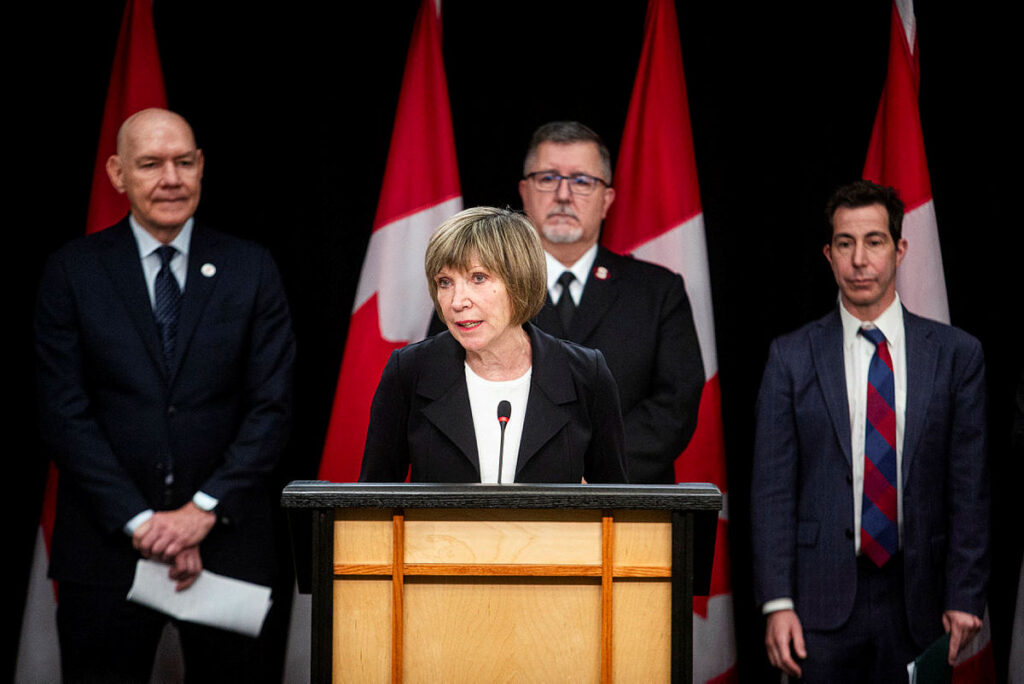 Emergency Management Minister Eleanor Olszewski, centre, is the only Liberal MP who won an Edmonton seat in the 2025 general election. But political insiders like pollster Janet Brown say the Liberals could win more in the City of Edmonton in the next election. The Hill Times photograph by Andrew Meade
For decades, Barnes said, Albertans have thrown their support behind the Reform, Canadian Alliance, and now the Conservative Party, but in order to form government and to appeal to voters in other regions of the country, the party has failed to advance the province’s interests in Ottawa. Alberta Now, Barnes said, would be focused on the province’s priorities, same as the Bloc does for Quebec.
“They [the Conservative Party] allow their votes to be whipped in a way that is not beneficial for Alberta in a way that lets the parties and the leaders try to earn votes in [Ontario’s] 905 [Toronto region], in Quebec, or in the Maritimes, and Albertans want a voice in Ottawa,” said Barnes.
“That’s the first step. The second thing is like the Bloc Québécois, which has been there for Quebecers, and at times has won up to 50 seats, Quebecers always have an outlet to have a little more provincial and regional representation, and Alberta Now is going to do the same thing.”
Barnes represented the provincial Alberta riding of Cypress-Medicine Hat as a Wildrose and United Conservative MLA for three terms from 2012 to 2023. Then-premier Jason Kenney kicked Barnes out of UCP caucus over his criticisms of the provincial government’s pandemic policies. Barnes did not seek re-election in the 2023 provincial election.
Janet Brown, CEO of Janet Brown Opinion Research, said it’s too early to predict what impact the burgeoning Alberta Now Party would have on future federal election results. She said the new party would most likely have an impact in rural areas, but the Conservatives win with such large margins that shaving off a small chunk would not make any difference.
As for the winners and losers in the Oct. 19 referendum, Brown said the winners are the “stay” side, and the losers are the “leave” side. She disagreed with the opinion that Carney is the winner in this exercise, arguing that his entry in the campaign did not make any significant difference in people’s opinion. In the lead-up to the referendum, Carney stayed mostly out of the picture, but did attend some rallies in the campaign’s last few days.
“These numbers [the referendum result] are very close to what the polling showed, and the polling has not changed over the last year and a half,” said Brown.
Get Today’s Headlines Newsletter
Your quick scan of the news you need each weekday to be the smartest person in the room.
By entering your email address you consent to receive email from The Hill Times containing news, analysis, updates and offers. You may unsubscribe at any time. See our privacy policy
“So, even though Mark Carney is a popular figure here in Alberta, there doesn’t seem to be any evidence that he convinced people who were leaning towards separatism not to lean towards separatism.”
She, however, agreed that with Carney’s current popularity, the federal Liberals could win more seats in the next election.
Cory Morgan, a senior columnist for the Western Standard magazine, said that the new Alberta Now party and Carney’s popularity could give Liberals an opening to win seats in urban centres like Calgary and Edmonton.
“Very possibly in the urban areas,” said Morgan, who campaigned for the “leave” side in the Oct. 19 referendum, and is the author of The Sovereigntist’s Handbook.
“In the rural, I mean, you still look at the numbers, and you’re looking at 70-per-cent type of Conservative support.”
arana@hilltimes.com
The Hill Times

Abbas Rana is the assistant deputy editor at The Hill Times. He reports on parliamentary caucuses, nomination contests, party leadership campaigns, the Prime Minister’s Office, and cabinet. Rana won the 2025 Ontario Community Newspaper Award for Best News Story (circ. over 8,000) for his story on Conservative nominations in that year’s election. Contact him at arana@hilltimes.com. See all stories BY ABBAS RANA