
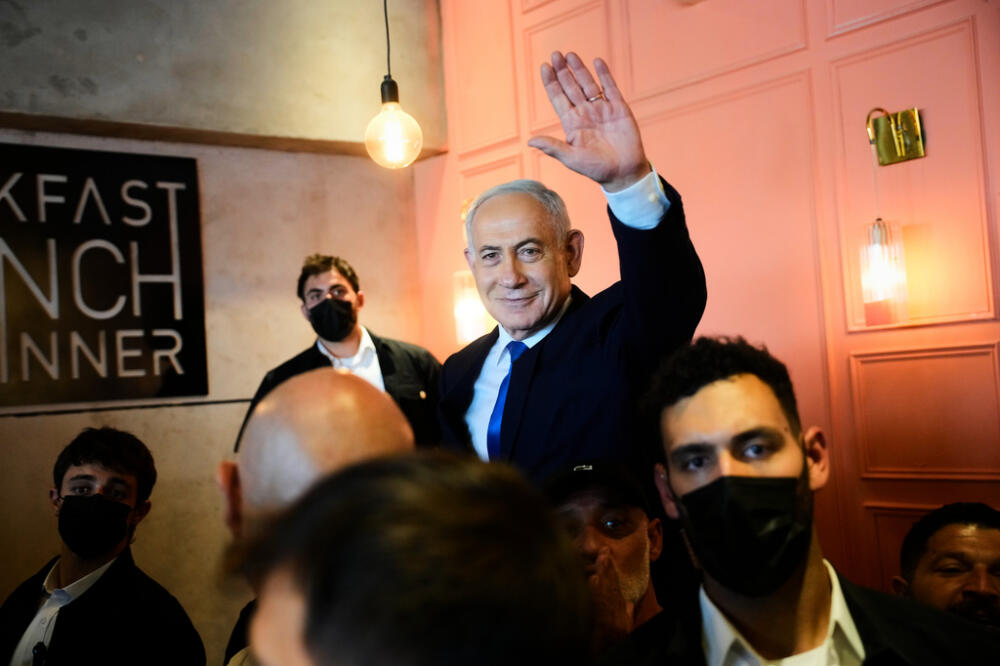
Israel goes to the polls in a razor-close election. What the results will mean for the trajectory of the war with Iran, ongoing conflict in Gaza and the West Bank and the future of U.S.-Israel relations.
Guests
Dahlia Scheindlin, Public opinion researcher and international political strategist. Senior columnist at Haaretz. Author of “The Crooked Timber of Democracy in Israel: Promise Unfulfilled.”
Also Featured
Mohammad Darawshe, Director of Strategy at Givat Haviva’s Center for Shared Society. He researches Arab community in Israel.
Gilad Malach, Research fellow at the Israel Democracy Institute specializing in Israel’s ultra‑Orthodox (Haredi) community.
The version of our broadcast available at the top of this page and via podcast apps is a condensed version of the full show. You can listen to the full, unedited broadcast here:
Part I
MEGHNA CHAKRABARTI: This week, a major election is taking place that could determine the trajectory of the war with Iran. Tomorrow, Israelis vote in their first national election since the Hamas-led attacks of October 7th, 2023, and this election is seen as a referendum on the leadership of Israel Prime Minister Benjamin Netanyahu.
A sitting U.S. president has never publicly endorsed a candidate in an Israeli election. That is, until last week, when President Donald Trump announced he is supporting Netanyahu, urging Israelis in two Truth Social posts to reelect Netanyahu so the two leaders can, quote, “finish the job,” end quote, against Iran.
Netanyahu thanked Trump in a recorded call.
NETANYAHU: Donald, we have a job to finish. You said it, and we’ll finish it together. We’ll finish it, and no one else will do it.
TRUMP: Actually, I actually crafted that one myself. That wasn’t one that was put out by some guy writing something. That was crafted by me. You’re a warrior.
CHAKRABARTI: CNN reports today that Israel has been preparing to resume strikes against Iran over the past week, and that Netanyahu had been lobbying Trump to join the attacks before tomorrow’s Israeli election.
Quote, “Netanyahu really wanted and tried to convince Trump for a joint attack in Iran before the elections, and Trump did not give a green light,” end quote. That is from an Israeli source who reportedly told it to CNN. The failed push to escalate the war may also indicate increasing tensions within the Israeli government because CNN also reports that Israel Defense Forces Chief of Staff, Eyal Zamir, warned U.S. Joint Chiefs Chairman Dan Kane that new attacks could disrupt the vote in Israel, and that led to the U.S. to resist Netanyahu’s push.
Within Israel’s Channel 12 elaborated with more reporting over the weekend. A, quote, “unprecedented confrontation is unfolding between IDF Chief Zamir and Prime Minister Netanyahu,” the report said. Zamir had been resisting carrying out the military action. He reportedly wanted further deliberations, and Netanyahu’s signed guarantee for legal authorizations for the strikes.
Netanyahu’s office denies both reports. Now, more broadly, Benjamin Netanyahu is Israel’s longest serving prime minister. Whether he will stay in the job after tomorrow’s election is another question entirely. Polls suggest that Netanyahu’s governing bloc may not win enough seats to remain in power, which makes tomorrow’s election perhaps the most consequential one in Israel for years, both for Israel and for the United States.
So to get a deeper understanding of what’s at stake here, I wanna turn to Dahlia Scheindlin. She’s a political analyst, public opinion expert, and a columnist for Haaretz. She’s based in Tel Aviv. She’s also author of The Crooked Timber of Democracy in Israel: Promise Unfulfilled. Dahlia, welcome back to On Point.
DAHLIA SCHEINDLIN: Oh, nice to be back here, Meghna. Thanks for having me.
CHAKRABARTI: I’d like to actually just start with your summary of that biggest question. In Israel, what is at stake for Israelis with tomorrow’s election?
SCHEINDLIN: It’s a great question, but it’s one that’s increasingly difficult to answer by characterizing all of Israelis.
I think that Israelis are deeply polarized between not only the usual fragmentation of parties and different subgroups that we have in Israeli society, which goes way back, but in particular, society is deeply divided between supporters of the government and supporters of opposition parties, and they have completely different things on their minds, even though they do share some issues.
Israelis are deeply polarized.
Dahlia Scheindlin
But let me give you a sense. You opened with the issue of striking Iran, and I think that for supporters of the government they are completely convinced that Israel is in an existential war with external enemies, and only Netanyahu knows how to fight them, and only Netanyahu knows how to manage the pressures from outside actors who are not in Israel’s favor.
And they also believe those pressures are coming from Israel’s allies, which is true. And they think that Netanyahu has the greatest kind of strength and savvy and experience on the global stage to manage Israel’s interests as best as possible in order to fight the wars that they believe Israel needs to fight in order to survive.
These people, again, the supporters of the government I’m talking about, also believe that Israel is fighting back against internal enemies. That’s part of the populist appeal. There is a strong sense that there are internal forces trying to weaken the country by not being as committed to the wars against external enemies as they should be, or trying to take down right-wing governments through unelected institutions, kind of a classic populist narrative.
But a lot of people really believe that who are supporting the government. And just to give you some numbers, we’re talking about roughly 40% to 43% of the voters according to all of the polls towards the end, but really, it’s been a very consistent number. Right now, the current government is polling at around 50 to 52 parliamentary seats out of 120.
Reflecting what I just said, about 40 to 43%. But now we have to talk about what Israelis care about who are supporting opposition parties, and that represents at present a majority of the voters. We’re looking at 55 to 60%. And of course, these could still shift on election day. But those people have some different concerns.
Of course, they are concerned about external enemies, and of course, they certainly see that Israel is facing very serious threats both from Hamas and Iran and proxies, et cetera. But they are more than anything convinced that Netanyahu has taken the country in the wrong direction.
They are infuriated by the lack of accountability of this government in refusing to establish a state commission of inquiry. They feel the wars are being fought in a way that prejudices Israeli, Israelis who are serving in the army while ultra-Orthodox Israelis are not serving in the army, and they have a blanket exemption.
Most of them are not serving in the army and have not been since the start of statehood. Now, these seem like very specific issues that outsiders are a little bit less attuned to, but I think that certainly from Israeli Jews who are supporting the Zionist parties of the opposition, those are the two hammering issues that are of very deep concern.
They, of course, stand for the image of this government as one that is completely indifferent to the needs of the people, one that has not taken responsibility, and one that has led Israel into this chaotic situation. Then of course, there are Arab or Palestinian citizens of Israel, and I think the biggest driving force from every person I speak to is to get rid of the ultra-nationalist Jewish supremacist parties that have been such a key part of the outgoing government that has really had an extremely material impact on their lives.
There is a serious problem with organized crime and homicide that has, the rate has shot up since this government took power, and most of that is within the Arab community. So they feel like this is a very direct threat and they feel very motivated to go out and vote in order to support opposition parties against the current government.
CHAKRABARTI: So there are actually several large issues there. And I actually appreciate the summary because it’s a good survey of the complexities of how different groups of Israelis feel right now. So throughout the course of the rest of the conversation, Dahlia, I’d like to actually take these sort of piece by piece.
And I want to start with one of the middle ones that you talked about, that people who are opposed to Netanyahu’s leadership feel that he and his government have been indifferent, as you said, to the needs of the people. That’s very interesting because as you know better than anyone, Netanyahu himself has frequently said that he’s anything but indifferent to the existence of the Israeli state.
And in fact, very recently in speaking with The Jerusalem Post, he basically said that his entire political career has been in defense of Israel. So here he is.
NETANYAHU: I don’t need the job I’m fueled by a mission and the mission that I stated in right after 1979 when the Iranian revolution took place, I said, “This will be a mortal threat.” And I’ve dedicated the bulk of my adult life to try to prevent them from having the means to destroy us, and we’re well on our way to achieve that, and that’s what has to be decided now. Who will finish the job?
CHAKRABARTI: Dahlia, I wanted to ask you that from the perspective of American listeners issues of Israeli elections are often, or just Israel itself are whittled down to Israelis versus Palestinians, the existence of the Israeli state in terms of the threats from states like Iran.
So how do these two things balance against each other with Israelis themselves? Because as you said, Israelis aren’t in denial about the threat from Iran, but at the same time, they seem to be souring on the leadership of a man who said my entire political career is to fight against such threats.
SCHEINDLIN: I think that for a very long time, Iran was considered a looming threat, but not quite that, not so imminent. And yes, Israelis worried about it, but they never really saw Iran as their number one security threat. Netanyahu was always working very hard to put it at the top of people’s agenda.
And in general, he has always tried to claim that he was Mr. Security, defender of the country, the only one who would be tough, but a lot of that was actually belied by his actions or things that he did or didn’t do. He never did strike Iran before he had the opportunity after October 7th to rally the U.S. kind of support and cooperation even though there were times when he seemed to threaten, to be willing to do that.
And even with Palestinians, right? He liked to talk tough, and he had people in his government who liked to talk tough. He led Israel through an accelerated cycle of wars, but they were wars that he always was assuming he could keep restrained. They were limited in time and scope. He called them mowing the grass.
His general approach was to try to play the two forces off of one another, Hamas and Fatah, so that he wouldn’t actually have to do anything, not full-scale war like happened after October 7th, and certainly not a peace process, which would’ve been the other direction. So in some ways, he talked a bigger game always.
Now Israelis do see Iran as a threat, and Iran’s part, the regime is certainly partly responsible for that, for its kind of talk. Of course, Netanyahu also talks about wanting to destroy the Iranian regime. It’s quite a mutual and frankly, mutually convenient kind of threat. But I think what happened was that over the course of the two wars that Israel did fight with Iran in June 2025 and in February 2026, Israelis could not help but notice that the wars did not achieve the aim of destroying Iran’s nuclear program, its ballistic missile program, its regional proxies, and it certainly didn’t topple the regime.
And so those are kinds of, those were basically the main goals that Netanyahu was outlining more or less explicitly for the toppling of the regime. But Israelis understood it, and you couldn’t miss that they just were not achieved, and Israelis, were extremely, well Israeli, the Israeli Jewish population was extremely supportive of both wars at the time.
But support began to decline as the disruption to Israeli life went on and on, and the goals were not achieved. And then, they felt like Netanyahu had not really managed it well. Trump had forced the ceasefire. And so I think ultimately, even supporters of the opposition who may have supported the wars against Iran are reverting to something they thought well before these wars, which is Netanyahu is making most of his decisions to protect his own political position.
Now, again, the issue of Iran was a bit of an exception because people thought that he was doing it for security reasons, but then they were disappointed with the outcome.
Part II
CHAKRABARTI: I just want to take a moment here to talk specifically about one of the issues that you mentioned before the break, and that is an unrelenting despair and anger about October 7th, 2023, and specifically Netanyahu’s leadership around that moment, because the Hamas-led attacks of that day are on the minds of Israeli voters in a way that maybe American voters wouldn’t think about.
Because it’s not about how the Israel Defense Forces have responded in Gaza to the attacks. That’s obviously a major issue here in the United States. But it’s specifically around Prime Minister Netanyahu’s perceived responsibility for what happened on October 7th. So earlier this month, at a memorial ceremony, a father whose son was killed on October 7th shouted his anger at Netanyahu.
The father there is saying, quote, “You didn’t protect my son on October 7th. You didn’t protect 1,200 people who were murdered in one day on October 7th. Shame. Disgrace.” End quote. Now, as far as we can tell, there has been a slow but continuous drip of reporting questioning what Netanyahu knew before the attacks, allegations that officials from Egypt and the United Arab Emirates warned Netanyahu about a possible Hamas attack.
And Netanyahu’s former military secretary even says that the prime minister may have received repeated warnings about the risk of war. Now, Benjamin Netanyahu denies receiving advance warnings of the Hamas attack. He says security officials failed to alert him in time. He spoke with Middle East Eye in August.
(AUDIO PLAYS)
CHAKRABARTI: Netanyahu there saying, quote, “If they had woken me up, everything would have looked different. And that’s the story of October 7th.” But bereaved families, as Dahlia has said, have been calling for years for an official inquiry into what happened. And that’s where Netanyahu’s main challenger, Gadi Eisenkot, has made accountability for October 7th a central part of his promise to Israelis.
It was his closing message at his campaign launch in July.
(AUDIO PLAYS)
Eisenkot there saying, quote, “For Israel, we must ensure that when October comes again, the government of the awful October will finish its chapter in history, and we will begin a new chapter in the history of Israel, a far better chapter, because Israel must prevail, and it will,” end quote.
Okay, so Dahlia, just briefly, if you can explain what’s going on in terms of public opinion in Israel about Netanyahu and October 7th, and then I want to ask you about Eisenkot specifically. But go ahead.
SCHEINDLIN: I think that like I said, my thesis in the beginning is that Israeli society is so deeply divided over this, we can really only talk about the politicized division of supporters of the opposition parties versus supporters of Mr. Netanyahu. We have to understand these are such different worldviews that supporters of Netanyahu either believe Netanyahu when he says, “It’s a lie. I did not know about these warnings. These warnings didn’t happen,” or Netanyahu, at one point, regarding the reports that the Egyptian intelligence chief came to Israel said, “I demand to know who he met. I don’t know who he met.”
They’re saying either it’s true that he knew nothing about it, or, and I spoke to one longtime loyal Likud voter, Mr. Netanyahu’s party, and she said, there are warnings all the time. There’s warnings since the beginning of statehood. You can’t blame this on him.” So they support him. They have ways of rationalizing that. Whereas for the opposition, it is exactly the opposite. Now, I should be clear, that I think everybody in Israel thinks the blame is shared, certainly by the failures of the Shin Bet, the internal security agency, the army and army intelligence.
They all believe that the security and intelligence establishment has a lot of responsibility for missing this, but many of those leaders have already resigned. And so what they see is that the people who have the ultimate authority, particularly Netanyahu, have avoided any responsibility. So the people at the very top who have the most overall responsibility are the ones who have shirked it at every possible way.
And Israel does have a tradition and a law in place allowing for the establishment of independent state commission of inquiries. These are headed by a Supreme Court justice. Once upon a time, that was not a controversial prospect, but this ties into so many of the deeper issues that we didn’t even talk about in the beginning, which is what preceded October 7th.
The attempt to overhaul and undermine the independence of the Israeli judiciary has come from Netanyahu and the right wing. They have been arguing for years, laying the groundwork among the public opinion, that the judiciary is a political player who is working against the interests of the people and their constituencies.
The attempt to overhaul and undermine the independence of the Israeli judiciary has come from Netanyahu and the right wing.
Dahlia Scheindlin
Many people on the right wing, not exactly a majority, but a fair number close to a majority agree with them. And so they have been saying this entire time that a state commission of inquiry, which once upon a time would have been seen as the most authoritative and independent voice, would be a political player.
And they’ve gone further.
CHAKRABARTI: Dahlia, can I just jump in here? … Because I’m glad you brought that up, because it does remind us that before October 7th, Netanyahu’s attempt to overhaul the judiciary also sparked some of the largest, if memory serves anti-Netanyahu protests, especially in places like Tel Aviv.
So there already was significant public pushback against this judiciary overhaul.
SCHEINDLIN: Exactly, and it caused so much social chaos, and I should say not only in Tel Aviv. There were protests all around the country for 39 weeks straight. Oftentimes, the entire total of people demonstrating every week was hundreds of thousands, and many people were protesting during the week as well because they really feared that this judicial reform, as the government called it, would undermine any semblance, really, democratic institutions, checks and balances on the power of the executive, and they feared for their personal liberties.
And that created such a huge backlash, it was so disruptive and so divisive that people felt that it left Israel vulnerable and that they sensed, they felt that the government wasn’t really paying attention to anything else. And I think the greatest evidence or symbol, at least for the public, was the sacking of the defense minister, Mr. Netanyahu’s defense minister from his party, Yoav Gallant, who said, “This is creating so much internal division that it is leading to clear and immediate security threats.”
And Netanyahu, instead of heeding his warning to pause the legislation, fired him. Now, that was in March 2023, so anybody who’s debating about whether Netanyahu was warned or not can simply go back to the most public of all warnings.
And that, again, for the opposition, symbolizes just how much Netanyahu was willing to ignore the professional warnings and analysis of the security establishment even when they did try to warn him and continued being committed to this reform for the purposes of staying in power, and that’s where they feel he’s indifferent to what the people really need.
CHAKRABARTI: And a little bit later we’ll also talk about the corruption charges that Netanyahu’s facing, which many people say were also, or at least I’ve read some people say that were also possibly part of his motivation to overhaul the judiciary. But let’s talk for a moment about Gadi Eisenkot, the sort of the leader of the opposition who we’ll see what happens tomorrow, but if a government, if Netanyahu’s party does not win enough seats and Eisenkot’s does, and he’s able to form a coalition, which we’ll get to in a minute, tell me a little bit more about him, and why he is focused on October 7th as a main part of his campaign.
SCHEINDLIN: Yeah. I think all of the opposition parties are focusing on October 7th because they know how important it is for, first of all, for the people who are demanding a state commission of inquiry, and also because it is Netanyahu’s biggest failure. Now, Gadi Eisenkot is the leader of the party that’s ranked, that’s topping all polls except for the very clearly right-leaning survey researcher.
Two pollsters out of eight who are conducting regular surveys, in six of those eight pollsters, Gadi Eisenkot’s party is the biggest. And now, there’s a lot of uncertainty, but he is the so far, still best positioned. If there anybody is going to replace Netanyahu, he is best positioned according to current polling.
He is a former chief of staff of the IDF. His security credentials can’t even be questioned. And especially for the right-wingers, he is most closely associated with two of the doctrines that have really defined Israel’s military policies in a way, you know, over the last decade.
One is the Dahiya doctrine, which he himself called the use of disproportionate force against areas where of Lebanon outside Beirut that are sheltering Hezbollah, and the campaign between wars, which was a sort of covert ongoing war against Iranian assets in mostly in Syria and Lebanon.
And so he does not, nobody can say that he is going to somehow give up on Israeli security or that he’s somehow soft on security. Never mind Netanyahu is trying. But that’s one, that’s the obvious point, and the other thing is that Israelis who come for the Israeli Jewish population, so anybody who comes from a lifetime in the military is seen as, enjoys a certain level of trust. Because they are seen as having devoted their lives to an institution that Israeli Jews view as above politics and serving for the good of the state.
Nobody can say that [Eisenkot] is going to somehow give up on Israeli security, or that he’s somehow soft on security.
Dahlia Scheindlin
And the other contrast that I have pointed out, I wrote an article about this in The New York Times a few weeks ago, is that Gadi Eisenkot is not trying to talk about these wonderful triumphs and achievements of the government in a self-serving way. He himself is a bereaved father.
He lost his son to the war. His son was killed two months into the war in Gaza in December 2023. And he lost a nephew the next day, and then another nephew a year later. It’s almost, it really, it puts him in a very tragic situation, but I think a lot of Israelis describe him as relatable. I think Israel’s not in a good mood right now.
The Netanyahu supporters think that things are going pretty well and that Netanyahu handled the response well, and they can talk about a lot of achievements, but the majority of Israelis are telling pollsters from the Israel Democracy Institute that on four major social indicators, the majority are pessimistic.
And part of that is because of all of the loss and suffering and the difficulty that, I know this sounds strange for a lot of your listeners who obviously, like me are devastated by what Israel has done to Gazan society and the level of death and destruction there.
But if we’re talking about the internal Israeli perspective, it’s also people serving for hundreds of days in these wars are, well, it’s both disruptive to their lives, their families, their studies, their employment, their economic situation, and then, some are killed, wounded, suffer post-trauma, all sorts of injury, and that has a huge effect on Israeli society.
And I think people see Eisenkot as more attuned to what society is going through. They see him as more pragmatic, and they see him as, frankly, just less self-serving. They think he will build a government that does not include the fundamentalist, religious extremists that Netanyahu has put into his coalition.
[Israelis] think [Eisenkot] will build a government that does not include the fundamentalist, religious extremists that Netanyahu has put into his coalition.
Dahlia Scheindlin
He has built an ironclad alliance with really extreme religious forces that are making Israel more theocratic, but also, constantly escalating wars because they want to annex all of the territory. West Bank, Gaza, they want to conquer more land in Lebanon and Syria. And so I think people, it’s not because they’re feeling particularly peaceful and dovish, but they just want somebody who I think is putting their interests first, is viewed as somewhat more pragmatic, and is less allied with these really extremist forces, who they also see as very divisive inside Israel.
CHAKRABARTI: Dahlia this brings me to U.S.-Israel relations because as right now in the United States, there is at least, if not the beginnings, we’re well into what seems like a potential sea change in Americans’ views on Israel, from both the left and the right.
Obviously, on the left, there is massive outrage and discontent over Israel’s response to October 7th, three years later in Gaza, right? More than 74,000 Palestinians dead, the razing of most of the Gaza Strip, et cetera. There’s been, we have not in the United States heard as much open calls to separate U.S. and Israeli interests from Democrats as we’re hearing this time around in the U.S. midterm elections.
But also on the right, there is a chorus of voices, they’re not necessarily in Washington, but a chorus of right-wing voices who want similar separation between the United States and Israel because of the war in Iran, which they say, President Trump promised no new, quote-unquote, “stupid wars,” and here we are fighting this war in Iran.
So with that in mind, though, what you’re describing, Dahlia, between both Netanyahu and Eisenkot, though, sounds to me like on those two issues, there will be no change, no matter who is the next prime minister of Israel.
SCHEINDLIN: I think that there will be some differences, but they’re certainly not the kinds of differences that the international community and the American public, and maybe even the American administration is thinking about.
There will be some differences [between Netanyahu and Eisenkot], but they’re certainly not the kinds of differences that the international community and the American public … is thinking about.
Dahlia Scheindlin
Although I imagine American policymakers will be far more attuned to these kinds of differences that I have in mind. One is that without knowing exactly what Eisenkot would have in mind, listen, Netanyahu right now is in a situation where he seems to be laying the groundwork for an immediate war with Iran again.
As you pointed out in the beginning, he may have even preferred to strike Iran, even before the elections or possibly immediately afterwards. I do think that if there is a change of government, I don’t expect a government led by Gadi Eisenkot to do that so fast. I think they will have to get their bearings.
And I think what we’re hearing from the security establishment in Israel, very open tension with the chief of staff, just the headlines over the last couple of days, that the chief of staff of the Israeli army today does not think that Israel needs to strike Iran right this minute. This is something that can wait.
And so I imagine that if Eisenkot does become prime minister, again, far from certain, but I do think he would wait, plan, get more people on board if he does in fact think that Israel needs to strike and to escalate, and initiate that kind of escalation. It’s very hard to say, but I don’t think he would be rushing into it the way Netanyahu seems almost to be inevitably on a course to escalating again.
And with relation to the Palestinians, okay, this is, again, this is not going to be the terms of reference that the international community and American audiences have in mind. But I do think American policymakers will understand what Eisenkot means when he says that he does not wanna annex the entire West Bank.
He wants to commit to the Trump plan for the 20-point ceasefire plan, which again, this is not a matter of being peace-loving, two-state solution supporting guy. He has said he is not ambiguous about anything, final status. He doesn’t seem to support a two-state solution. He would still back settlements in Area C, but he does not wanna continue expanding or make an irreversible, or take irreversible hold of the entire West Bank.
And in terms of following the Trump plan in Gaza, if he is serious about committing to the 20-point plan, that does include articles, clauses that say Israel cannot annex Gaza, and that it is based on phased withdrawal of the IDF. Now, the difference is, and Netanyahu has openly rejected that plan at certain points, and he has also eventually then said we can go ahead with this, but we will not allow any sort of reconstruction with Gaza until Hamas is completely disarmed, which is a kind of a euphemistic way of saying never.
And that’s because Netanyahu and his government openly want to annex Gaza, rebuild settlements, and expel Palestinians, and they are saying that as individuals. They don’t really say that it’s government policy. But individuals within the government, both among the coalition partners, the extremists that I talked about, but also senior ministers in Netanyahu’s own party have been saying this kind of thing.
So that is a marked difference, and I think that’s where Israelis, even if they’re certainly, most of them are certainly not left-wing, but I don’t think they really wanna take that on. We have polling to some, showing that the majority don’t really want that kind of outcome even though Israel is in a very belligerent frame of mind.
But those are the terms of reference right now in Israel. Those are the boundaries of the debate whereas I think many in the international community, and certainly among publics, expect that Israel should be having a conversation about how to end the Israeli Palestinian conflict altogether, how to end occupation, how to get Palestinian self-determination. It’s very, it’s really not a conversation that’s being had in Israel with one exception.
Part III
CHAKRABARTI: Dahlia, for the next few minutes, I actually wanna talk about two other voting groups in Israel who are playing a particular role here.
And one of them is a group that has oftentimes, I guess you could fairly say, been excluded in a way from the country’s political system, and that is Arab citizens of Israel. They make up about a fifth of Israel’s population. Many identify as Palestinian, and historically, they have voted at lower rates than Jewish Israelis.
So we spoke with Mohammad Darawshe. He works at Givat Haviva, a center, the center which promotes Jewish-Arab relations.
MOHAMMAD DARAWSHE: For Arab citizens, the first thing about elections is to assert citizenship, to assert equal participation in the political system. Basically, to say that we are part of this entity called the State of Israel, and we are not here as guests, we are as homeowners of the state.
For Arab citizens, the first thing about elections is to assert citizenship, to assert equal participation in the political system.
Mohammad Darawshe
CHAKRABARTI: But Arab parties have usually been excluded from negotiations to form governing coalitions, which Darawshe says has disillusioned many voters. In 2022, just 53% of Arab voters in Israel turned out. The national average was more than 70%. Darawshe, though, expects a higher turnout this year.
DARAWSHE: I think that we are nearing maybe 65 to 68% turnout.
This means addition of about, every four and a half, 5% of Arab voters means one additional seat to the Arab political parties, but also, it’s an additional seat to the center block.
CHAKRABARTI: Many of these voters oppose Netanyahu’s war in Gaza, which has killed at least 74,000 Palestinians.
They’re also concerned about their own lives within Israel. Darawshe says there’s currently an epidemic of organized gang violence in Arab communities, and about 80% of the country’s murder victims last year were Arab.
DARAWSHE: Police negligence is tremendous, and they keep it as pretty much a chaotic life where the danger of an Arab citizen to get killed is about eight times more than the danger of a Jewish citizen to get killed.
The danger of an Arab citizen to get killed is about eight times more than the danger of a Jewish citizen to get killed.
Mohammad Darawshe
CHAKRABARTI: Netanyahu’s primary challenger, Gadi Eisenkot, has pledged to crack down on violent crime and treat Arab communities more equally. However, he too has ruled out including Arab political parties in a governing coalition. But Darawshe says, depending on turnout, Eisenkot may have no other choice.
DARAWSHE: The leaders of the Arab political parties, they do not expect wonders from Eisenkot.
They do not expect absolute solutions, but definitely improvement, significant improvement on the civil right issues of Arab citizens, and with that they will provide the support, the safety net, or political partnership option to Eisenkot.
CHAKRABARTI: Darawshe is concerned that turnout, though, could be suppressed by voter intimidation.
Netanyahu’s Likud party and the far-right religious Zionism party have announced plans to send nearly 2,000 activists to polling places in Arab communities, citing unsubstantiated claims of voter fraud.
DARAWSHE: Anywhere from sending extreme right-wing people to the ballots in Arab towns and villages, that will create an intimidating situation.
People with guns, people with presence that might threaten normal people there to say voting station will be dangerous for me.
CHAKRABARTI: So that’s Mohammed Darawshe, director of strategy at the Givat Haviva Center, which promotes Jewish-Arab relations. Now, Dahlia, I wanna get your take on this, especially since not that long ago, in fact, it was just over the weekend, Prime Minister Netanyahu at a press conference said if Eisenkot wins he could introduce, quote, these are Netanyahu’s words, “An Eisenkot and Muslim Brotherhood government could be formed in Israel.” So what role do you see Arab citizens of Israel playing?
SCHEINDLIN: First of all, let me say that Netanyahu didn’t just say that on the weekend. He’s been saying some version of that at really every single day and probably every hour for months now.
It’s been his chief line of attack against all the opposition parties, particularly against that leading party led by Gadi Eisenkot, that they cannot form a government unless they have the support of an Arab party. Now, sometimes when there are direct kind of rhetorical or political attacks or legal attacks, like such as the nation state law of 2018, which frankly elevated the status of Jews inside Israel, a lot of times you will see Arab turnout fall.
But this time I think we’re seeing the opposite. There has been such a sense of trauma following the term of this government, largely because of somebody we haven’t really mentioned, which is the Minister of National Security, the person who’s responsible for the police. And his name is Itamar Ben-Gvir.
… He’s from a party that is pretty much an open Jewish supremacist party, and it’s been manifested very clearly in his utter neglect of the issue of organized crime, which is not a new issue. He literally canceled projects, or programs that had been started by the short-lived 18-month change government that had really begun, you actually saw it in the data, the decline in the homicide rate during that brief ’21 to 2022 period. And then the homicide rate then shot up to unprecedented levels.
Mostly the victims are mostly Arabs because they are victims of organized crime in Israel. And so this community feels like Itamar Ben-Gvir is completely serious about his intention to make life as hard as possible for Arabs or Palestinian citizens of Israel, just as he is trying to do for Palestinian security prisoners in jails.
It’s one of his chief themes. They feel like this is active and direct persecution of their community, and that has been one of the biggest rallying points for them to encourage each other to go out and vote. We do have projections of turnout certainly being over 60%, possibly as high as 65%.
Now I’ve heard optimistic estimates that maybe it will even be higher. I heard Mohammed Darawshe’s estimate of maybe 68%. I think that I am cautious because I think this community in general has more of a tendency to surprise on the lower side of voting. But I should say that the historic gap in voter turnout with Palestinian citizens of Israel is not that historic.
It goes back mainly to the year 2001, and that was exactly what I said after a major incident in which there were demonstrations that turned violent when police clashed with the demonstrators in an Arab town against the Second Intifada, and the police opened live fire, killing 13 of them.
And in protest, there was a major boycott effort for a special election that was held, in 2001. And since then, the rate has never quite recovered to the level of Jewish voting. But I think that they do have a long history before that of quite high levels of participation.
And there is a very strong tradition of political participation in general. So I wanted to go back to one thing you said briefly in the beginning, that they have been left out of the political system. It’s true that they have always been kept out of the game of coalition formation, which is where Israel builds its executive power, and that changed for the first time when an independent Arab party joined the coalition in 2021.
But they have always, again, largely with high turnout, participated in Israeli elections, which means they have always had Knesset representation. And then, from the Knesset they have done their part in terms of which laws to support and which policies to try to support. So they have always been really rather integrationist in terms of wanting to be part of Israel’s political, social, and economic life.
And I think that trend has grown stronger over time, which is why we have seen a constituency of support for that one party that did go into a governing coalition, which I should also mention the fact that they didn’t join the governing coalitions, the parties representing Arab or Palestinian citizens of Israel was mutual, right?
Their parties didn’t really want to take part in the government. That one party, the United Arab List, broke that taboo and basically was, people were very happy about it. Surveys regularly show that Arabs in Israel overwhelmingly do want one of their parties to join the governing coalition.
CHAKRABARTI: Yeah. So actually I appreciate that that clarification there because I did really what I was focused on is the governing coalition, the government, of course … the absence. But it’s important what you noted. Now, we’ve only got about less than 10 minutes left, and there’s two other very important issues that I want to be able to touch on with you. Because another group that we have not talked about yet but that plays a very important role in Israeli politics is, of course, the ultra-Orthodox community there, and their very deeply felt opposition to mandatory con- conscription in Israel.
And so to get a little bit of a sense of that, we spoke with Gilad Malach, and he studies the ultra-Orthodox community.
GILAD MALACH: The last election, the ultra-Orthodox got 18 seats, a bit more than 15% of the Knesset. This time they might get around 15 or 16 seats. So because of all these reasons, they will lose part of their power in the seats of the Knesset, but even more than that, they might lose part of the power as kingmakers in the politics of Israel.
[The ultra-Orthodox community] might lose part of the power as kingmakers in the politics of Israel.
Gilad Malach
CHAKRABARTI: And Malach also says that, we’ll talk about obviously the issue of mandatory conscription, but he says for the ultra-Orthodox in Israel, there are other issues that go beyond army service.
MALACH: We are talking about curriculum in their education system. We are talking about financial support for Torah learners without working welfare without even try to work.
So there is a chance, if there will be a change, that it won’t be some tiny changes for the ultra-Orthodox, but a real change in the attitude of the state to their community.
CHAKRABARTI: So Dahlia, just take a minute here because there’s a final question I want to ask you that’s I think quite important.
But this issue of the ultra-Orthodox community in Israel is massive within Israel, but it’s almost never talked about as international observers look on the Israeli election.
SCHEINDLIN: That’s interesting, because I feel like I’m almost tired of talking about it so much.
To explain the political dynamics, remember that the mass exemption for the ultra-Orthodox yeshiva students has gone back to the start of statehood, and it’s been a thorn in the side of most Israelis, and that includes left, center, and right, certainly among the Jewish community, for pretty much all of that time.
There have been efforts to try to draft them by appealing to the High Court of Justice that go back to the 1980s. And in recent years, when all the various efforts really failed, the laws that were put into place to try to draft them incrementally failed, and people have been angry, and the Supreme Court finally ruled that the government needs to start drafting them, but all of that was even before the war.
And once there is an active war, there has never been such a massive reserve call-up in Israeli history. We have hundreds of thousands of Israelis serving, again, hundreds of days, totally disruptive to their lives in very difficult ways. I mentioned this before, people dying and wounded and many of those are from the communities that are what Americans would call modern Orthodox Jews, so Israelis call them national religious.
But they are also very observant Jews, and in a way, they feel most betrayed by the ultra-Orthodox and by the current government, which has been shielding the ultra-Orthodox from the draft and preventing the enforcement of apprehending draft dodgers who have received draft orders.
According to the court order, they had to receive draft orders, but the government has really actually passed a law that they cannot be arrested even though arrests had begun. And the Supreme Court froze that law, but for many Israelis, that just happened in July. And so for many Israelis, that was one kind of final straw, and I do think that’s one of the government’s biggest vulnerabilities because otherwise, the national religious community tends to be very right-wing and would probably support parties of the government.
Many of them still will, but even if a few percentage of them peel off, and I do know of that tendency, at least among some portion, we’ll have to see just how many. I think that would, if this government does not win tomorrow, that will be one of the contributing factors.
CHAKRABARTI: Yeah. I wanna wrap up with a question along the lines of, what you wrote about in your book, The Crooked Timber of Democracy in Israel: Promise Unfulfilled.
Because you just not that long ago had a column that appeared in The Guardian where I think when, how I started by asking you what’s at stake here? It seems to me in this column, what you see truly at stake with this election is, Israel’s political identity as a functioning democracy.
Because you point out in this column that Israel has, quote, “Demonstrated a flaw- flawed, ambiguous commitment to democracy,” because it doesn’t actually have a written constitution, no law that explicitly states guaranteed equality to all citizens. And then as you said earlier, you feel that this has led to what you and others see as a full-blown assault on the independent democratic institutions of Israel, which is leading to, as you talked about, a really fundamental discontent for different reasons, but across Israeli groups.
And this is where basically there’s a quote that you have in this that I want you to end by explaining. We just have two minutes, but you say, quote, “No Israeli government can offer a different future without fundamental and comprehensive change on these deepest issues. What is needed is a fundamental reassessment of the country’s entire social ethos.”
We’ve only got two minutes left … but this seems to be quite a profound moment as you describe it in Israel.
SCHEINDLIN: Sure. I don’t expect all of those things to happen just at once, but until Israel resolves its own contradictions, or at least, sets a guiding path towards a country that is committed to democratic values, particularly the equality of all citizens, which it doesn’t even want to enshrine in primary legislation or a constitution, particularly it has to define its borders.
Where does the law apply and where does it not apply? What is the role of religious forces in public and private life? Is this a country that draws, a state that draws its authority from the people or from God? If it’s God, it’s necessarily leaving out those who don’t believe in it. And so these are the kinds of contradictions that Israel has managed to fudge over the years by living in an ambiguous zone, by thrusting the court, the Supreme Court and the High Court of Justice, which is the same institution in Israel, into the position of making decisions that political leaders and lawmakers didn’t want to make, and then blaming the court for intervening politically.
But the court, of course, is responding to citizens who have been appealing to the court for answers on these issues to protect their civil liberties and their human rights and their individual rights and protect values like equality. And I should also say that over the years, the problems that I’ve pointed out, the lack of a constitution, goes back to the beginning of statehood, but it is fundamentally inseparable from the issue of occupation.
Because if you don’t know where your borders are and you let yourself have a grey zone where the law might or might not apply, that is the mechanism that enables occupation to continue. Occupation, it’s a military regime. It does not have anything to do with democracy. It does not care about civil liberties or human rights.
If you don’t know where your borders are and you let yourself have a grey zone where the law might or might not apply, that is the mechanism that enables occupation.
Dahlia Scheindlin
And to implement that kind of a regime, flowing from the same institutions of the Israeli state, I think it’s a mistake to look at this as some sort of separate regime. It is not a separate regime. It’s part of Israel. And until Israel makes a decision that’s not going to be its future, it can never really fulfill the self-image that it has wanted of a democracy.
Now, it’s true, many citizens live under more or less democratic, more or less democratic lifestyles, right? Israeli citizens at least. Palestinians, of course, don’t have rights of representation under the authority that ultimately has control over their lives. But those, but as Israelis finally realized in 2023, the government was willing to sacrifice the very institutions that protect the rights that they came to hold very dear, mostly for the sake of religious extremists who wanted to continue ruling Palestinians forever.
The first draft of this transcript was created by Descript, an AI transcription tool. An On Point producer then thoroughly reviewed, corrected, and reformatted the transcript before publication. The use of this AI tool creates the capacity to provide these transcripts.