
This is part one of a two-part analysis based on the Jewish Federations of North America’s 2026 binational study of Jewish Americans and Jewish Israelis, exploring where the communities are aligned and where they differ. Part two will address where American and Israeli Jews see things differently, and why.
The last three years have been historic for both American and Israeli Jews. Israel has experienced the trauma and loss of Oct. 7 and the ensuing wars firsthand. Many American Jews have worked to support Israel, while experiencing a dramatic rise in security threats, antisemitism and attacks on Zionism at home. It would be understandable, therefore, if the result was two Jewish communities less connected to one another, each struggling to deal with its own challenges. And indeed, many headlines have focused on division, distance and disagreement.
But our data, gathered in May and June, are clear: American and Israeli Jews feel closer to one another today than we have in years, and that closeness has grown alongside the “surge” — the sustained rise in American Jewish engagement we’ve tracked since Oct. 7.
To be sure, our research also found places where American and Israeli Jews see things differently. We’ll take that on directly in an upcoming piece. But it is important to start with the reawakening of shared peoplehood since Oct. 7, an important development that is the foundation upon which all other discussions should begin.
The share of American Jews who describe Israelis as extended family or part of their own community has climbed from 46% to 62% since 2021. Today, fully 71% of American Jews feel emotionally attached to Israel. In contrast, the share of American Jews who say they feel no real connection at all to Jews in Israel has dropped by more than half since 2021, from 28% to 13%.
Israelis show movement in the same direction. The share calling American Jews extended family or part of their own community climbed from 45% to 53% over the same period, while the share saying they feel nothing in common with American Jews dropped from 14% to 10%.
Seventy-nine percent of Israelis and 56% of Americans affirm that Jews around the world, regardless of where they live, share a common fate and must act accordingly. Most also reject the idea that Jewish life in the diaspora is a “problem” to be solved through aliyah, or immigration to Israel. Early Zionist thought was built in part on the concept of shlilat hagalut, the “negation of exile,” the belief that Jewish life outside Israel was inherently unsustainable and needed to be resolved through return to the land. That idea has receded sharply from mainstream Jewish and Zionist thought since the state’s founding.
This deepening sense of shared peoplehood shows up in action, not just sentiment. In the first two years following Oct. 7, the Jewish federation system raised $908 million through the Israel Emergency Campaign, funding more than 4,200 grants to 877 organizations across 208 communities in Israel. North American Jews made that giving possible. Israeli organizations and Israeli society did the work of turning it into recovery on the ground. Sixty-eight percent of Israelis said that American Jewish philanthropic giving after Oct. 7 made them feel that Diaspora Jews genuinely care about Israel and Israelis. (Jewish federations raised and allocated $908 million in emergency support for Israel following the attacks, before shifting to a new giving framework to “Rebuild Israel”).
As noted, the rise in a shared sense of peoplehood between U.S. and Israeli Jews closely mirrors the surge in Jewish engagement domestically that we’ve followed closely for three years. Engagement with Jewish life among American Jews is up 38% today, and that rise tracks with a rise in connection to Israel. That 38% reflects people who changed what they do. Another 12% felt a stronger pull toward Jewish identity and pride in peoplehood without yet changing their behavior. Together, that’s roughly half of AmericanJews registering some shift in connection since Oct. 7.
When we asked American Jews in open-ended discussion why they feel connected to Israel, the top reasons were remarkably consistent: seeing Israel as a safe place for Jews, including for themselves; seeing Israel as the homeland of the Jewish people; having a sense that Israel is where Jewish history began; believing that Jews are responsible for one another, and holding religious or biblical connection. Others pointed to feeling more whole in Israel, the belief that the Holocaust made a Jewish homeland necessary, that Israel is part of their own culture and simply feeling pride in Israelis themselves.
While much of this growing sense of interconnectedness emerges from the events of the last few years, especially the shock American Jews felt on Oct. 7 and the pain Israelis feel watching antisemitism rise around the world, there are clear elements of the results that we can build upon, influence and encourage. American Jews who have traveled to Israel once are 1.7 times as likely to feel real commonality with Israeli Jews. American Jews who have traveled to Israel more than once are 3.8 times more likely to feel commonality with Israeli Jews. American Jews who have lived in Israel, perhaps not surprisingly, are 11.2 times more likely to share this sense of peoplehood.
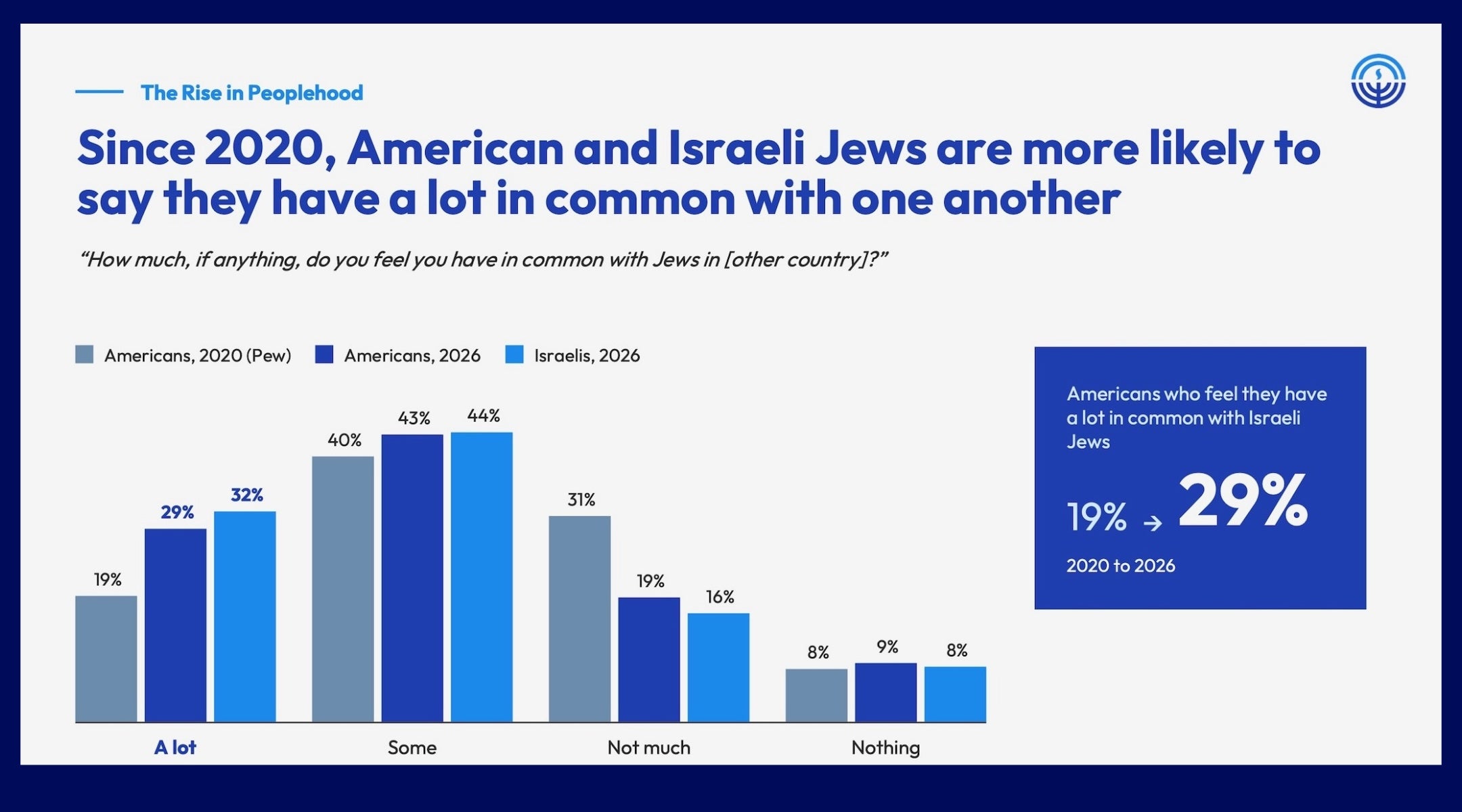 According to a JFNA study, since 2020, the share of American Jews who feel they have “a lot” in common with Israeli Jews has risen from 19% to 29%, approaching the 32% of Israelis who feel similarly about American Jews. (Courtesy Jewish Federations of North America)
The same holds true in reverse. Visiting the U.S. as a tourist doesn’t move an Israeli’s sense of connection to American Jews. But compared to Israelis overall, those who participate in Jewish communal life while visiting are 2.8 times as likely to feel a sense of peoplehood with American Jews, and those who serve as emissaries, work at a Jewish camp or otherwise live inside an active American Jewish community while in the U.S. are 2.6 times as likely.
This is also true for Israeli Jews who encounter American Jews in Israel. Eighty-seven percent of Israeli Jews with real, engaged contact with American Jews feel commonality with us at far higher rates, compared to 52% among those with no contact. This gap holds even after taking into account religious practice and political ideology. Fifty-seven percent of Israeli Jews with real contact describe American Jews as siblings or extended family, compared to 45% among those with little or no contact.
We are in another challenging season for the Jewish people. Upcoming elections in Israel and the United States bring their own pressures and highlight disagreements both within and between our Jewish communities. It would be easy to conclude that we have more differences than we have commonalities, and to approach discussions from a place of distance and division. But there is opportunity in this tense moment to recognize our deep sense that we are one community.
Our data confirm that today we feel closer than ever, and we recognize that our lives are shaping each other’s. Perhaps even more importantly, our data show what we can do to strengthen and perpetuate this trend. We need to keep investing in things we know build connection: more travel, more Israeli emissaries in North American communities and more programs that put people in real contact — especially partnership programs between US and Israeli communities like Partnership2Gether, which has connected people and communities for more than three decades.
And we need to scale innovation that will enable shared volunteer projects, philanthropic partnerships across both communities, stronger business and professional ties and digital opportunities to learn from one another. These opportunities can ensure impact when travel is impractical, reach those who are less engaged and ensure that this sense of connection to and understanding of Jews across the world is accessible to everyone in our greater Jewish family and community.
Our tradition teaches that “kol yisrael arevim zeh bazeh,” all Jews are responsible for one another. That responsibility isn’t theoretical. It is the reason we show up for each other in moments that matter. Three years after Oct. 7, our data tell us we are still showing up.
A Season of Big Decisions. From the Knesset campaign to American midterms, Jewish communities are weighing what comes next. Help JTA keep delivering the deeper context.
One-time
Monthly
Choose an amount to donate
$72$180$360$500
Support Us

is senior vice president for Israel and Overseas and director general of Jewish Federations of North America’s Israel Office.

is chief impact officer for Jewish Federations of North America.
The views and opinions expressed in this article are those of the author and do not necessarily reflect the views of JTA or its parent company, 70 Faces Media.