
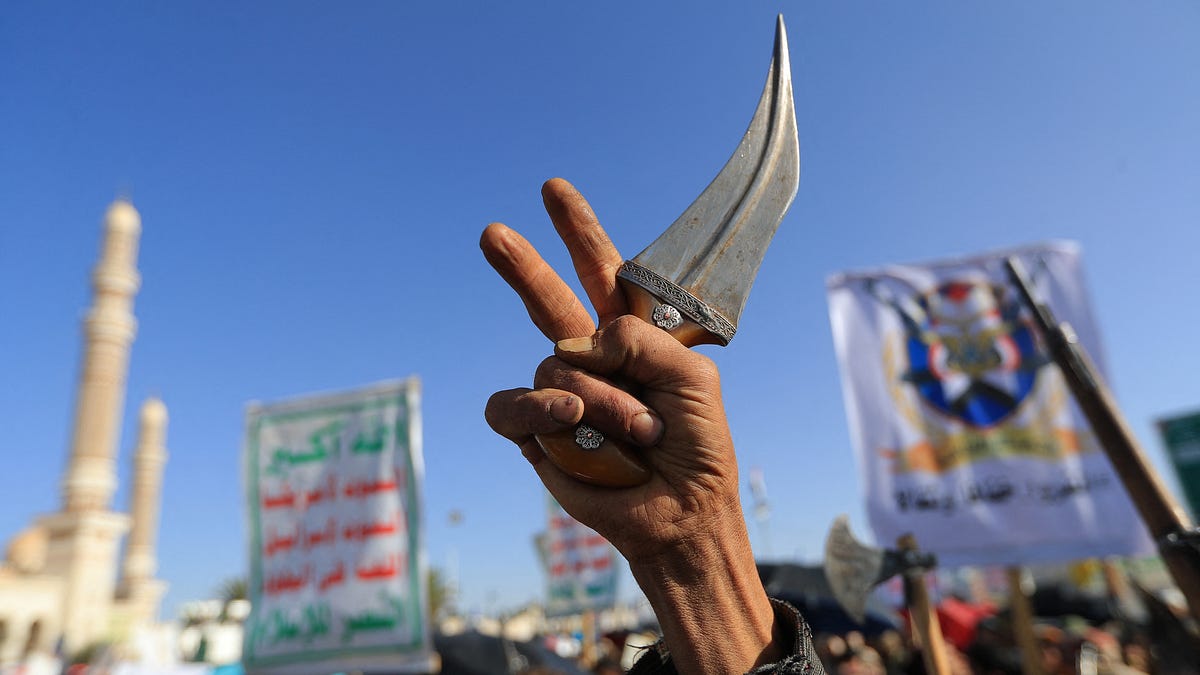
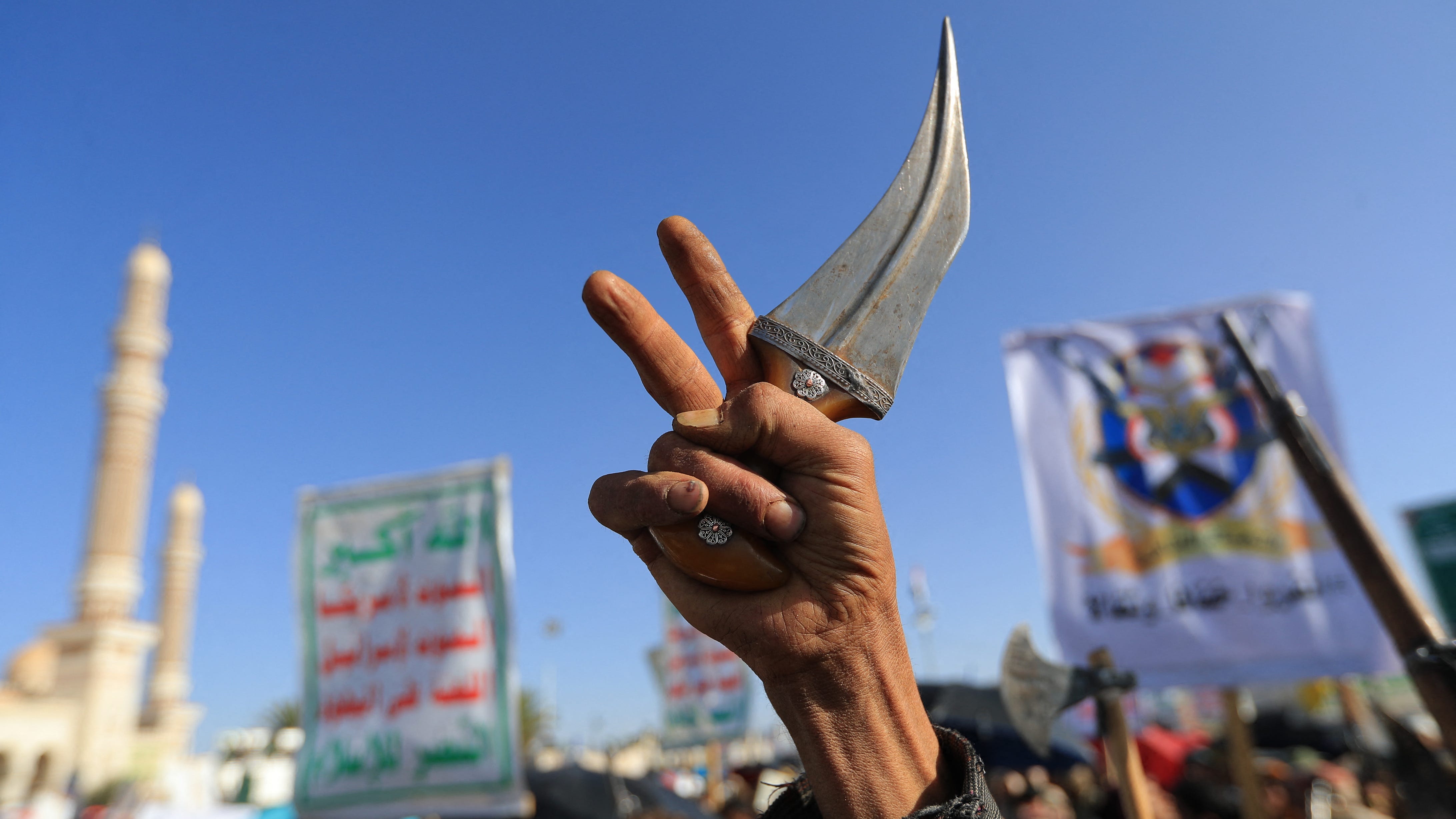
 Supporters of the Houthi authorities gather during a protest against the Saudi intervention in Yemen, in Sanaa, on October 9, 2026. (Photo by Mohammed Huwais / AFP via Getty Images)
OF ALL THE WARRING GROUPS in all the various conflicts in the Middle East, the Houthis in Yemen seem to me to be the least well understood relative to their importance, at least based on news reports about them. Too often this faction is summarized as merely an “Iran-backed” terrorist group. That is true, but nothing close to the whole truth, and so misleading that I worry it may cause some Americans—including policymakers—to arrive at unrealistic and dangerous conclusions about what kind of threat the Houthis pose to American interests and what American policy toward them should be. Last weekend, Saudi Arabia once again defended itself against Yemen. The Houthis fired at least twelve missiles and two drones at Saudi territory. While Saudi air defenses claim they intercepted and destroyed the missiles, including one headed toward Riyadh, the incident marks the continuation of a month of bombardment against the kingdom that has grounded thousands of flights and disrupted shipping. The Houthis have escalated their attacks against Saudi Arabia’s airports, energy facilities, and military installations, including a devastating attack earlier this month on Riyadh’s international airport that killed thirteen and wounded hundreds more—the deadliest attack on the country in over a decade.
For Americans focused on the Iran war, the temptation may be to view these attacks as yet another example of Tehran directing its regional proxies. That interpretation overlooks the fact that Houthis have been fighting Saudi Arabia for more than a decade. The current campaign reflects the Houthis’ own particular political, territorial, and economic ambitions. They don’t need instructions from Iran to attack their northern neighbor (although Iran certainly benefits), they have reason enough—and now they also have cover from the ongoing confrontation between the United States and Iran.
The Houthis are a major problem, not just for the Yemeni government and for Saudi Arabia but for all international trade, and therefore for the United States. To know how to address the problem, it’s first necessary to know who the Houthis are, where they come from, and what they want.
THE HOUTHIS EMERGED IN THE 1990s from a political and religious movement in northern Yemen. Rooted in the country’s Zaydi Shia community, they initially challenged the Yemeni government’s political and economic policies, eventually becoming an armed insurgency. By 2014, the Islamist group had beaten back the Yemeni Army and seized the capital, Sanaa. Saudi Arabia feared that a hostile insurgency along its southern border, especially one supported by Iran, could become a permanent threat to the security of the Saudi state and the royal family. What followed was a grinding war involving airstrikes, ground offensives, missile attacks, blockades, and an extraordinary humanitarian catastrophe. Since 2014, hundreds of thousands have been killed by violence, disease, or famine; millions have been displaced; and Yemen has become one of the world’s most desperate humanitarian emergencies.
But for all that, neither side has achieved its original objectives. Even with support from the UAE, Saudi Arabia’s military superiority did not translate into the defeat of the Houthis, while the Houthis’ control of northern Yemen never translated to control of the entire country. Over time, with the help of Iranian technology and know-how, the Houthis improved their missile and drone capabilities and repeatedly demonstrated that they could threaten Saudi cities and critical infrastructure. A United Nations–brokered truce in 2022 significantly reduced large-scale fighting, and Saudi Arabia subsequently pursued negotiations to extricate itself from the conflict. But the truce never resolved Yemen’s underlying and ever-expanding political disputes, and negotiations failed to produce a lasting settlement. The fighting diminished, but the war’s fundamental causes remained—a warning to contemporary American policymakers.
The Houthis, while certainly allied with Iran and to some degree dependent on it for support, are not an arm of the Iranian government. The Houthis make decisions based on their own calculations, and their ambitions in Yemen don’t always align perfectly with Tehran’s priorities. After the October 7th attacks, the Houthis started their current campaign of attacks against shipping in the Red Sea, with the apparent goals of raising revenue through ransoms and of positioning themselves within the Arab and Islamic world as defenders of the Palestinians in Gaza—especially as the Gulf States were initially tacitly supportive of Israel. That campaign paused after both Israel and the United States carried out a series of airstrikes against the Houthis, hitting both military and economic targets. Then the Houthis started up again. An American bombing campaign, Operation Rough Rider, lasted for about seven weeks in the spring and summer of 2025 but attracted relatively little media attention (with the exception of the Signalgate scandal that emerged from the Trump administration’s handling of one set of strikes). That autumn, as part of the fragile Israel–Hamas ceasefire, the Houthis agreed not to attack commercial shipping in exchange for an end to the airstrikes—that is, until the United States started a new war with Iran in February.
The renewed escalation in 2026 should therefore be understood not as the beginning of another war, but as the latest chapter in one that has never truly ended.
For the first month after the United States and Israel began their campaign against Iran, the Houthis were quiet. It’s not known publicly whether Iran asked the Houthis to retaliate at that time, but it seems possible the Yemeni group was biding its time, waiting to see what would happen in Tehran. Only weeks after the election of Mojtaba Khamenei as the new supreme leader of Iran, when it was clear there would be no regime change, did the Houthis restart their campaign against Red Sea shipping.
Since July, Houthi forces have conducted offensives along Yemen’s Red Sea coast and around the strategically important city of Taiz. Government-aligned forces continue attempting to break the Houthi encirclement of Taiz, but even a successful operation would accomplish little without securing the roads connecting the Taiz to Aden, the nominal seat of the Yemeni government since it lost the official capital, Sanaa (though many of Yemen’s leaders spend a great deal of time in Saudi Arabia). Those inter-city routes are essential for moving supplies, reinforcements, and commercial goods. Meanwhile, the Houthis have sought greater control over territory near the Bab al-Mandab Strait, the narrow maritime passage connecting the Red Sea to the Arabian Sea—and therefore also connecting the Suez Canal and the Mediterranean Sea to the Indian Ocean. Control of this coastline provides military advantages, economic leverage, and the ability to threaten international shipping.
The connection between these operations and the attacks on Saudi Arabia is important. The Houthis’ immediate demands are largely economic, but their ultimate ambitions are political and territorial. They want Saudi Arabia to end military operations against them, remove restrictions on ports and airports that are now under Houthi control, provide financial concessions, and accept arrangements that would give them greater access to Yemen’s oil and gas revenues. These demands are not about improving living conditions for Yemen’s population, although the country’s economic suffering is severe. Control of revenue, transportation routes, and natural resources would strengthen the Houthis’ ability to govern territory, finance their armed forces, and consolidate political power.
The Houthis are attempting to improve their negotiating position through military pressure. They want Riyadh to conclude that continued resistance is more expensive than making concessions. That’s a strategy they’ve employed before, as these kinds of repeated attacks on Saudi infrastructure helped create pressure for the 2022 truce. Renewed strikes against airports, oil facilities, and transportation networks reflect the same type of asymmetric operations.
But this time, the Houthis are operating within a much more dangerous regional environment.
WHILE THE IRAN–HOUTHI RELATIONSHIP DOES NOT include a traditional alliance, much less a military chain of command, both sides share a primary objective: reduce American and Saudi influence in the region. Consider what the current campaign is accomplishing. Saudi Arabia is being forced to devote expensive air-defense systems and ammunition to protecting its cities and infrastructure. Commercial aviation and energy operations are facing recurring disruptions. Saudi leaders must now weigh the economic consequences of continued fighting against the political costs of concessions. And the United States, already deeply engaged in its war in Iran and attempts to assuage its Middle Eastern partners, must consider whether additional support for Saudi Arabia could expand American involvement in yet another conflict.
If it’s not clear, all of these developments serve Iranian interests.
When I commanded American forces in the Middle East, I saw how much regional operations depend on infrastructure, transportation, communications, fuel, maintenance, and host-nation cooperation. A military installation doesn’t have to be destroyed to become less effective. Repeated attacks, transportation disruptions, and threats to supporting infrastructure can complicate operations and force commanders to devote additional resources to protection rather than their assigned missions. The Houthis are demonstrating how such this leveraged pressure can work against Saudi Arabia. Iran may not be able to dictate to the Houthis whom they attack, or when and how, but it still benefits from the Houthis destabilizing and distracting Iran’s adversaries.
Tehran has warned that further American military action could bring retaliation against U.S. forces and facilities throughout the Middle East. American intelligence officials have recently warned of advanced Iranian planning for attacks against American targets in the region, like military bases (of which there are many), embassies, or commercial shipping.
Which raises another dimension of this campaign the Trump administration is facing that deserves attention: the growing imbalance between the cost of attacking and the cost of defending.
Modern air-defense systems are extraordinarily capable, but their interceptors are expensive, their inventories are finite, and replenishing those inventories takes time. A relatively inexpensive drone or missile can force a defender to expend a weapon that costs considerably more. Even successful interceptions may produce dangerous debris, while repeated alerts disrupt civilian life and economic activity. This is not simply a mathematical comparison between the price of a missile and an interceptor. It’s a question of strategic endurance.
A Saudi commander who successfully intercepts eleven incoming missiles has achieved an important tactical victory. But if the Houthis can continue launching attacks, consuming defensive ammunition, threatening civilian infrastructure, and creating pressure for political concessions, they can still accomplish their broader objectives. Saudi Arabia can intercept missiles, and the United States can destroy Iranian military capabilities, without necessarily eliminating the political and economic pressures those adversaries are attempting to create.
THERE IS A DANGER IN TREATING EVERY HOUTHI attack as merely another Iranian operation. Doing so risks misunderstanding an adversary that has demonstrated considerable independence, resilience, and determination over more than a decade of warfare. The Houthis want control, resources, political legitimacy, and a more favorable settlement with Saudi Arabia. Iran wants to weaken American influence, impose costs on U.S. regional partners, and create leverage in its confrontation with Washington. Those objectives are not identical, but either by design or coincidence, they increasingly and significantly reinforce one another.
The latest attacks against Saudi Arabia are just another reminder that the Middle East’s wars cannot be compartmentalized. A conflict that began more than a decade ago over Yemen’s political future now intersects with a much broader struggle involving Iran, the United States, regional security, and the global economy. When the war between Iran and the United States ends—as it eventually must—the conflict with the Houthis will not necessarily end with it.