

The government-affiliated newspaper Iran reported on Thursday that institutions offering foreign curricula and diplomas from countries including Canada and Britain were attracting Iranian students.
A mother whose 15-year-old daughter attends an online high school based in Toronto told the newspaper her family pays $7,000 annually to prepare her daughter for admission to Canadian universities without leaving Iran.
Another father cited shortcomings in Iranian schools’ approach to practical skills and creative thinking as reasons for enrolling his son in a foreign online college alongside his education in Tehran.
Diplomas not recognized in Iran
Mohammad Salimi, head of the Education Ministry’s Center for International Affairs and Overseas Schools, warned that the foreign online institutions in question lack authorization to operate in Iran and that their diplomas are not recognized by the domestic education system.
Students attending only these institutions are not registered in Iran’s official education databases and could face difficulties continuing their studies domestically, Salimi told Iran daily.
For families planning to send their children to universities abroad, however, recognition by institutions in the destination country may matter more than approval from Iranian authorities.
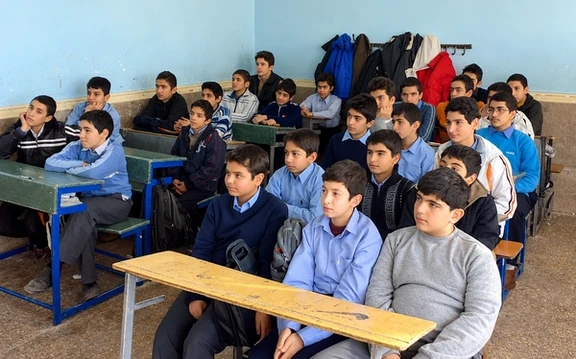 Students attend a classroom lesson at a school in Iran, where some families are increasingly exploring international online education as an alternative to the domestic curriculum.
A diploma’s lack of recognition in Iran does not necessarily make it invalid internationally. Its acceptance depends on the school’s accreditation and the admission requirements of individual universities.
What do foreign schools offer?
The expansion of international online schools allows students to follow American and British curricula without relocating.
International Virtual Learning Academy (IVLA), a private American school, provides online education from elementary through high school, allowing students to select courses and progress at a pace suited to their circumstances.
Annual high school tuition starts at $2,679 for its basic program, rising to $3,799 or $5,279 for packages offering additional educational support.
Britain’s King’s InterHigh offers live and recorded online classes, with subjects including computer science, economics, psychology and film studies.
For the 2026–2027 academic year, annual tuition is £7,250 for students aged 14 to 16 and £7,585 for the pre-university program covering three principal subjects.
Crimson Global Academy also provides American and British curricula online. Annual full-time tuition for its American high school program ranges from $22,375 to $25,500.
The differences show that foreign online schooling does not carry a uniform price. Costs vary according to grade level, course selection and the educational services provided.
Ideological education and alternative choices
Some families are turning to foreign education in a country whose school system was restructured around the Islamic Republic’s religious and political objectives after the 1979 revolution.
UNESCO has documented how Iranian textbooks were revised after the revolution to incorporate Islamic teachings, with religious and political content extending beyond religious education into subjects including history, social studies and Persian literature.
 Teachers Brand Iran’s Ideological School Curricula ‘Dead End’ For Kids
Iran’s Fundamental Reform Document of Education also identifies the cultivation of Islamic-Iranian identity and religious values among the education system’s central objectives.
In a study published in July 2025, education researcher Golnar Mehran examined Iranian social studies textbooks and the role of Islamization and politicization in their content.
By contrast, the international online schools examined offer greater flexibility in course selection, different academic pathways and preparation for universities abroad.
The YouTube generation and English-language learning
The spread of the internet and social media has also exposed Iranian students to English-language material and international educational resources from an early age.
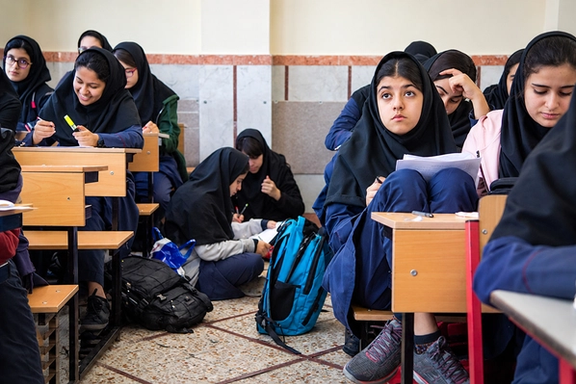 Female students attend a classroom lesson at a school in Iran, where the education system emphasizes Islamic values and a centrally prescribed curriculum.
YouTube, online gaming and English-language social media content have expanded opportunities to learn beyond formal classrooms, despite extensive internet filtering in Iran.
A 2024 survey by the Iranian Students Polling Agency, ISPA, found that roughly half of the university students surveyed used YouTube.
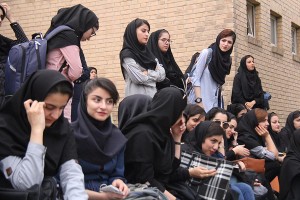 State-backed poll shows most Iranian students use foreign social media
Another official survey published in 2026 found that around 23 percent of children and adolescents aged six to 15 used tools to circumvent internet restrictions.
A 2026 study involving 120 English-language learners in Tehran and Isfahan found that structured educational use of YouTube, Instagram, Telegram and WhatsApp over 12 weeks significantly improved English proficiency among participants in the experimental group.
Such resources can make international online education more accessible to students who develop sufficient English-language skills.
IVLA, for example, expects international applicants to have adequate English proficiency but does not require a language-test certificate at enrollment.
Dollar-priced education and a future beyond Iran’s job market
The cost of foreign online schooling means it is largely accessible to families with greater financial resources, some of whom may be considering educational and professional futures beyond Iran.
English-language instruction, exposure to international curricula and experience with remote learning could help prepare students for university education abroad and potential participation in the global labor market.
The growth of remote employment has also created opportunities for people to work for foreign companies or clients without emigrating. Language skills, digital proficiency and familiarity with international educational and professional environments can support access to such work.
However, Iran’s internet restrictions, difficulties receiving foreign payments because of limited access to international banking networks, and overseas employers’ hiring policies can still obstruct those opportunities.
More than 16.5 million students were enrolled in Iran’s education system at the beginning of the 2026–2027 academic year, but no comprehensive figures have been published on the number attending foreign online schools or whether enrollment is increasing.
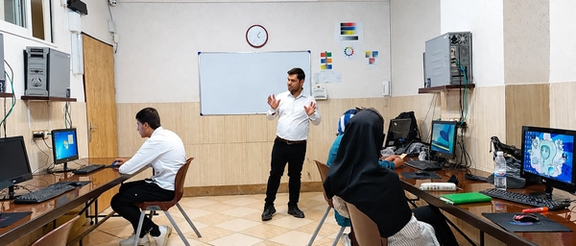 An instructor leads a computer training session in an Iranian classroom as students work at desktop computers.
It is also unclear how many intend to pursue education abroad and how many regard foreign courses as a supplement to their domestic schooling.
Although the newspaper Iran focused on tuition costs and the risks associated with diploma recognition, the parents it interviewed described different priorities, including alternative curricula and preparation for education overseas.
For families already investing substantial sums in international schooling, recognition by Iranian authorities may carry less weight than access to foreign universities, migration opportunities or employment beyond the domestic market.
The Education Ministry’s warning about unrecognized diplomas therefore addresses only part of a broader issue: how far Iran’s education system can meet the expectations of students increasingly using the internet, English-language resources and online education to explore academic and professional opportunities beyond the country’s borders.