
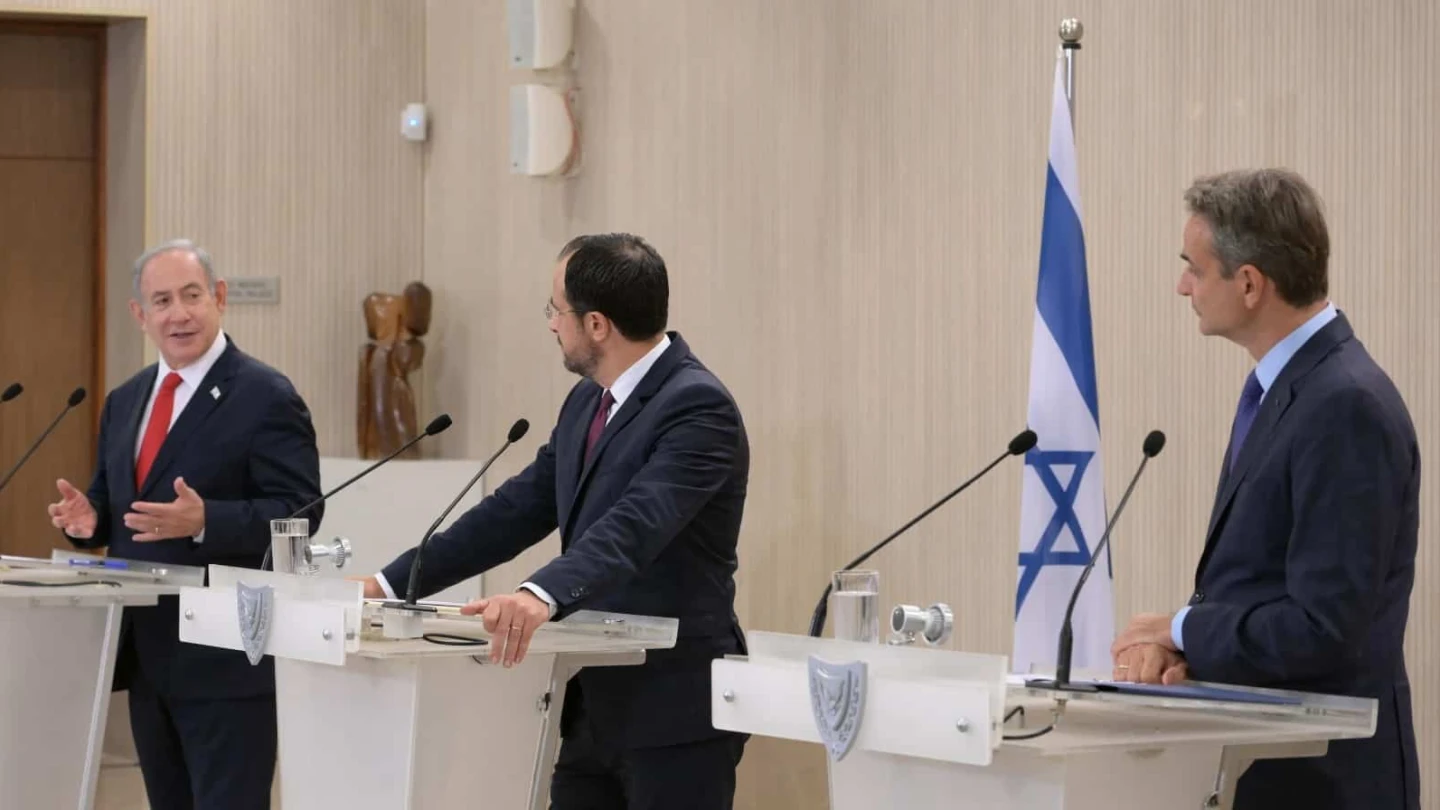
(Oct. 30, 2026 / JNS)
Israel’s election has produced uncertainty in Jerusalem, but it need not produce strategic uncertainty in Athens or Nicosia. With nearly 90% of votes counted, Israeli Prime Minister Benjamin Netanyahu’s bloc stood at 53 seats and the opposition bloc led by Gadi Eisenkot, a former chief of staff of the Israel Defense Forces, at 48, with the predominantly Arab parties at a record combined 19.
Neither camp is near the 61 seats needed to govern, and more than 500,000 double-envelope ballots remain to be counted. The composition of Israel’s next governing coalition is unresolved.
For Greece and Cyprus, however, the essential question is not whether Israel will remain a partner. It is whether its next government will have the authority, cohesion and attention to move shared priorities forward.
The distinction matters. In its Oct. 29 assessment, Greek newspaper To Vima reported that Athens regarded Netanyahu’s continued presence as reassuring amid regional uncertainty, while emphasizing that Greece’s strategic relationship was with the Israeli state, not an individual leader. Familiarity has value. It is not the foundation of the relationship.
Greek Prime Minister Kyriakos Mitsotakis had already made that explicit on Oct. 9: “Greece’s strategic relationship is with the State of Israel, not necessarily with the current government.” As a concrete benefit, he cited the Israeli air-defense technology behind Greece’s “Achilles Shield,” noting that Israel does not sell such systems to just anyone and that Athens secured ownership of the source code.
This was not sentimental diplomacy. It was about Greek national interests.
Cyprus’s public position points in the same direction. Welcoming Israeli President Isaac Herzog on Sept. 10, President Nikos Christodoulides called for deeper strategic cooperation across tourism, trade, security, energy and defense. That breadth matters: Cyprus is investing in a relationship extending well beyond the fortunes of any Israeli party.
The reasonable inference is that both governments’ immediate priority will be continuity of implementation: maintaining defense coordination, advancing energy projects and establishing effective channels with whoever governs Israel. That is a reading of their public commitments, not a claim to know confidential post-election deliberations.
There has already been a practical test of the partnership’s resilience. In December 2021, when Naftali Bennett, not Netanyahu, was Israeli prime minister, Israel, Greece and Cyprus reaffirmed their cooperation in Jerusalem, including defense coordination and the “3+1” framework with the United States. The partnership survived a change of Israeli leadership because its rationale survived.
By December 2025, the three countries’ tenth summit had committed them to annual leaders’ meetings, intensified ministerial and working-level contacts, closer security cooperation and protection of maritime routes and critical infrastructure. These are mechanisms intended to carry policy beyond personal chemistry.
A trilateral military work plan for 2026 added joint exercises, training, working groups and strategic dialogue. Such arrangements create relationships between institutions, not simply photographs of politicians shaking hands.
For Israel, this should be understood as strategic value rather than diplomatic consolation. Partners seeking Israeli capabilities are acknowledging that the Jewish state contributes to their security. The proper response is to deepen that usefulness, not take their support for granted.
The Jewish state is not merely a problem for others to manage. It is a partner offering capabilities its neighbors want.
The lesson for Israel’s critics is uncomfortable: The Jewish state is not merely a problem for others to manage. It is a partner offering capabilities its neighbors want. Cooperation grounded in reciprocal interests is more durable than either ideological enthusiasm or a shared dislike of a third country.
Energy provides both a major opportunity and a warning against complacency. The European Commission describes the Great Sea Interconnector as a project linking Greece and Cyprus first, with Israel envisaged at a later stage. For Nicosia, it promises a direct electricity connection to Greece; for the wider partnership, it would give physical substance to regional connectivity.
But an ambition is not an operating cable. The French-flagged survey vessel Abeille Marengo reached Crete on Oct. 27 and was awaiting a NAVTEX maritime notice, now expected in early November, before resuming seabed surveys. Reuters had reported in mid-October that the project applied to restart the work after months of delay amid the Greek-Turkish maritime dispute, with Ankara insisting on prior coordination.
The Israel-Greece-Cyprus relationship need not be presented as an anti-Turkish alliance. Nevertheless, the obstacles confronting shared infrastructure demonstrate why diplomatic backing and sustained political attention matter. Electoral uncertainty cannot be allowed to become an excuse for strategic drift.
Washington also has a stake in this. In June 2026, the United States, Cyprus, Greece, Israel and Rice University signed a declaration of intent to establish an Eastern Mediterranean Energy Center in Houston. This is not a guarantee that every project will succeed. It is further evidence that cooperation is acquiring an institutional life beyond the three leaders’ offices.
How, then, should Athens and Nicosia read the coalition possibilities?
A renewed Netanyahu-led government would offer a familiar interlocutor. Its practical value would depend less on the prime minister’s name than on the coalition’s stability and capacity to implement commitments. Familiarity without delivery would not be enough.
An Eisenkot-led alternative would require new political relationships, but it would inherit the same geography, security interests and institutional commitments. The Bennett precedent warns against assuming that a change of government means a change of strategic orientation. Coalition composition could affect priorities, budgets and diplomatic tone without overturning the partnership itself.
A broad unity arrangement could provide greater room for long-term decisions, although opposition leaders’ stated refusals to serve under Netanyahu mean it cannot be treated as the default outcome. Prolonged deadlock would create the clearest risk of delay: Officials could maintain routine cooperation while major initiatives competed for the attention of a politically constrained leadership.
These scenarios differ politically, but their strategic lesson is similar: governing capacity matters more than partisan preference.
Continuity also should not be confused with unconditional agreement. Mitsotakis explicitly defended Greece’s freedom to criticize Israeli government policies while preserving the strategic relationship. A mature partnership must accommodate disagreements without allowing every dispute to threaten its foundations.
Israel’s next government should therefore make early engagement with Athens and Nicosia a priority. It should reaffirm existing commitments, identify which projects can realistically advance and protect working-level cooperation from coalition turbulence. Greece and Cyprus, in turn, should judge their Israeli partner by its commitments and conduct, not domestic political labels.
The partnership is not irreversible, and no serious analysis should pretend otherwise. Projects can stall; governments can disagree; political attention can wander. But the evidence supports a durable strategic direction, not a relationship awaiting permission to exist from the next coalition.
Israel’s election will determine who governs the Jewish state. It should not obscure why Greece and Cyprus have chosen to work with it. The people around the cabinet table may change. The national interests connecting Jerusalem, Athens and Nicosia will not disappear with them.